Black sea bass
Centropristis striata · Serranidae
- Saltwater
- Coastal
- Easy
- Size
30–66 cm
- Weight
0.4–4.3 kg
- Lifespan
20 years
Where to fish
- Reef
- Rocky shore
Habitat icons: Flaticon
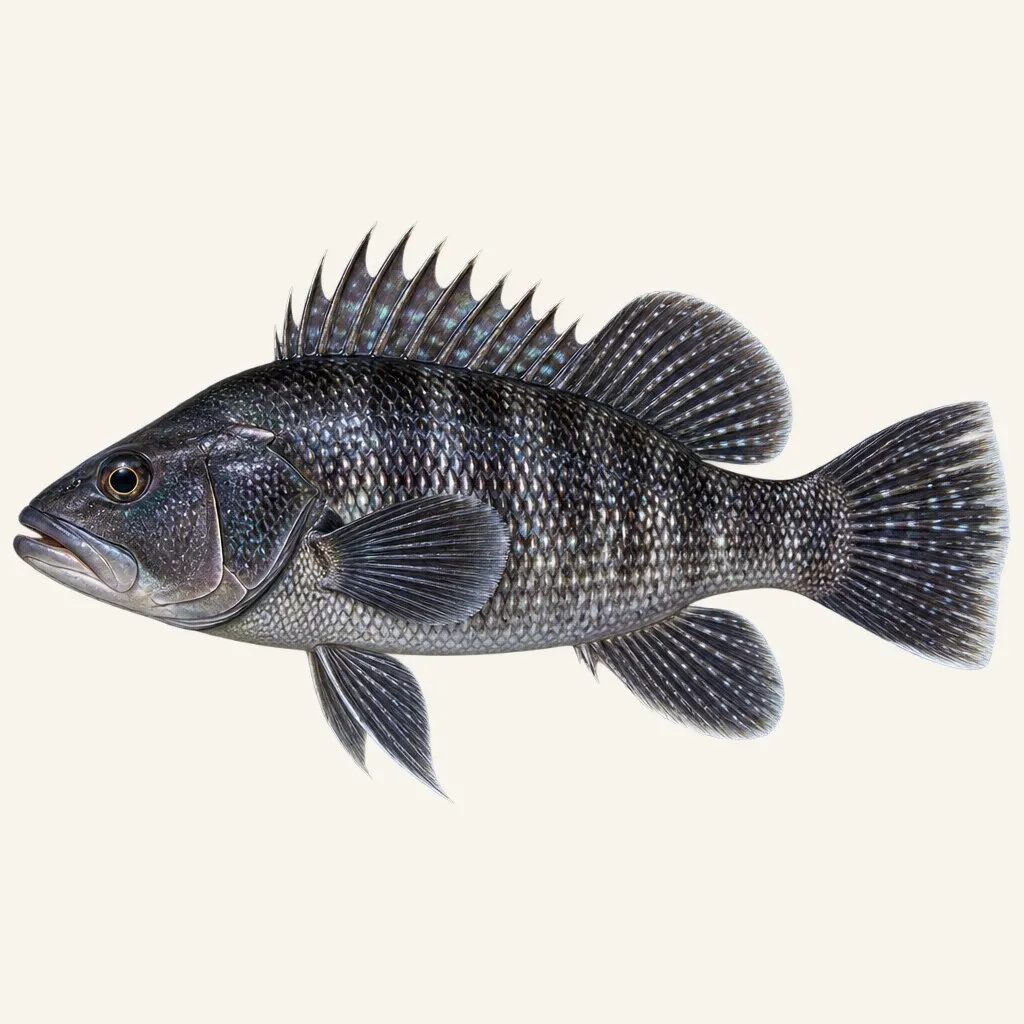
A stocky blue-black temperate sea bass of the northwest Atlantic, a protogynous hermaphrodite that lives close to rocky structure and wrecks.
Calendar
Recorded in 2 countries
Puerto Rico · United States
GBIF occurrence records — native and introduced populations combined.
Its range
The species holds the western Atlantic from Canadian and Maine water south to north-eastern Florida, together with the eastern Gulf of Mexico, between about 45 and 25 degrees north.
The southern limit is set by temperature and it moves. The record notes that the fish reaches the extreme south of Florida during cold winters — that is, the range extends southward when the water cools, which is the opposite of the usual reading of a map and a reminder that a warm-water margin is a ceiling rather than a floor for a temperate species.
The whole distribution has been shifting north over recent decades as the shelf has warmed, with the centre of the population moving up the coast. That creates a problem no biology can solve: the fish moves between management jurisdictions while the allocations between them stay where they were written.
Identifying it
The big ones have a hump. On the nape, just behind the head, a fleshy swelling rises and thickens the whole profile in front of the dorsal fin, so that a large individual has a blunt, top-heavy outline that a small one does not.
That hump is a sex character, and it is the reason this page is arranged the way it is: it is the visible sign of a sex change that has already happened. A humped fish is a male, and a male is a fish that spent the first part of its life as a female.
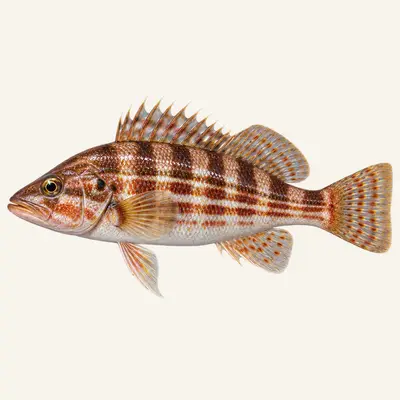
The rest follows the same age gradient. Small fish are brownish and marked with dark bars along the flank — the striata of the name — and they lose the barring as they grow. Large fish go smoky blue-black, take a blue cast about the head and the hump in the spawning season, and become stockier and deeper through the body.
So every feature that makes a black sea bass conspicuous is a feature of an old, transformed male, and the anonymous barred fish around the same piece of structure are the females and the young.
Breeding
The species is a protogynous hermaphrodite. Fish mature as females, spawn as females for a period of their lives, and some of them then reorganise their gonads and finish as males.
Two published figures frame it. First maturity is recorded at about 19 cm, within a range starting as low as 11, and the oldest fish on record reached 20 years. Maturity therefore comes early and life goes on for a long time afterwards, which leaves a wide span of years in which the change can occur.
The consequence is a population structured by size in a way that a fish with fixed sexes is not. The small and medium fish on a wreck are mostly females. The large ones are mostly males. The supply of males on a piece of structure therefore depends on fish surviving long enough to make the change, and it is replenished at the speed at which females grow into it.
A fishery that keeps the biggest fish and returns the small ones is therefore doing something specific: it is removing males and leaving females. Doing that hard and repeatedly on the same wreck skews the sex ratio of the group that lives there, and the correction has to come from below, one fish at a time, over years.
The water it needs
Hard structure, and nothing else will do. Rocky bottom, jetties, ledges, reef and — above everything on this coast — wrecks. The recorded depth starts at 1 m, so the range of situations runs from a stone breakwater within casting distance of the beach to a hull sitting in deep water offshore.
The species is oceanodromous, which here means an annual movement rather than a long migration: fish work inshore onto shallow structure as the water warms and pull out to deeper wrecks and ledges when it cools. The same population is fished from a jetty in summer and from a boat over deep wreckage in the cold months.
Groups are resident on a structure while they are on it. A wreck holds its own population, and that is what makes the species so easy to overfish in one place while remaining abundant a few miles away.
Areas
- US Atlantic coast (Maine to Florida)
- Coastal rocky reefs and ledges
- Wrecks and artificial structures
- Jetties and breakwaters
Techniques
- Bottom bait fishing
- Vertical fishing over wrecks
- Light jigging
- Drift fishing with bait
Baits
- Squid strips
- Sea worms
- Cut fresh fish
- Crabs
- Bottom jigs and soft plastics
How to catch it
Everything is a compromise with the structure, and the compromise has one term: the fish dives back into it the moment it is hooked.
That governs the tackle. A rig heavy enough to turn a fish's head in the first second beats a fine one that gets bitten more often, because a bite that ends inside a wreck costs the terminal tackle as well as the fish. Baits are held hard on the bottom, right against the metal or the rock, and dropped back in as soon as they are clear.
Squid strip, cut fish and crab are the standard baits, and small jigs worked vertically along a hull take fish just as well when they are up off the bottom.
Handling deserves a word, because the record's threat-to-humans line for this species reads venomous rather than harmless. Whatever the exact basis for that entry, the fish carries stiff spines in the first dorsal and the anal fin and it is worth taking by the lower jaw and the belly rather than closing a hand over its back.
This is among the most closely managed fish on the American east coast, with measures that differ by state and by season and are revised frequently. They come from the regional fishery management council and the state agencies, and they change often enough that last year's understanding is not a guide.
Conservation
The mechanism to hold on to is the one described above: this species keeps its males at the top of the size range, and fisheries take fish from the top of the size range.
Nothing about that is fatal on its own — the change is not rare and the population produces new males as fish age into them — but it makes the species sensitive to the shape of the removal rather than only to its size. Taking a hundred large fish and taking a hundred small ones are not the same act here, and no total catch figure distinguishes them.
The residency on structure compounds it. Because a wreck holds a group that stays, effort concentrated on known marks falls repeatedly on the same fish, and modern electronics have made every piece of structure on this coast a known mark. A population can look healthy in aggregate while individual wrecks are stripped of their large fish, and it is precisely the large fish that carry the males.
Add the northward movement of the stock and the practical problem is complete: a species whose distribution is moving, whose sex ratio depends on age structure, and whose habitat is a scatter of fixed points that anyone can find. Twenty years of potential life gives it the capacity to recover, on the condition that some fish are left to get old.
Regulations
Heavily regulated along the US east coast (minimum size, bag limits and variable closed seasons); follow local regulations.
For guidance only. Legal sizes, quotas and open seasons vary by location and season: always check the local regulations in force before fishing.
Other names
Black sea bass is the standard name, and it belongs to a serranid — a relative of the groupers and the hinds, not of any freshwater bass and not of the striped bass caught in the same estuaries.
The name travels badly. Sea bass on a European menu means an entirely different fish, of a different family, on a different ocean; black bass in North American fresh water means the largemouth and smallmouth; and giant sea bass, on the Pacific coast of the same country, is another animal again. The three words are common enough that a fish record carrying them and nothing else is not identifiable.
Centropristis is built from the Greek for a spine or spur and for a saw, after the armament of the head and gill cover. Striata means striped, after the barring carried by small fish and lost with age — a name taken, as often happens, from the stage of the animal that a collector is most likely to have in a jar.
Along the American east coast the large humped males have local names of their own, which is a fair indication of how differently they are regarded from the smaller fish on the same wreck.
Sources: fishbase.se · api.gbif.org