Black grouper
Mycteroperca bonaci · Serranidae
- Saltwater
- Coastal
- Medium
- Size
70–150 cm
- Weight
4.4–100 kg
- Depth
60–250 m
Where to fish
- Reef
- Rocky shore
Habitat icons: Flaticon
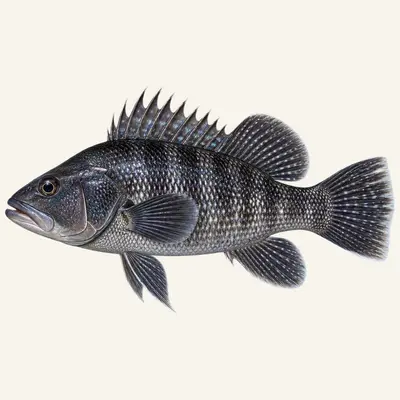
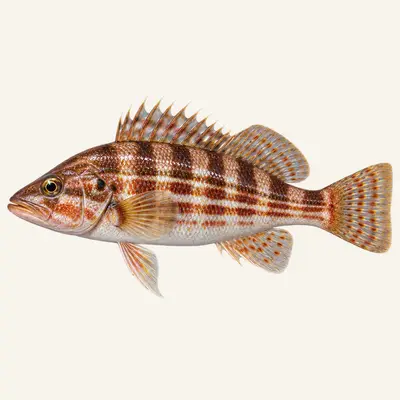
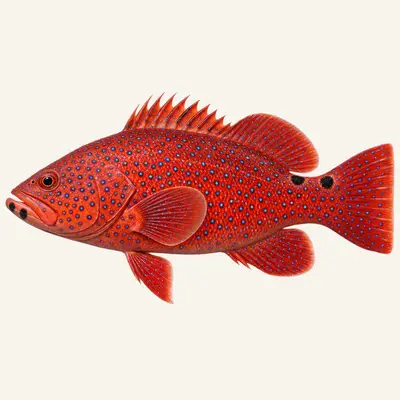
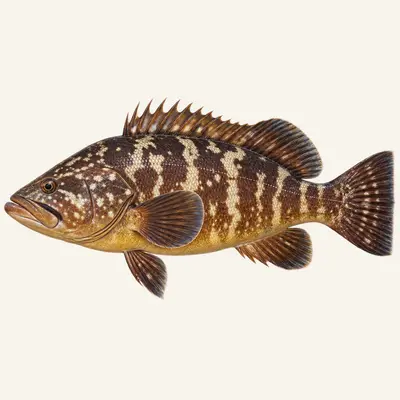
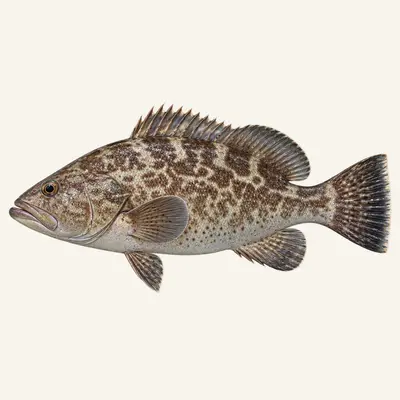
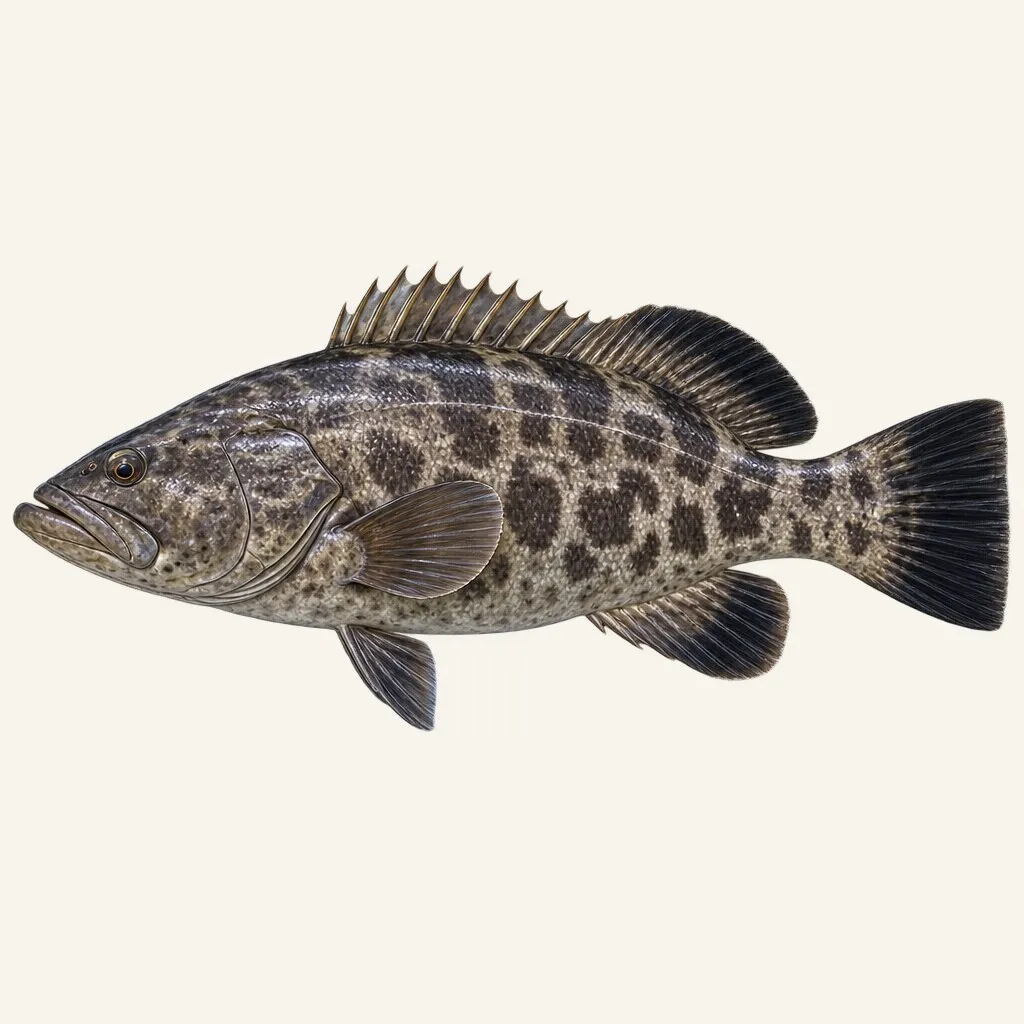
The black grouper is a large Caribbean serranid with a greyish-brown body scattered with numerous small blackish-blue rounded spots giving it a distinctive appearance. Its body is more elongated than Epinephelus groupers. It haunts deep coral reefs and rocky bottoms in the Gulf of Mexico and Caribbean.
Calendar
Recorded in 14 countries
Bahamas · Belize · Bermuda · Brazil · Cayman Islands · Colombia · Cuba · Guadeloupe · Honduras · Jamaica · Mexico · Panama · Puerto Rico · United States
GBIF occurrence records — native and introduced populations combined.
Its range
Bermuda and Massachusetts south to southern Brazil, including the southern Gulf of Mexico and the Caribbean.
One line in the distribution changes how that range should be read: adults are unknown from the north-eastern coast of the United States. The northern end of the map is populated by juveniles alone.
Which means that part of the range produces nothing. It receives recruitment carried up from spawning that happens further south, grows fish for a while, and contributes no reproduction of its own. A stretch of coast can hold this species in numbers and still be a net consumer of the stock rather than a contributor to it.
Identifying it
The flank carries rectangular blotches of dark grey, laid out in something close to a chequer. Rectangles are unusual — the groupers of the same water carry rounded spots, vermiculations or saddles — so the shape of the marking is the character, not its colour.
The outer third of the second dorsal, the anal and the caudal fin is black. It is a broad, clean band and it survives handling, which makes it the mark to fall back on when the flank pattern has faded on a dead fish.
The edge of the preopercle is smooth and evenly rounded, with no notch and no lobe at the angle. That detail is diagnostic within the genus rather than incidental: the mottled grouper of the eastern Atlantic has enlarged serrations at exactly the same place, forming a rounded lobe, and comparing the two corners settles which fish is in hand.
Body depth is contained 3.3 to 3.5 times in standard length, head length 2.5 to 2.8. Gill rakers total 17 to 24. Eleven dorsal spines and 15 to 17 soft rays, against three anal spines and 11 to 13 rays.
Breeding
The species is monandric, meaning there is no such thing as a male that was not first a female. Every male in the population is a converted fish.
A study on the Campeche Bank produced some of the most precise figures available anywhere for this mechanism. Females changed sex between 85.5 and 125.0 cm fork length, with a median of 103.3 cm. At 114.5 cm, half the females in the sample had made the transition. The age at which it happens is 15.5 years.
Fifteen and a half years is the number that governs everything else on this page. A male of this species represents a decade and a half of growth in a fish that is not going to be replaced from below, because nothing below is male and nothing can become male any faster. The year classes underneath a removed male contain no substitute; they contain females that will need another fifteen years.
First maturity, as a female, comes at about 68 cm, within a range of 47 to 95.
The water it needs
A solitary fish of rocky and coral reef, between 60 and 250 m.
The literature describes it as common but difficult to approach, and that is an unusual sentence to find in an identification account. It is also valuable, because it inverts the expectation this family sets. Several of the large groupers are inquisitive, hold their ground when a diver arrives and are noted for being easy to get close to. This one leaves.
That single behavioural difference reorganises the fishing, the diving and the survey work, and it means abundance estimates built on visual counts of other groupers do not transfer to this species.
Areas
- Deep coral reefs
- Rocky bottoms
- Underwater drop-offs
- Wrecks
Techniques
- Bottom fishing
- Deep jigging
- Cast and retrieve with soft lure
- Trolling
Baits
- Whole or cut fish
- Squid
- Shrimp
- Large soft lures
What it eats
Adults live mainly on fish. Juveniles live mainly on crustaceans.
The shift towards mobile prey in a solitary animal that avoids approach describes an ambush hunter rather than a bottom forager, and it is consistent with the depth: at 60 to 250 m over reef there is more to be gained by taking a fish out of open water than by turning over rubble.
How to catch it
Wariness is the fact to plan around. Where other groupers can be reached by getting close, this one withdraws, and that applies to the presentation as much as to the approach — a bait or a lure that arrives badly does not get a second look from a fish that has already moved off.
The depth band, 60 to 250 m, makes it a boat fishery worked over rock and reef relief, and a fish of this size at that depth decides the outcome on its first run for the bottom.
The one piece of information available before the fish is even landed is its sex, and it comes from length alone. Anything over about a metre is a male, and it is a male that took fifteen and a half years to become one. That is not a judgement about whether to keep it; it is the price of the decision, known in advance.
Flesh quality is excellent and the fish is sold fresh, which is why the species is heavily commercial across its range. Ciguatera has been reported from it as well, and the risk attaches to particular areas rather than to the species as a whole.
Conservation · Near Threatened (IUCN) — This species is in decline. Release your catch quickly and handle it with care — wet hands, as little time out of the water as possible.
Conservation
The arithmetic is the whole of it. A male appears at fifteen and a half years and around a metre. A fishery that grades on size removes males, and a female needs fifteen years to make one good.
Two things compound that. The species forms spawning aggregations, so animals that are solitary for most of the year come together at predictable places and times — which is when the size-selective removal is most efficient. And the northern margin of the range holds only juveniles, so the geographic spread of the population is wider than the spread of its reproduction.
Put together, the picture is of a stock whose breeding males are a thin slice at the top of the size distribution, concentrated seasonally, in a species that is difficult to survey precisely because it will not let anyone near it.
Regulations
Check the local regulations in force (legal size limits, closed seasons, bag limits).
For guidance only. Legal sizes, quotas and open seasons vary by location and season: always check the local regulations in force before fishing.
Other names
Black grouper in English. The name is a poor guide to the animal, which is grey with darker rectangles rather than black anywhere except the outer edges of three fins, and it is applied loosely enough in trade to be worth distrusting.
Caribbean Spanish says cuna bonací, and the specific epithet bonaci comes from that regional name rather than from Latin.
French uses badèche bonaci or badèche noire, badèche being the French word for the Mycteroperca as distinct from the Epinephelus groupers. English has no equivalent split: grouper covers both genera, which differ in size, in behaviour and in the pressure they are under, and the market name records none of it.
Sources: fishbase.se · api.gbif.org