Coney grouper
Cephalopholis fulva · Serranidae
- Saltwater
- Coastal
- Medium
- Size
44 cm
- Lifespan
11 years
- Depth
1–150 m
Where to fish
- Reef
- Rocky shore
Habitat icons: Flaticon
Clear deep reefs (at least 45 m). In Bermuda and the West Indies they are common in shallow water, but usually hide in caves or under ledges during the day.
Calendar
Recorded in 24 countries
Antigua & Barbuda · Bahamas · Bermuda · Brazil · British Virgin Islands · Caribbean Netherlands · Cayman Islands · Colombia · Curaçao · Dominica · Dominican Republic · Grenada · Guadeloupe · Honduras · Jamaica · Martinique · Mexico · Puerto Rico · Sint Maarten · St. Barthélemy · St. Vincent & Grenadines · Turks & Caicos Islands · U.S. Virgin Islands · United States
GBIF occurrence records — native and introduced populations combined.
Identifying it
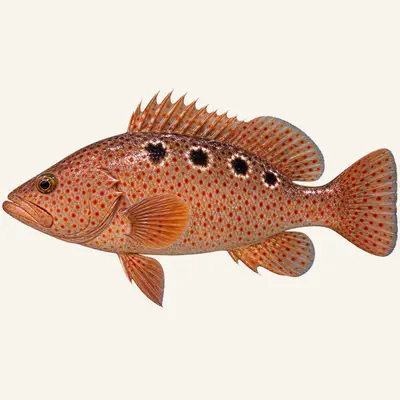
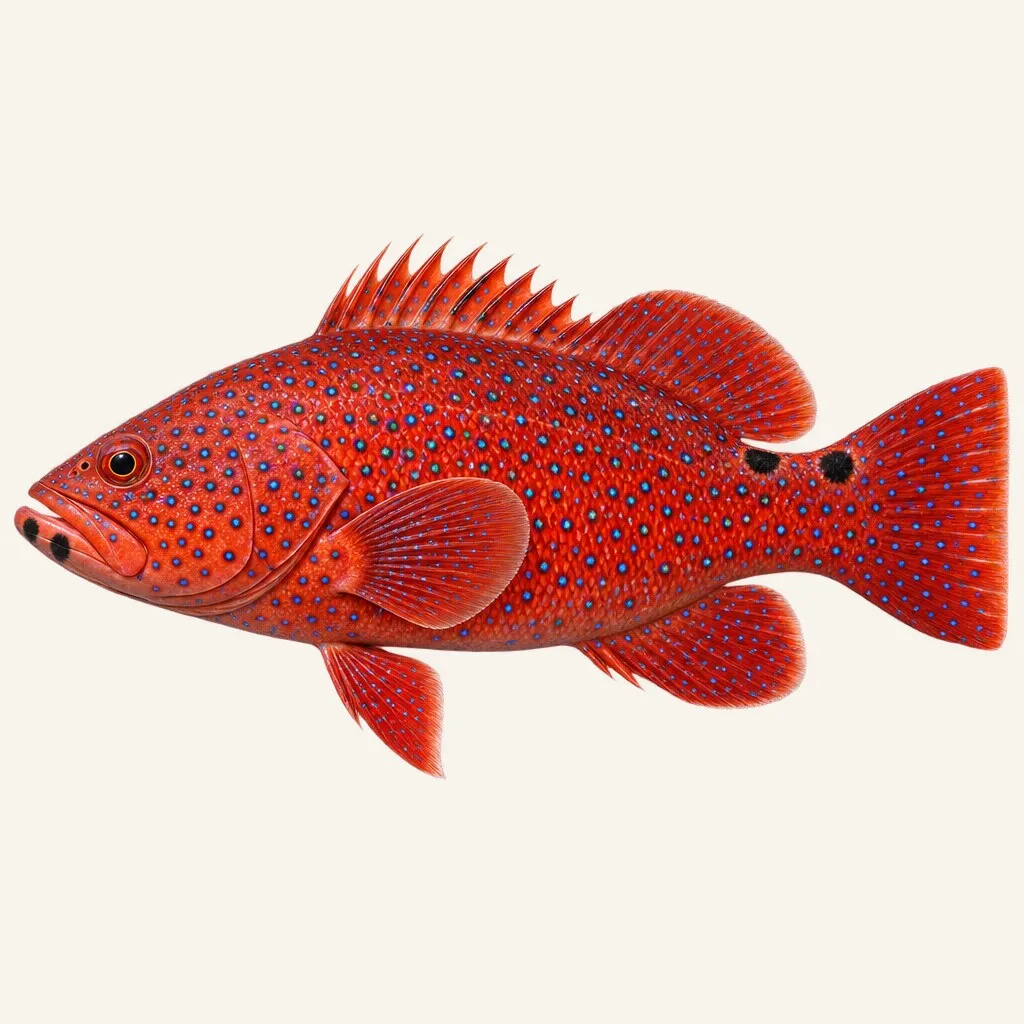
Red body, red fins, and small blue dots each ringed with a fine black line scattered over the whole animal. That combination of a red ground and ringed blue spotting answers the question at swimming distance, without anything having to be measured.
Two black markings then confirm it beyond doubt. The upper edge of the caudal peduncle carries two clear black spots, and a pair of black blotches sits on the tip of the lower jaw. The jaw pair is the one to look for on a fish already in the boat, since it survives the fading that takes the red out of a dead grouper within minutes.
Body depth is contained 2.6 to 2.9 times in standard length, head length 2.3 to 2.5 times. The area between the eyes is flat. The preopercle is rounded, with a shallow notch above its angle, finely serrated and moderately enlarged along the upper edge and fleshy along the lower; the subopercle and interopercle are smooth. Both nostrils are small and of much the same size — a point of separation from the red hind of the same reefs, whose own description gives the rear nostril as the larger of the two. The maxilla is scaled and reaches at least as far back as the rear edge of the eye. The tail is convex behind with angular corners, and the flank scales are ctenoid.
Nine dorsal spines with 14 to 16 soft rays; three anal spines with nine rays.
Breeding
Spawning is an appointment, and the hour of it is fixed. It happens just before sunset, on several consecutive days, and within that arrangement a male spawns each day with every one of the several females holding station in his harem.
That is a very different schedule from the ones the large groupers keep. It is not a season, not a date and not a phase of the moon: it is a daily engagement repeated over a run of evenings, with the whole output of a harem passing through one narrow slot of failing light each time.
Fecundity is estimated between 150,000 and 282,000 eggs per female. Each egg measures 0.95 mm and carries a single oil globule, which is what keeps it up in the water column once released — the fish provides buoyancy rather than a nest.
The species is protogynous. Females become fertile at 16 cm and change into males at around 20 cm, and the males hold territory.
The water it needs
Coral reef and clear water, and the depth at which that combination is met varies enormously from one part of the range to another. In the Gulf of Mexico the fish are found on clear deep reefs, from at least 45 m down. At Bermuda and through the West Indies they are common in shallow water, but spend the day hidden in caves and under ledges.
The recorded band runs from 1 to 150 m, ordinarily 1 to 40. The same species is therefore accessible to a snorkeller in one sector and beyond a diver's comfortable range in another, and the two situations pose entirely different practical problems.
Divers describe the fish as wary but approachable — it keeps its distance without leaving.
Areas
- Coral reefs
- Tropical rocky bottoms
- Cavities and overhangs
- Coastal wrecks
Techniques
- Bottom fishing
- Cast and retrieve with small soft lure
- Live bait fishing
- Vertical fishing
Baits
- Small live fish
- Shrimp
- Cut squid
- Small soft lures
What it eats
Small fishes and crustaceans make up the bulk of it, but the way some of that food is obtained is the fact worth carrying. This grouper will follow morays and snake eels, and feed on whatever they flush out of the reef.
It is a strategy of secondary predation, and it says something exact about the animal. An eel working its way through coral heads is doing what a stocky, short-bodied fish cannot do — reaching into holes — and everything driven out of the far side of a crevice comes out into open water. Escorting a hunter with access to ground that is closed to it turns the grouper's own limitation into an advantage, and it costs nothing.
The reef therefore has to hold eels for this trick to be available, which ties the species to structure that is complex rather than merely large.
How to catch it
The window is narrow and it is precisely dated. Spawning falls just before sunset, and dusk is also when the fish come out from the cover they have used all day. One slot of the day answers both questions at once: where they are and whether they are moving.
Ground follows the region. Through the islands the search is under ledges and at cave mouths in daylight, in shallow water. In the Gulf of Mexico nothing shallower than about 45 m is worth working.
Territoriality and small size make this a fish taken over a fixed address rather than found by covering water. A male holds a piece of reef, and a bait dropped directly onto the structure he occupies is a bait in front of the one fish there that will move to it.
Ciguatera poisoning has been reported from this species. The toxin originates on the reef rather than in the fish, and whether a given stretch of coast is affected is answered locally and nowhere else.
Conservation
The pressure point is the hour, not the season. Because the whole reproductive output passes through the minutes before sunset, and because that is also the moment the fish become catchable, the productive window and the vulnerable window are the same window. A fish taken at dusk on its own ground is very often taken part-way through a run of consecutive spawning evenings, and the days remaining in that run go with it.
Exposure then splits along depth, and the split is worth stating because it means no single judgement covers the species. Where the fish live shallow — Bermuda, the West Indies — they are within reach of every method there is. Where they live at 45 m and below, in the Gulf, most of those methods do not reach them. The state of the stock on one of those coasts says nothing about the other.
There is also a second, quieter demand. Beyond the food fishery this grouper is traded commercially for aquariums, and a red fish spotted with blue is wanted for its appearance at sizes well below the ones a food fishery bothers with — which is to say below the length at which females turn into males.
Against all that, 11 years of recorded life and first maturity at 16 cm leave a real capacity to renew, provided the reef keeps enough males to hold its ground organised.
Regulations
Check the local regulations in force (legal size limits, closed seasons, bag limits).
For guidance only. Legal sizes, quotas and open seasons vary by location and season: always check the local regulations in force before fishing.
Other names
Coney in English. The word has nothing to do with the fish's appearance or habits: it is an old English name for a rabbit, and how it came to settle on a Caribbean grouper has never been satisfactorily reconstructed.
Caribbean Spanish gives cabrilla, French coné ouatalibi or petit mérou rouge. Brazilian coasts, at the southern end of the range, use their own names again.
The genus is the useful part of the scientific name. Cephalopholis gathers the small, short-bodied groupers, and the separation from Epinephelus is not merely a matter of size: these are fish organised in harems on small patches of reef, where the large groupers hold much bigger ground and gather to breed. Reading a catch record that says only grouper loses that distinction entirely.
Sources: fishbase.se · api.gbif.org