Atlantic goliath grouper
Epinephelus itajara · Serranidae
- Saltwater
- Coastal
- Hard
- Size
150–250 cm
- Weight
44–455 kg
- Lifespan
37 years
- Depth
0–100 m
Where to fish
- Reef
- Rocky shore
Habitat icons: Flaticon
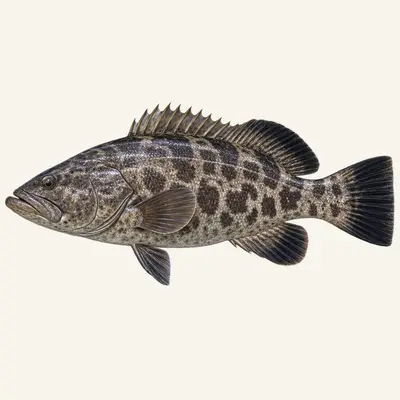
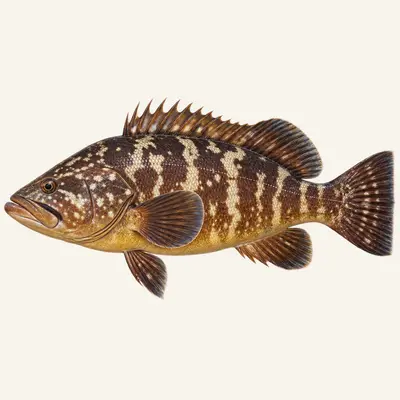
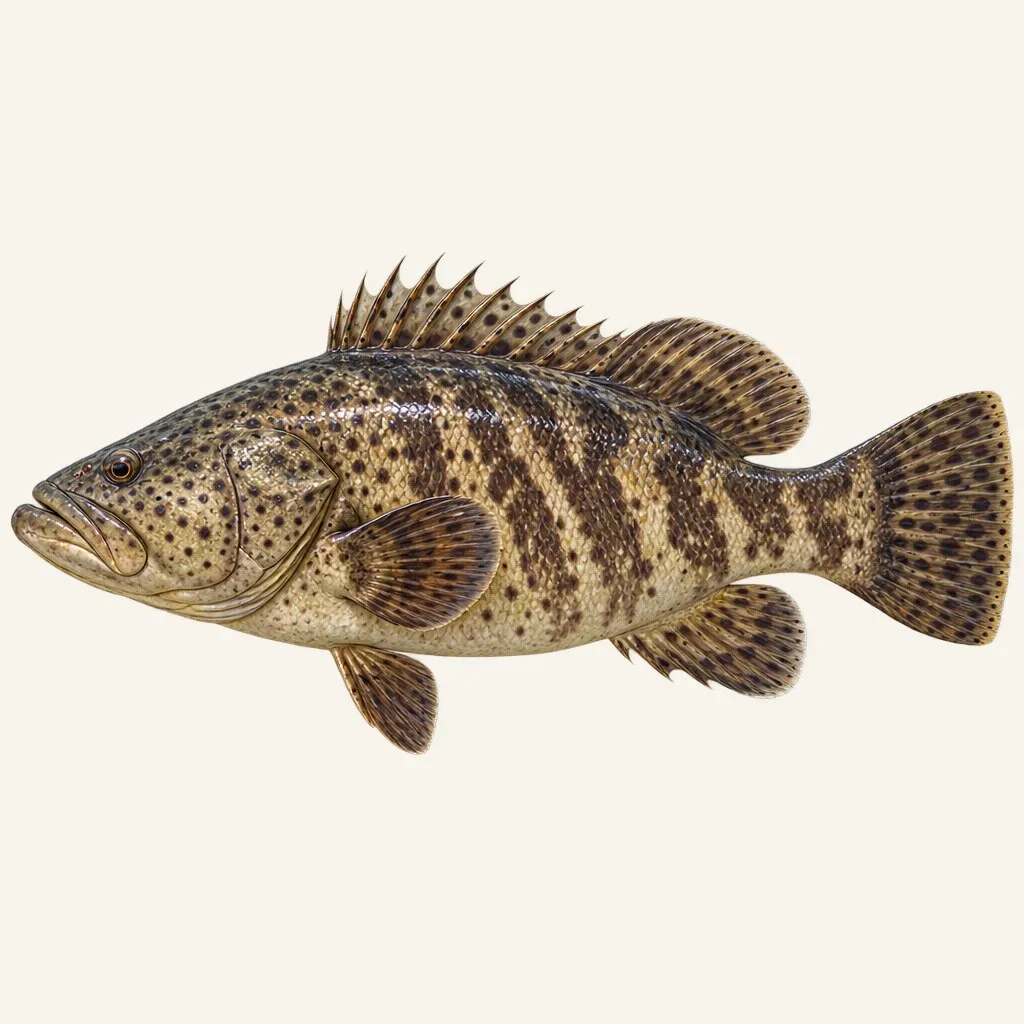
The goliath grouper is one of the world's largest serranids, reaching 2.5 m and over 400 kg. Its massive body is yellowish-brown with small spots and irregular dark bands. It occupies rocky bottoms, wrecks and mangroves along tropical and subtropical Atlantic coasts, often in shallow water.
Calendar
Recorded in 19 countries
Benin · Brazil · Cameroon · Congo - Brazzaville · Côte d’Ivoire · Cuba · Equatorial Guinea · French Guiana · Gabon · Ghana · Guinea · Guinea-Bissau · Liberia · Mexico · Nigeria · Puerto Rico · Senegal · Sierra Leone · United States
GBIF occurrence records — native and introduced populations combined.
Its range
The western Atlantic range runs from Florida to southern Brazil, including the Gulf of Mexico and the Caribbean. In the eastern Atlantic the species occurs from Senegal to Congo, and it is rare in the Canaries.
Two points of nomenclature carry real weight here. The giant groupers of the eastern Pacific, from the Gulf of California to Peru, belong to a separate species and are not this one, so any figure quoted from that coast describes a different animal. And within the western Atlantic the populations of this species are discrete — separated from one another rather than continuous. A local extinction is therefore not repaired by fish arriving from next door, because there is no exchange to draw on.
Identifying it
The head is extraordinarily broad, and that is the first thing to register on a fish this size. The space between the eyes is flat, the preopercle rounded and finely toothed, and the gill cover carries three flattened spines with the middle one the longest.
The body is heavy and elongate: depth goes 2.7 to 3.4 times into standard length, head length 2.3 to 2.9 times. Ground colour ranges through brownish yellow, grey and greenish, with small black spots over the head, the upper body and the fins. Juveniles are tawny with irregular vertical banding.
Two details of the mouth close the identification. The maxilla is scaled and reaches well past the eye. And there are no canines at the front of the jaws at all — instead, three to five rows of teeth of roughly equal size along the middle of the lower jaw. The pelvic fins are smaller than the pectorals, and thick scaled skin covers the bases of the soft dorsal and the anal.
The numbers say the rest: a common length of 150 cm, and first maturity at 128 cm.
The water it needs
A solitary fish of shallow inshore water, over rock, coral or mud, from the surface down to 100 m and mostly above 46.
The life cycle is organised around mangroves. Juveniles grow up in them and in brackish estuaries; large adults return to estuaries at times. A coast that loses its mangroves loses its young goliath groupers, and it does so regardless of what condition the offshore reef is in.
Adults hold small home ranges with little movement between reefs. Each keeps to a refuge cave or a wreck and defends the ground around it with a threat display: mouth open, body quivering. The largest individuals have been recorded stalking and charging divers.
Areas
- Coastal mangroves
- Submerged wrecks
- Shallow rocky bottoms
- Coastal coral reefs
Techniques
- Bottom fishing with large baits
- Wreck fishing
- Heavy jigging
- Large soft lure
Baits
- Whole fish (mullet, mackerel)
- Large squid
- Whole crab
- Lobster
- Octopus
What it eats
Crustaceans come first, spiny lobsters in particular, followed by turtles and by fish, stingrays among them.
Taking a stingray means disregarding the barb. Taking a turtle means a mouth that will accept the whole animal. Those two items say what a grouper of that bulk amounts to better than any figure on a scale would.
How to catch it
The species has been heavily overfished, spearfishing above all. The reasons are not subtle: an enormous animal, territorial, faithful to one wreck or one cave, curious enough to approach a diver, and occupying a home range small enough that finding it once means finding it again.
Fishing for it is prohibited or tightly restricted across much of its range, and those provisions must be checked with the competent authority before any trip.
A safety note follows from the size and the territoriality rather than from any temperament. The open-mouthed threat display is not a bluff coming from an animal this size, and charges on divers are on record. The species is listed as traumatogenic for that reason and not because it has teeth worth mentioning.
Conservation · Vulnerable (IUCN) — This species is threatened with extinction. Always release it (no-kill), handle it with the utmost care and check local rules — fishing for it may be prohibited.
Conservation
Three characteristics combine here, and none of them can be reversed on a short timescale.
The small home range means every reef and every wreck holds a few known, locatable individuals. Fishing pressure does not get diluted across the population; it empties one site, then the next.
The western Atlantic populations are discrete, so there is no recolonisation from adjacent areas. A site that has been cleared stays cleared.
And maturity does not arrive until 128 cm, against a maximum reported age of 37 years. Most individuals encountered have therefore never bred, and a mature fish represents more than a decade of growth already invested.
Juvenile dependence on mangroves adds a pressure entirely separate from fishing. Coastal development removes the nursery before a single fish has been caught, and the effect on the adult population appears a decade later.
Regulations
Check the local regulations in force (legal size limits, closed seasons, bag limits).
For guidance only. Legal sizes, quotas and open seasons vary by location and season: always check the local regulations in force before fishing.
Other names
Atlantic goliath grouper is the current English name. Until 2001 the fish was called jewfish in American usage; the name was formally changed, and the old one still turns up in older books, in tackle-shop conversation and in historical catch records, which is worth knowing when reading them.
Atlantic is now part of the name for a reason. The Pacific fish that was long included under it is a separate species, and both are called goliath grouper, so the qualifier is doing real work rather than decorating.
Spanish gives mero guasa, Brazilian Portuguese simply mero. The species epithet itajara comes from Tupi, which makes it one of the few grouper names in the literature that originates with the people who fished the animal first.
Sources: fishbase.se · api.gbif.org