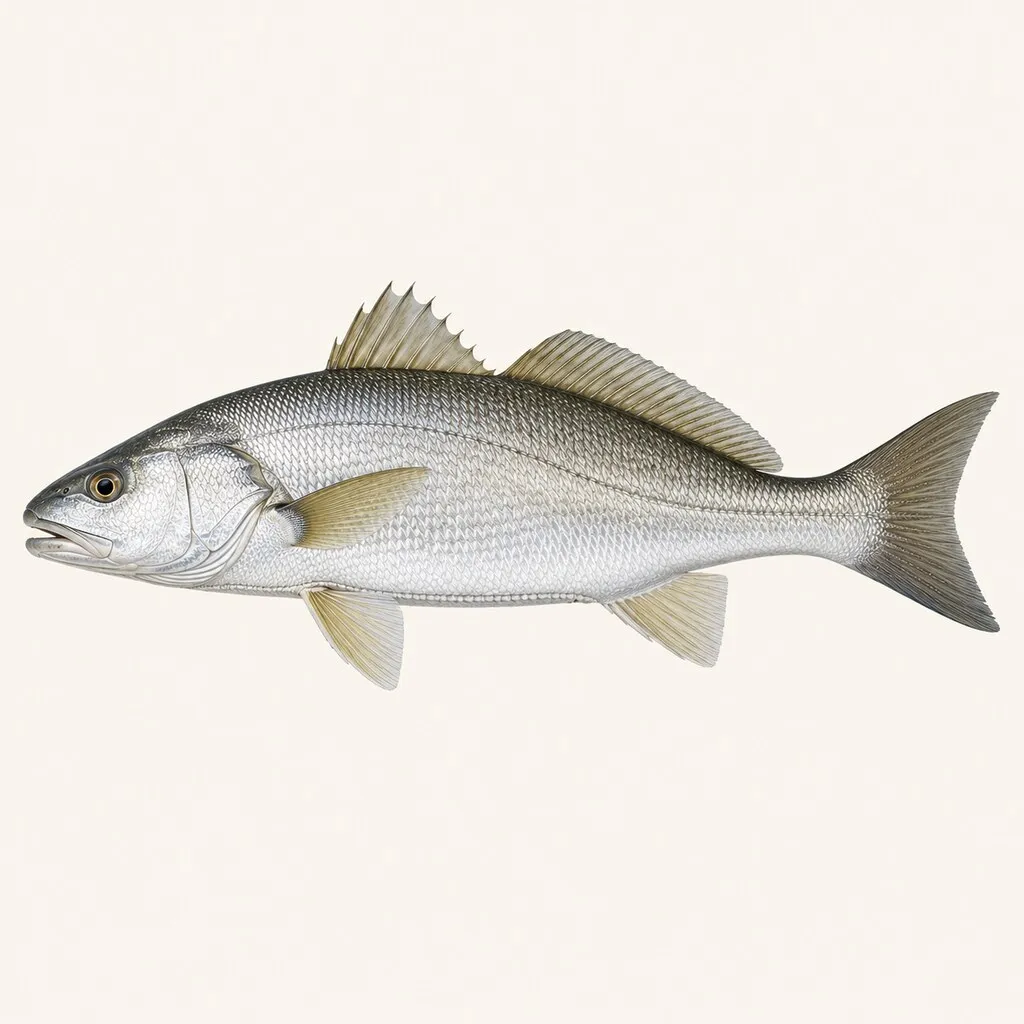
White seabass
Atractoscion nobilis · Sciaenidae
- Saltwater
- Coastal
- Medium
- Size
100–166 cm
- Weight
11–41 kg
- Lifespan
20 years
- Depth
0–122 m
Where to fish
- Rocky shore
Habitat icons: Flaticon
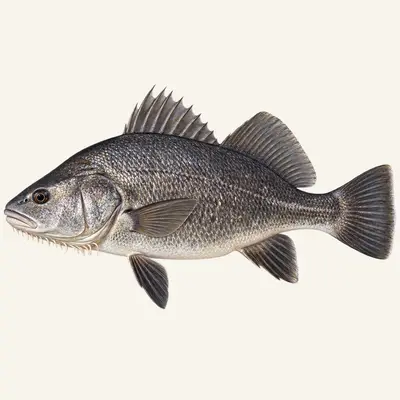
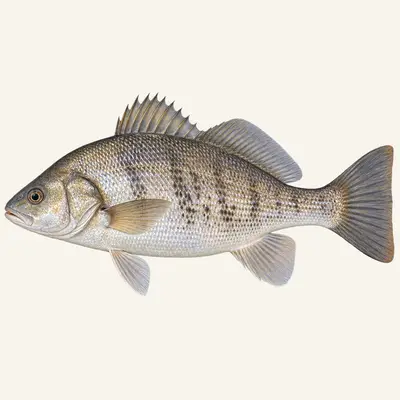
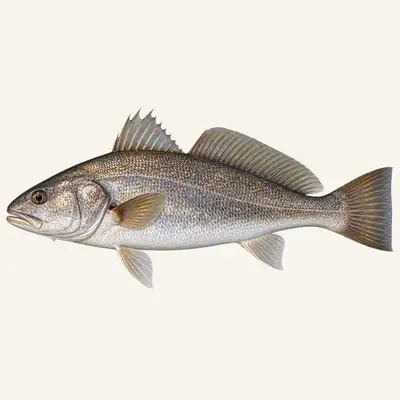
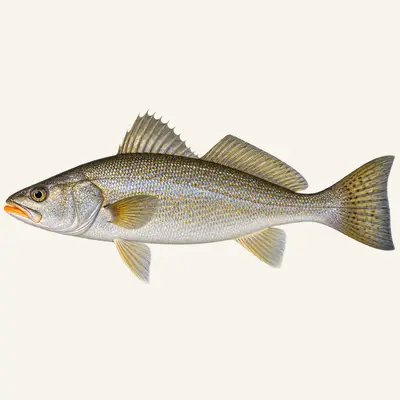
The white seabass is a large coastal sciaenid of the North American Pacific, with an elongated silvery body, blue-grey back, and an oblique mouth lined with sharp teeth; it can exceed 1.5 m and 35 kg. It lives near rocky shores and kelp beds from California down to Baja California.
Calendar
Recorded in 2 countries
GBIF occurrence records — native and introduced populations combined.
Its range
The species occupies the eastern Pacific from Alaska to southern Baja California and the Gulf of California — on paper a range of more than forty degrees of latitude, in practice a very lopsided one. The recorded latitudes run from 65 degrees north down to 22, and the fishery, the schools and the nurseries all sit in the southern third of that.
The northern half of the chart is what a wandering fish produces. It is the southern California and Baja coast, with its kelp, its rocky headlands and its warm bays, that holds the population, and the Gulf of California adds a second, separate body of water on the far side of the peninsula.
Identifying it
Look at the base of the pelvic fins. Each one carries a fleshy appendage where it meets the body — a small flap of tissue, easy to feel and easy to see once it has been pointed out. It is the character to work from on a silvery fish that could otherwise pass for several other things over a kelp bed.
The counts back it up: ten or eleven spines in the first dorsal, then 20 to 23 soft rays, two anal spines followed by eight or nine rays, and 24 vertebrae. The body is fusiform, the profile long and clean, built for open water rather than for holding station on a rock.
Breeding
The eggs are released into open water. Nothing is built, nothing is guarded, and the whole reproductive effort of a fish is handed to the current within minutes of leaving it.
Against that, the animal is long-lived: the oldest on record reached 20 years, and common length is a metre. A fish that spawns pelagically and lives two decades bets on repetition rather than on protection, and it can only make that bet if it survives to spawn many times over.
The water it needs
Three grounds, used at three stages, and they are not adjacent.
Adults school over rocky bottom and inside kelp beds, which is where they are usually looked for, in water running from the surface down to about 120 m. The same fish are also found in the surf zone, right against the beach.
The young are somewhere else entirely: in bays and along sandy shores, with no rock and no kelp involved. The nursery is therefore not a smaller version of the adult habitat but a different one, which means a bay can be full of the species and hold nothing an adult angler would recognise as a fish worth targeting.
Areas
- Coastal bays and coves
- Marine rocky zones
- Coastal shallows
- Coastal kelp beds
Techniques
- Coastal live bait fishing
- Casting metal lures
- Bottom jigging
- Slow trolling
Baits
- Live anchovies
- Sardines
- Metal lures
- Squid strips
What it eats
Fishes, squid and crustaceans, in that order of prominence.
Squid is the entry worth building a plan around. It is a prey that concentrates — squid gather in dense, predictable numbers on their own spawning ground and stay there — so a diet with squid in it means the predator has periods when its food is not spread evenly over the coast but heaped in one place. Finding that heap does more than any refinement of tackle.
How to catch it
The kelp edge, the rocky high spots and the surf line, worked with what the fish eats: whole squid and squid strip, live baitfish, and metal that carries down through the school.
Schooling is the fact that organises the day. This is not a territorial animal sitting on a piece of structure and waiting for something to be dropped on it. The fish move as a body, they arrive on a mark and they leave it, and a spot that produced nothing for two hours can produce for twenty minutes. Time spent in the right place beats water covered, but only if the wait is deliberate rather than accidental.
The vertical range is wide — surface to more than a hundred metres — and the same mark can hold fish at very different heights depending on light and on where the bait is. Nothing about the species commits it to the bottom.
Along the coast it occupies, the fishery is subject to management measures that differ between American and Mexican waters and between state and federal jurisdiction. They are held by the fisheries authority for the area, and they are what to consult before a trip.
Conservation
This population's history is the argument, and it is a rare one: it went down and it came back.
The Californian fishery for the species declined heavily over the twentieth century, to the point where the fish became scarce enough that catching one was a story. Two things changed afterwards. Set gillnets were removed from the nearshore state waters where the schools live and where the young grow, and a hatchery programme began releasing juveniles into the bays. The stock rebuilt over the decades that followed, and the fish is again a mainstay of the southern California sport fleet.
The mechanism worth taking from that is where the pressure had to be lifted. It was not offshore. It was in exactly the band of water this species cannot avoid — the kelp beds where the adults school and the bays where the young live are the same water that receives coastal development, and there is no deep-water refuge in the life cycle to fall back on.
The remaining exposure is the schooling itself. A fish that gathers is a fish that can be found, and a stock rebuilt by removing a form of gear can be drawn down again by effort concentrated on the aggregations. Twenty years of potential life means the large fish in a school took most of two decades to get there, and a size structure is slower to rebuild than a headcount.
Regulations
Check the local regulations in force (legal size limits, closed seasons, bag limits).
For guidance only. Legal sizes, quotas and open seasons vary by location and season: always check the local regulations in force before fishing.
Other names
White seabass is the standard name and it is wrong twice over. The fish is not a bass and it is not related to one: it belongs with the croakers, alongside the red drum and the weakfishes, and its nearest relatives are fish that grunt through a gas bladder. Seabass on the same coast is applied to serranids that share none of its habits.
Spanish usage on the Baja coast has corvina blanca, which at least puts the animal in the right family, corvina being the working word for drums throughout Latin America. The northern spelling seabass, run together, is the form used in American fisheries documents; the two-word version tends to signal a different fish.
Atractoscion is built on the Greek for spindle and on the classical name of the drum family — a spindle-shaped sciaenid, which describes it exactly. Nobilis means noble, and the epithet was applied to a good many large food fishes in the nineteenth century without saying anything about this one in particular.
Sources: fishbase.se · api.gbif.org