Meagre
Argyrosomus regius · Sciaenidae
- Saltwater
- Coastal
- Medium
- Size
150–230 cm
- Weight
38–103 kg
- Depth
15–300 m
Where to fish
- Estuary
Habitat icons: Flaticon
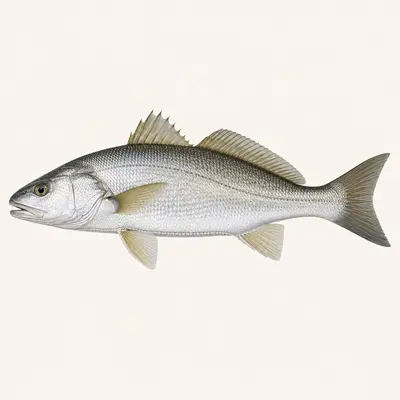
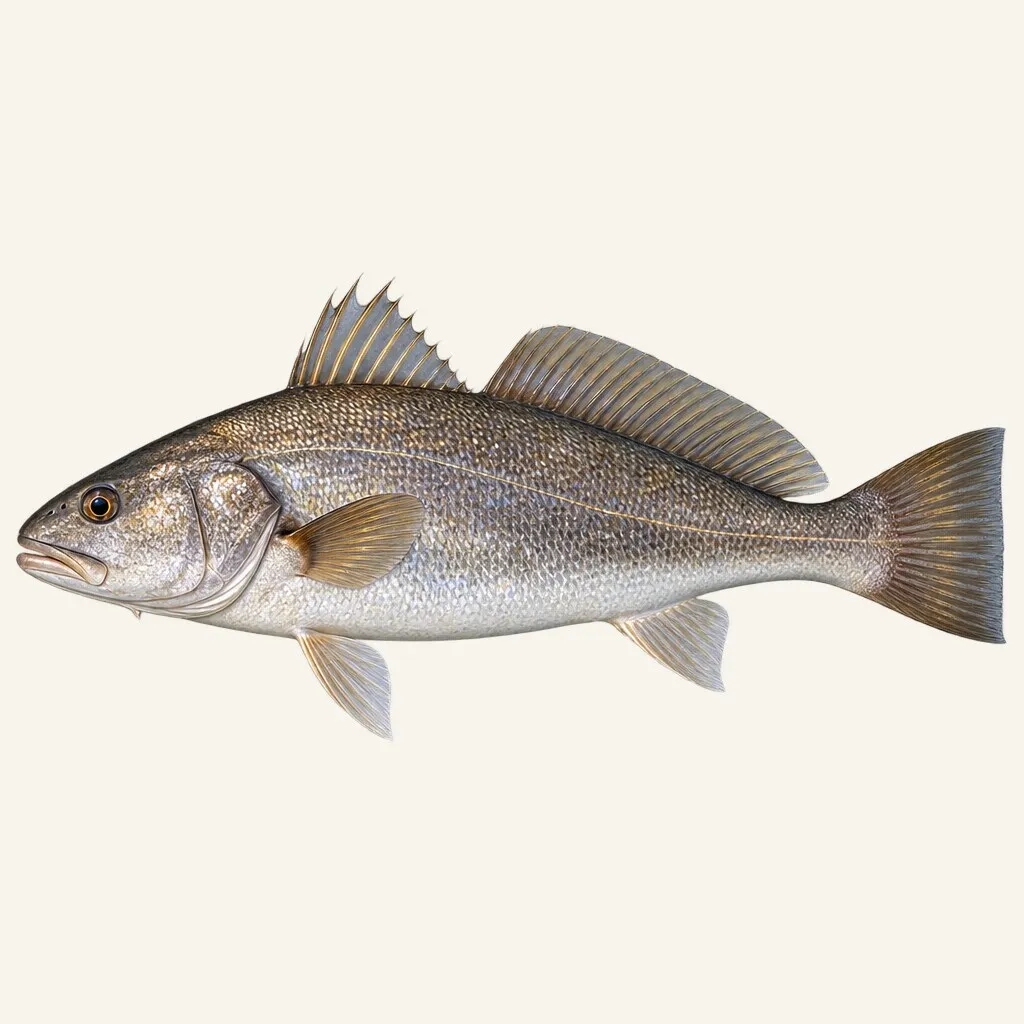
The meagre is a large coastal sciaenid with a fusiform silvery body, bronze-grey back, and a wide protractile mouth; it can exceed 2 m and 70 kg. It inhabits coastal waters and estuaries of the north-east Atlantic and Mediterranean, and produces an audible grunting sound using its swim bladder.
Calendar
Its range
The species runs from Norwegian water south to Gibraltar and on to the Congo, and occupies the Mediterranean and the Black Sea throughout. It has also passed through the Suez Canal into the Red Sea, an addition made in the last decades rather than inherited.
The chart should be read as an envelope rather than as a residence. Adults and juveniles alike move along the shore and between deep and shallow water in response to temperature, so the northern end of that band is occupied at some seasons and empty at others. A meagre off a northern coast is a fish that arrived, not a fish that lives there.
Identifying it
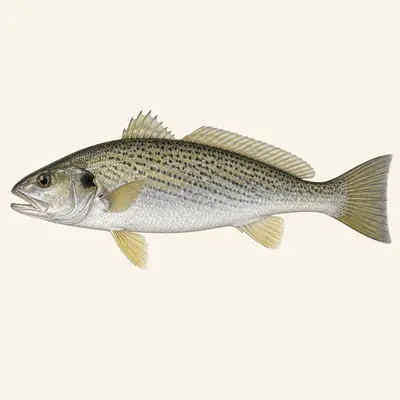
The second dorsal fin is twice the length of the first. On a big silver fish lifted out of a river mouth, that proportion is the quickest thing to check: ten or eleven spines in the short front fin, then a long soft fin of 27 to 29 rays carried back over most of the body.
The scales are rough — the diagnosis says so in as many words — and a dry palm run forward along the flank catches on them.
The body is fusiform, thick through the shoulder and never deep-bodied. The back is bronze-grey and the flanks hard silver.
Size finishes it. This is the largest of the eastern Atlantic drums, and an ordinary adult is already a long fish — the figure given for common length is 150 cm. In the water it can be confused with very little.
The water it needs
The recorded depth band goes from 15 m down to 300, and adults use the shelf as well as the shore. What matters more than the depth is the height: they hold close to the bottom, in mid-water and right at the surface, moving between the three according to where the food is.
Juveniles and sub-adults do something different. They go into estuaries and coastal lagoons and stay there, which puts the young of the species in enclosed water and the adults on the open coast — two habitats, one animal, with the change of address arriving partway through its life.
Adults come inshore to spawn in spring and summer, and they concentrate to do it.
Areas
- Channel entrances and river mouths
- Strong-current coastal areas
- Mediterranean estuaries
- Coastal lagoons
Techniques
- Live bait fishing (mullet, sardine)
- Casting large soft lures
- Deep jigging
- Coastal trolling
Baits
- Live mullet
- Fresh sardines
- Large soft lures
- Whole squid
What it eats
It hunts shoals. The recorded prey is clupeids and mugilids — sardines, shads, mullets — taken from schools rather than picked off a bottom, with swimming crustaceans making up the rest.
That is a different feeding pattern from the crab-and-shrimp drums of the same family, and it has an immediate consequence. A predator of shoals is found by finding the shoal, not by finding the ground. Bait fish pushed into a pass by the tide, working birds, a sounder full of a dense mark: those are the signs that matter, and the ground under them is almost incidental.
How to catch it
Fish the current and fish the whole column.
The tide is the mechanism. Passes, harbour entrances and river mouths concentrate mullet and sardine on a running flood, and the meagre works the seam that forms. Slack water disperses the prey and the predator goes with it.
Because the fish holds at any height, a bait fixed on the bottom covers a fraction of the water it lives in. Large soft lures worked through the middle layers, live mullet under a float, a deep jig on the same mark at a different state of tide — the choice is a choice of depth as much as of bait, and one mark can be worked three ways in a session.
Size of bait follows from the prey. An animal that swallows adult mullet is not going to be tempted down to a small offering, and a bait of that size also filters out most of what else is on the mark.
One number should stay in mind while deciding what to do with a fish. Maturity is recorded from about 80 cm. Against a common length of 150, that means the medium fish taken in a lagoon or an estuary are frequently animals that have not yet spawned once.
Conservation
The pressure specific to this species is not the fishing. It is that the meagre is farmed.
The record carries an aquaculture profile for it alongside the commercial fishery, and it is one of the few large fish grown in sea cages in European water. That fact changes what a capture means, and the change is not visible on the animal.
Cages sit in the coastal band — the same water the species spawns in, next to the same lagoons its juveniles use. Fish get out of cages. Nothing about a meagre in the hand says whether it hatched in the sea or in a tank, because there is no mark to look for: same species, same shape, same colour.
The practical consequence is about reading abundance rather than about ethics. A run of meagre appearing along a stretch of coast where there was none is normally taken as a wild stock recovering. Where the species is farmed nearby, that inference no longer holds on its own, and neither does the reverse. The wild population and the farmed one are two different accounts kept in the same water.
What remains solidly on the wild side is the spawning behaviour. The fish gather inshore, in spring and summer, in shallow and accessible water, and they do it in the places anglers already know — the passes and the mouths. A concentration of large fish at a predictable time is the most exposed form a stock can take, and the fish in it are the ones over 80 cm, which is to say the whole breeding population. Local rules cover this in several countries, and they come from the fisheries authority for the coast concerned.
Regulations
Check the local regulations in force (legal size limits, closed seasons, bag limits).
For guidance only. Legal sizes, quotas and open seasons vary by location and season: always check the local regulations in force before fishing.
Other names
Meagre is the English name, borrowed straight from the French maigre, and the reason for the word is not settled. Corvina and corvinão serve in Spanish and Portuguese, and the Italian name for it means gold-mouthed umbrine, which points at the colour inside the jaws.
The genus is the trap. Argyrosomus means silver body, and it holds several large drums scattered across the world's warm coasts: the kob of southern Africa and the mulloway of Australia belong to it too, and both are big silver sciaenids caught in surf and estuaries by people who call them something else entirely. A report of a meagre-like fish means nothing without a locality attached.
Regius means royal, which for once is a description rather than a compliment: this is the largest drum a European angler will meet.
Sources: fishbase.se · api.gbif.org