Black drum
Pogonias cromis · Sciaenidae
- Saltwater
- Coastal
- Medium
- Size
50–170 cm
- Weight
1.5–51 kg
- Lifespan
43 years
Where to fish
- Estuary
- Beach
- Rocky shore
Habitat icons: Flaticon
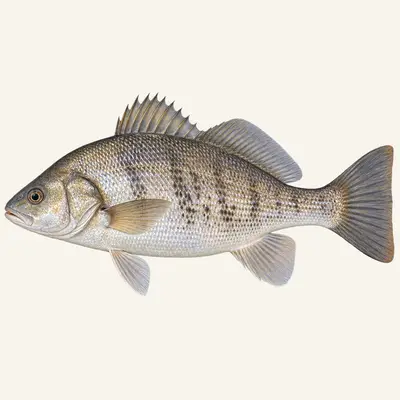
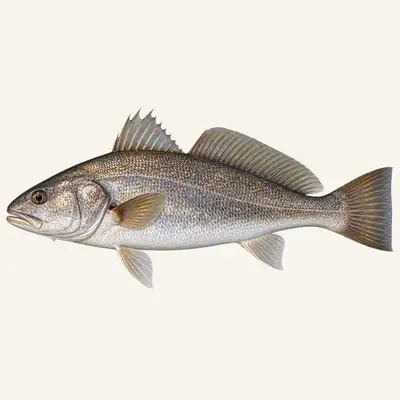
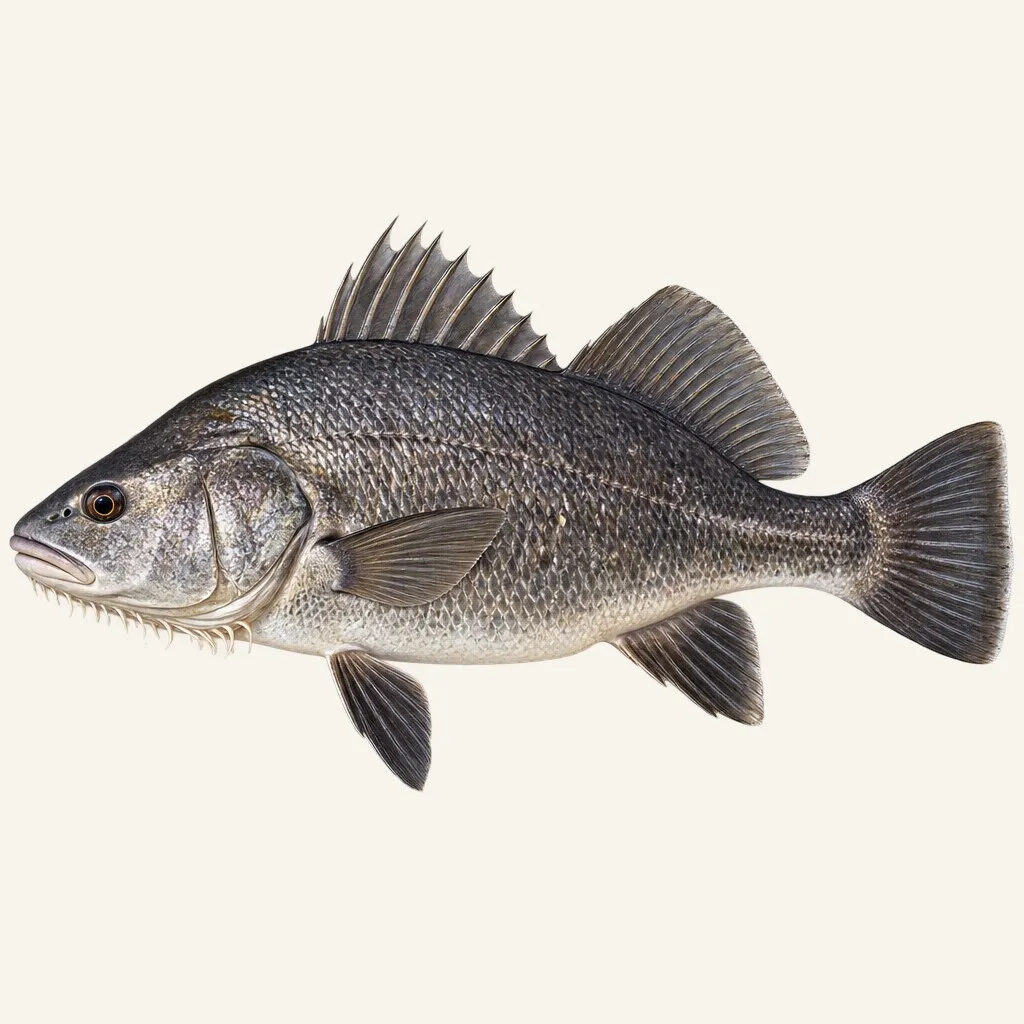
The black drum is a large, robust sciaenid with an oval, dark grey to blackish body, elongated fins, and a subterminal mouth equipped with powerful pavement-like teeth adapted for crushing shellfish and crustaceans; it can exceed 1.5 m and 50 kg. It inhabits shallow coastal waters, estuaries, and muddy or sandy shallows along the American Atlantic.
Calendar
Recorded in 3 countries
Argentina · Brazil · United States
GBIF occurrence records — native and introduced populations combined.
Identifying it
Turn the head over and count the chin. There are five pores, and between ten and thirteen pairs of short barbels set along the inner edges of the lower jaw and the gill cover, each pair a little longer than the one in front of it. It is a detailed, ordered arrangement, it is written into the published diagnosis of the species, and it can be read with a thumb in poor light.
Colour is unreliable and changes with age. Small fish wear four or five black vertical bars down the flank; the bars fade as the fish grows and a large one is plain, silvery grey to nearly black, with the pelvic and anal fins usually dark. Two fish of the same species at two sizes look like two species.
The counts are 11 dorsal spines followed by 19 to 22 soft rays, and two anal spines followed by five to seven. The body is deep-shouldered and high-backed rather than fusiform, and the mouth sits underneath the snout, angled at the ground.
One character is internal and worth knowing about anyway. The gas bladder of an adult carries numerous lateral appendages, branched and interconnected in a complicated pattern — a structure that is not present in that form in a young fish. The sound-producing apparatus of this species elaborates as the animal ages, so the deep carrying note it is named for belongs to the old fish rather than to the small ones.
The water it needs
Sand and soft mud in shallow coastal water, and the record adds a qualifier that is worth more than the substrate: especially in areas with large river runoffs, and in mangrove.
That is a preference for turbid, low-salinity, food-rich water — the discoloured plume where a river spreads across a bay. It fits everything else about the animal. A fish that finds buried shellfish with barbels does not need to see, so the water that blinds other predators costs it nothing, and the soft sediment those rivers deposit is where its food lives.
Juveniles work their way into estuaries, so the young and the adults overlap in the same systems rather than separating.
Areas
- Estuaries and inlets
- Sandy beaches
- Muddy coastal flats
- Jetties and breakwaters
Techniques
- Bottom fishing
- Surf casting
- Coastal trolling
- Drift fishing
Baits
- Blue crabs
- Fresh shrimp
- Mussels
- Bloodworms
- Razor clams
What it eats
This fish eats shellfish, and it eats them whole.
Behind the jaws sit heavy pavement-like plates, and they do not cut or hold: they crush. An oyster, a clam, a mussel or a hard-shelled crab goes in intact and is broken up outright, shell and all, with the fragments passed through and the meat kept. The mouth is set low and the barbels do the finding, feeling over sand and soft mud for something buried that the eye would never locate.
Crustaceans and molluscs therefore make up most of the diet, with fish taken opportunistically. Where the species is common on cultivated shellfish ground it is a genuine nuisance to the growers, for the plain reason that a bed of oysters is, to this animal, a field of food with no defence that works.
How to catch it
Fish the bottom, and fish something with a shell on it.
That instruction comes straight from the dentition. A crushing predator hunting by touch and smell in dirty water has no interest in a fast presentation and no way to react to one. Half a blue crab, a shucked clam, a bunch of mussels or a peeled shrimp, held still on the bed in a channel or a pass, is the method, and the takes are heavy and slow rather than sharp.
The corollary is that a lure is the wrong tool most of the time. This is not a fish that chases, and a plastic worked through the water column crosses over the top of an animal that is nose-down in the mud.
Tide gives the timing. A flood pushing over shellfish ground puts feeding fish onto it, and the same ground can be dead an hour after the water starts to drop.
Maturity is recorded from about 63 cm, with an average around 65. That is a large fish before the first spawning, which is unusual on this coast, and it means the medium fish taken in an estuary are frequently immature animals.
Conservation
The number that changes everything on this page is 43. That is the oldest reported age, and it makes the black drum one of the longest-lived fishes of the coast it occupies.
Set it beside the maturity figure and the arithmetic becomes uncomfortable. A fish does not begin to breed until it is a good size, and it may then go on breeding for three decades. The very large individuals are not exceptional specimens of an ordinary population; they are the accumulated survivors of thirty or forty year classes, and each one represents a spawning history no small fish can substitute for.
Removing one is therefore not equivalent to removing an average fish. It takes out decades of future reproduction and decades of past growth at the same time, and the replacement will not arrive within a fishing lifetime.
On parts of the coast, practice has drifted in the right direction for a reason that has nothing to do with conservation: the flesh of a large black drum is coarse, and where it has a reputation for carrying parasites the big fish go back and the mid-sized ones are kept. Where that holds, the habit happens to protect the right end of the size range, which is the opposite of how most fisheries behave. It is a local custom rather than a rule, and it protects nothing where it is not the custom.
The second pressure is on the food. A fish this closely tied to shellfish beds follows the fortunes of those beds, and where oyster reef has been dredged away or silted over, the fish loses the ground it feeds on rather than the water it swims in. Bag and size measures for the species vary by state along the American coast and are set by the fisheries body for each of them.
Regulations
Check the local regulations in force (legal size limits, closed seasons, bag limits).
For guidance only. Legal sizes, quotas and open seasons vary by location and season: always check the local regulations in force before fishing.
Other names
Black drum is the standard name and the drum in it is literal: the species produces a deep, carrying note that can be heard through a hull, and the sound gives its whole family the English name of drums and croakers.
Pogonias means bearded, after those chin barbels, and cromis comes from an old Mediterranean word for a fish that grunts. The naming is therefore entirely about two things you cannot see in a photograph.
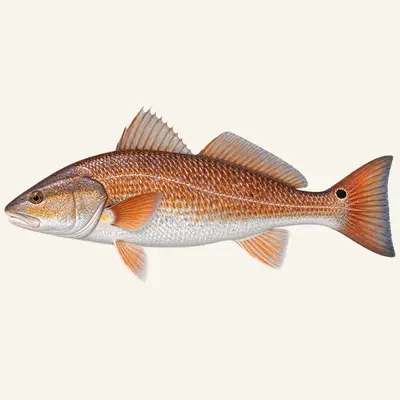
The word drum on its own is the difficulty. It covers this species, the red drum of the same water, and the freshwater drum inland, all three of them real drums and none of them interchangeable. Puppy drum, in the Carolinas, means a small red drum and not a young black one, so the colour word is doing all of the work in a name that sounds like a family label.
Spanish along the same coasts has corvina negra, and the barred juveniles are sold and reported under names of their own in several places, which is what happens whenever the young and the adults of a species do not look alike.
Sources: fishbase.se · api.gbif.org