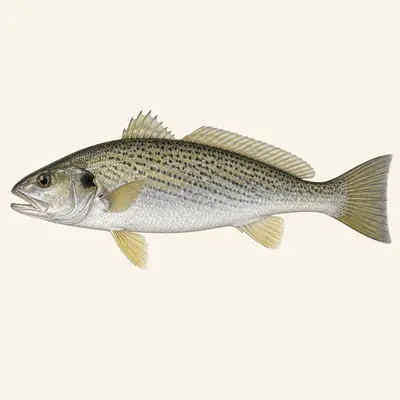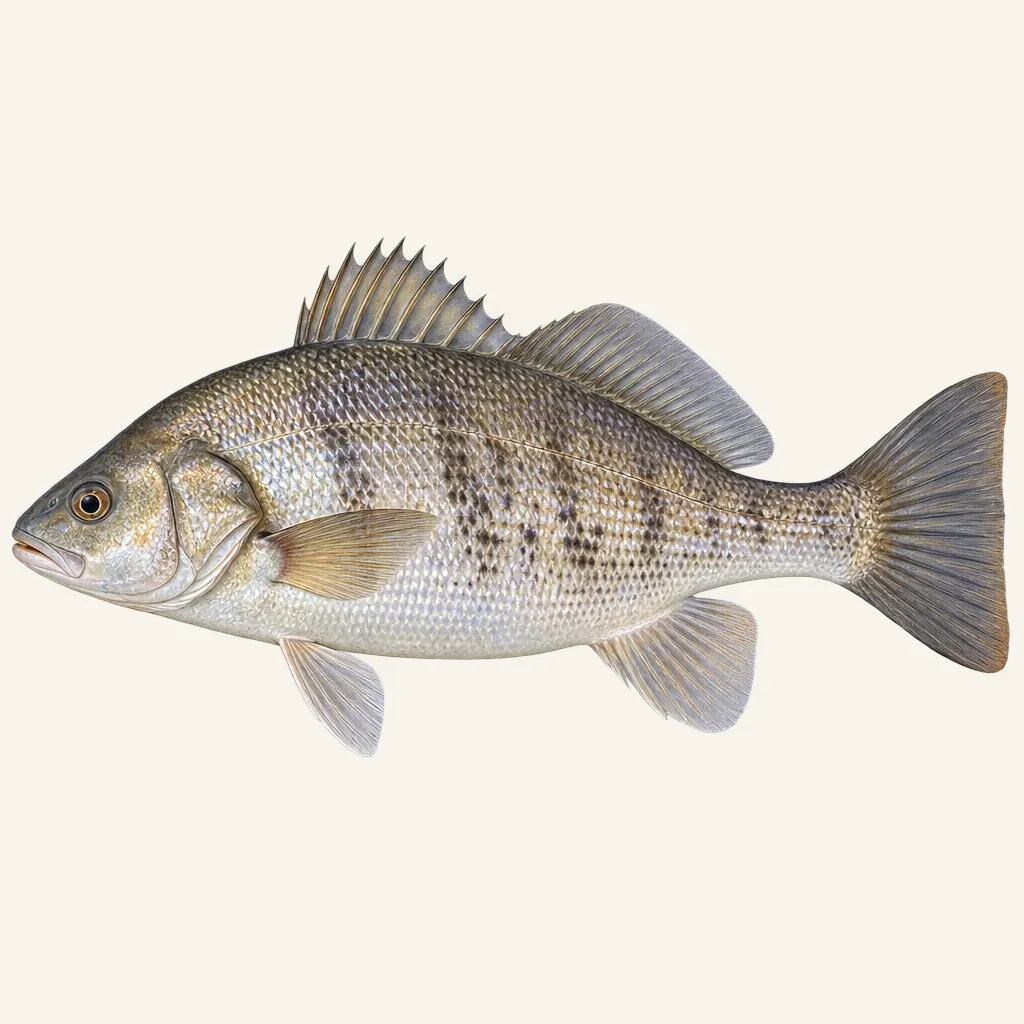
Freshwater drum
Aplodinotus grunniens · Sciaenidae
- Freshwater
- Bottom fish
- Easy
- Size
45–95 cm
- Weight
1.7–25 kg
- Lifespan
13 years
Where to fish
- Lake
- River
Habitat icons: Flaticon
A stout fish, the only strictly freshwater drum in North America, famous for the grunting sound males produce.
Calendar
Recorded in 4 countries
Canada · China · Mexico · United States
GBIF occurrence records — native and introduced populations combined.
Its range
The range runs from the St Lawrence and the Great Lakes across the Hudson Bay and Mississippi basins, north to Quebec, northern Manitoba and southern Saskatchewan, south to the Gulf, and on through the Gulf Coast drainages from Mobile Bay across eastern Mexico to the Usumacinta system in Guatemala.
That is 58 degrees of north latitude down to 15 — about as much of the continent as a freshwater fish covers. Very little else in North American fresh water is at home both under ice and in a Central American lowland river.
What makes it possible is a tolerance rather than a preference. The recorded upper limit is 32 °C, and at the other end the species holds through northern winters. A fish with that span does not need to specialise in any particular river; it needs the river to be big.
Identifying it
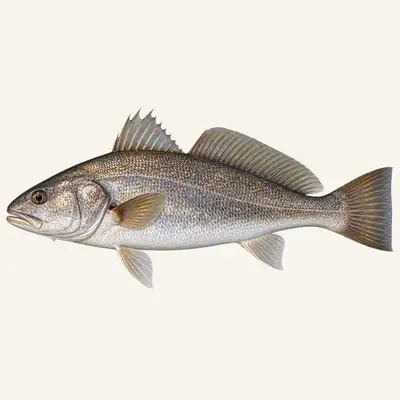
Context settles this one before anatomy does. It is the only member of the drum family in North America that lives its whole life in fresh water, so a sciaenid in the Mississippi or in Lake Erie can only be this fish — high-backed, blunt-headed, with a long two-part dorsal running most of the length of the body and a rounded tail rather than a forked one.
The detail worth keeping is inside the skull. The otoliths — the calcium stones of the inner ear — are unusually large in this species and shaped like a letter L, with a groove across one face. They come out whole when a fish is cleaned, they are hard and white and take a polish, and they have been picked out and kept as ornaments for as long as the fish has been eaten. Lucky stones is the name they go by.
They are also the reason anything is known about the fish's age. A stone that big holds a clear annual record, and the same object that ends up in a pocket is what a biologist sections to count the years.
Breeding
The eggs float.
That is a rare thing in fresh water, where the ordinary arrangements are a nest, a gravel bed, sticky eggs on vegetation, or a mouth. This fish releases eggs that rise and drift at the surface, and nothing is built, guarded or defended. The spawning happens in open water and the parents leave immediately.
Two consequences follow. There is no nest to protect and no bank to disturb, so nothing an angler does in spring can undo a spawning site. And the survival of a year class depends on where the current takes it, which makes the species dependent on open river length and lake volume in a way that a nest-building fish is not: eggs that drift into a dam face or a dead pool are eggs lost.
The water it needs
Bottoms of medium and large rivers and lakes, and the record's depth band starts at 30 m — deep water, not the margins.
That is easy to misread. The species is caught from banks and jetties often enough to look like a shallow-water fish, and the figure in the record says the water it is recorded from is deep. Turbidity costs it nothing either way: this is an animal that works the bed by feel and by taste, in water where sight would earn very little.
Large rivers, their impoundments, the deep basins of the Great Lakes and the confluences where two big flows meet are where the numbers are.
Areas
- Great Lakes
- Mississippi River basin
- St. Lawrence River
- Deep reservoirs
- Large river confluences
Techniques
- Bottom bait fishing
- Weighted worm rig
- Drifting with natural bait
- Soft plastics near the bottom
Baits
- Earthworms
- Crayfish
- Small dead baitfish
- Freshwater mussels
- Soft plastic lures
What it eats
The diet climbs a ladder as the fish grows. The larvae eat the larvae of other fishes. Young fish live on zooplankton. Adults work the bed for the immature stages of aquatic insects — Hexagenia mayfly nymphs above all — with amphipods, crayfish, molluscs, and fish, mostly shad and small drum of their own kind.
The mayfly entry is the one to fish around. Where Hexagenia are dense, they are the bulk of the food, and when a hatch is on, an adult drum is working nymphs on and just above the mud. A large bait presented into that produces nothing, not because the fish has stopped feeding but because it is feeding on something a hundred times smaller.
Molluscs and crayfish in the same list explain the rest of the year: hard food, taken off the bottom, crushed rather than swallowed whole.
How to catch it
Deep, coloured, still water over a soft bed, with a bait on the bottom. That is the whole method, and it is why the species is so often caught by people fishing for something else.
Worms, cut bait, crayfish and small dead fish all work, and so does a soft plastic dragged slowly along the bed — dragged, not hopped, since the fish is following a scent trail to something that is not trying to escape. Takes are heavy and unhurried.
Confluences, the deeper ends of reservoirs, the outsides of river bends and the tailwater below a dam concentrate fish, and warm weather concentrates them further. Common length is around 45 cm and the oldest reported age is 13 years, so an average fish is an adult in the middle of its life, not a survivor of an exceptional one.
Conservation
Nothing on record threatens this species, and the pressure it does face is of an unusual kind: it is fished for, caught in numbers, and then thrown away.
The freshwater drum has a reputation as a coarse fish across most of its range, and a great many are left on the bank or dropped back dead after a long handling. That is a decision made on taste rather than on evidence — the flesh is firm and perfectly good when the fish is bled and iced quickly — but the important part is what the habit costs. An animal that is going to be discarded gets handled as if it did not matter, and the mortality that follows is invisible in every record.
The drifting eggs add a second, structural exposure. A species whose year class rides the current through its first days needs an unobstructed length of large river, and impoundment shortens exactly that. The fish itself does well in reservoirs; its reproduction depends on what happens between them.
Regulations
Check the local regulations in force (legal size limits, closed seasons, bag limits).
For guidance only. Legal sizes, quotas and open seasons vary by location and season: always check the local regulations in force before fishing.
Other names
Freshwater drum is the name in field guides, and it says what the fish is. Grunniens means grunting: males produce a deep repeated note with the muscles of the gas bladder, loud enough to be heard through the bottom of a boat, and it is the sound rather than the appearance that named the animal in every language it has one in.
Aplodinotus means single-backed, after the long unbroken-looking dorsal fin.
Sheepshead is the trap. Across the Great Lakes this is the everyday name for the species, and sheepshead on the Atlantic coast is Archosargus probatocephalus, a marine porgy with human-looking teeth and no relationship to it. A report of sheepshead means one fish in Ohio and a different one in Florida.
Louisiana has gaspergou, usually shortened to gou, which comes down from a French phrase for a shell-breaker — a name given by people who had seen what the fish does to a mussel. Grunter, croaker and white perch turn up locally, the last of them borrowed from yet another unrelated fish.
Sources: fishbase.se · api.gbif.org