Orangemouth corvina
Cynoscion xanthulus · Sciaenidae
- Saltwater
- Coastal
- Medium
- Size
60–129 cm
- Weight
2.1–25 kg
- Depth
1–50 m
Where to fish
- Estuary
Habitat icons: Flaticon
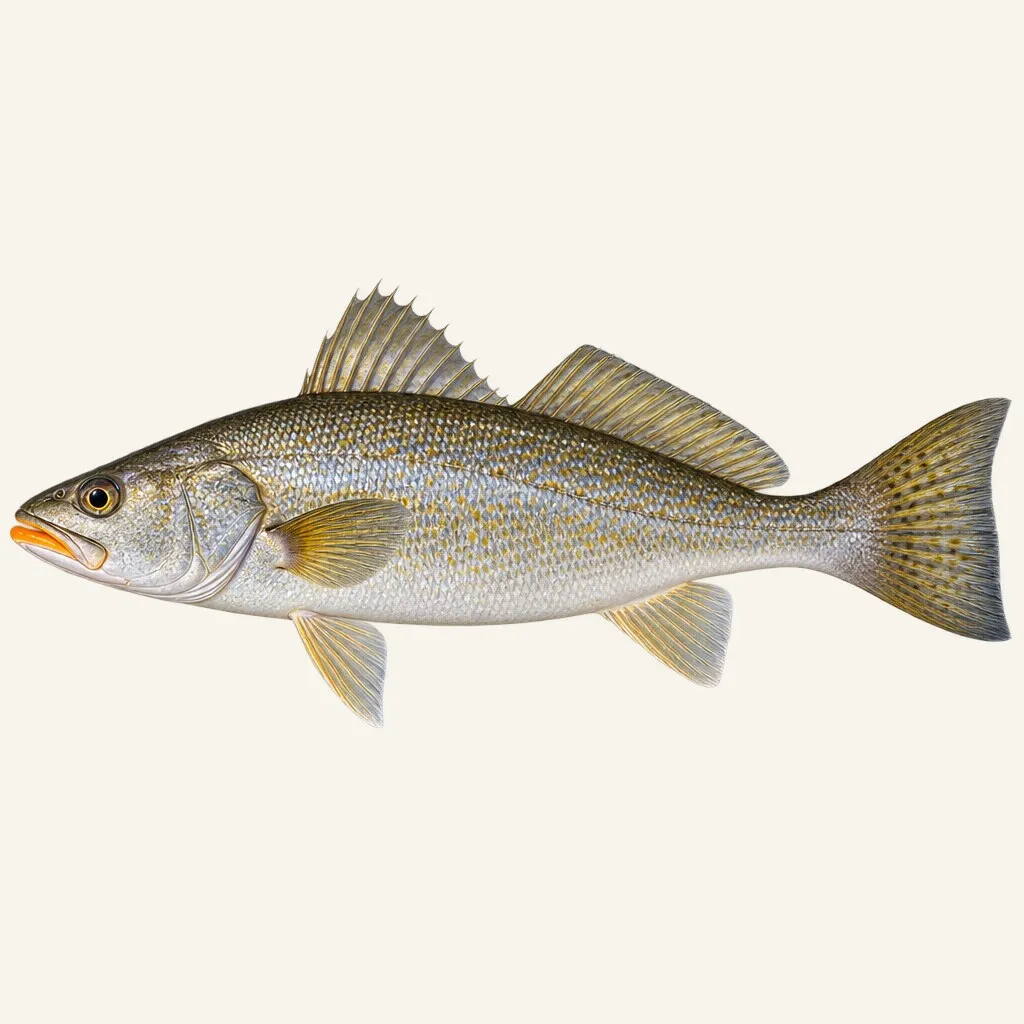
Large predatory drum of the eastern Pacific, recognizable by the orange interior of its mouth and prized for its vigorous fights.
Calendar
Recorded in 2 countries
GBIF occurrence records — native and introduced populations combined.
Its range
The Gulf of California is the centre of it. The range runs the Pacific coast of Mexico and Central America roughly between the 33rd and 14th parallels, and the Gulf — a long, warm, nearly enclosed arm of sea between the peninsula and the mainland — holds its northern end.
Then the anomaly. The species was introduced to the Salton Sea, in the desert of southern California: a landlocked water below sea level, which the record itself describes as highly saline. Nothing about that lake resembles the Gulf except the temperature.
What the introduction produced was one of the strangest fisheries on the continent — a large marine drum, taken from a desert shoreline, in water with no connection to any ocean. And its term was set by the water rather than by the fishing. Salt arrives with the inflow and nothing carries it back out, so the lake's salinity moves in one direction only. A fishery founded on that has a date on it from the start.
Identifying it
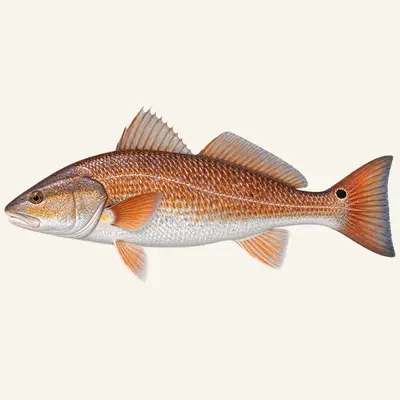
Colour is all the record leaves for identification. No fin counts, no scale rows, no meristics of any kind have been published for this species, and both of the names it carries describe pigment instead: the epithet is Greek for yellowish, and the accepted English name points at the orange lining of the mouth.
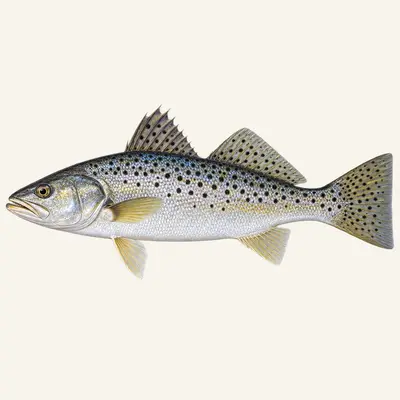
On the eastern Pacific that matters more than it would elsewhere. Several members of this genus share the same coast and the same lagoons, so where an Atlantic identification can be finished by geography, here it cannot — yellow in the fins and orange inside the mouth are doing real work rather than decorating a description.
Size finishes the job at the top end. This is the largest fish in the genus, and past a certain point no congener is a candidate.
The water it needs
Benthopelagic, from one metre down to 50. That combination is the cleanest separation from the two Atlantic congeners, which are classed as demersal and are described within a much narrower band: this fish works the water column, and it works it from the shallows of a lagoon to the bottom of a deep channel.
Estuaries and coastal lagoons are the listed setting, brackish water included, and the Salton Sea marks the far end of what it will tolerate — it was put into hypersaline water and it lived there. Between a river-fed lagoon and that lake, the species spans nearly the whole salinity range available on a coast.
It is a tropical fish and the latitudes say so, 33 degrees north down to 14. There is no temperate section of this range at all, which is the other thing that sets it apart from relatives that reach New York and Nova Scotia.
Areas
- Gulf of California
- Estuaries of Mexico and Central America
- Salton Sea (California)
- Coastal lagoons of the eastern Pacific
Techniques
- Lure casting and retrieving
- Live-baiting
- Light trolling
- Bottom fishing with natural bait
Baits
- Soft plastic lures
- Swimbaits and plugs
- Live sardines or anchovies
- Shrimp
- Metal jigs
How to catch it
The vertical span is the practical fact. This fish can be over 50 m of water or in a metre of lagoon, and what settles which is where the bait is rather than what the chart says, so the search is for the forage and not for the bottom.
Scale is the second. It is the biggest animal in its genus, and tackle chosen for the Atlantic members of the family is under-gunned here — that applies to the whole terminal end, not only to the line.
The record enters it as a high-value commercial species and as a game fish, which is to say two fisheries work the same stock, from different boats, with different reporting.
And the desert lake remains the oddity worth knowing about: a marine drum of this size, cast to from a shore hundreds of kilometres from its own ocean.
Conservation
The gap in the record is the problem, and it is a documented gap rather than an impression. There is no length at first maturity on file, no maximum age, no diet study, no morphology — while the same record ranks the commercial fishery as high. A stock landed at that scale, without the figures that say what the landings are doing to it, cannot be assessed. An unassessed fishery is not a safe one; it is an unmeasured one.
The shape of the sea it lives in concentrates the consequences. A nearly enclosed gulf holds one stock rather than a coastline of them, so effort applied at one end is not diluted by distance, and a decline in the Gulf of California is not repaired by fish arriving from further down the coast.
The introduced population offers no insurance. A species established in a lake whose salt content keeps climbing is not a reserve held somewhere safe, though it can easily be mistaken for one.
Regulations
Subject to local regulations; minimum sizes and bag limits may apply.
For guidance only. Legal sizes, quotas and open seasons vary by location and season: always check the local regulations in force before fishing.
Other names
Orangemouth corvina is the accepted English name, and its two halves come from different languages doing the same job. Orangemouth is the field mark. Corvina is Spanish, and on both American coasts it covers the whole family rather than any one species — a slab of corvina on a Mexican market stall may be any of a dozen drums.
The spelling matters as much as the word. Corvina and corbina both circulate in English, and in the surf fishery of southern California a corbina is a different fish in the same family, so the two spellings do not name the same animal in the same state.
Xanthulus is a diminutive built on the Greek for yellow: the little yellow one, which sits oddly on the largest fish in its genus. In the literature about the Salton Sea it appears simply as corvina, without qualification, which is worth knowing when reading anything written about that lake.
Sources: fishbase.se · api.gbif.org