Red drum
Sciaenops ocellatus · Sciaenidae
- Saltwater
- Coastal
- Medium
- Size
100–155 cm
- Weight
12–45 kg
- Lifespan
50 years
- Water temp.
15–26 °C
Where to fish
- Estuary
Habitat icons: Flaticon
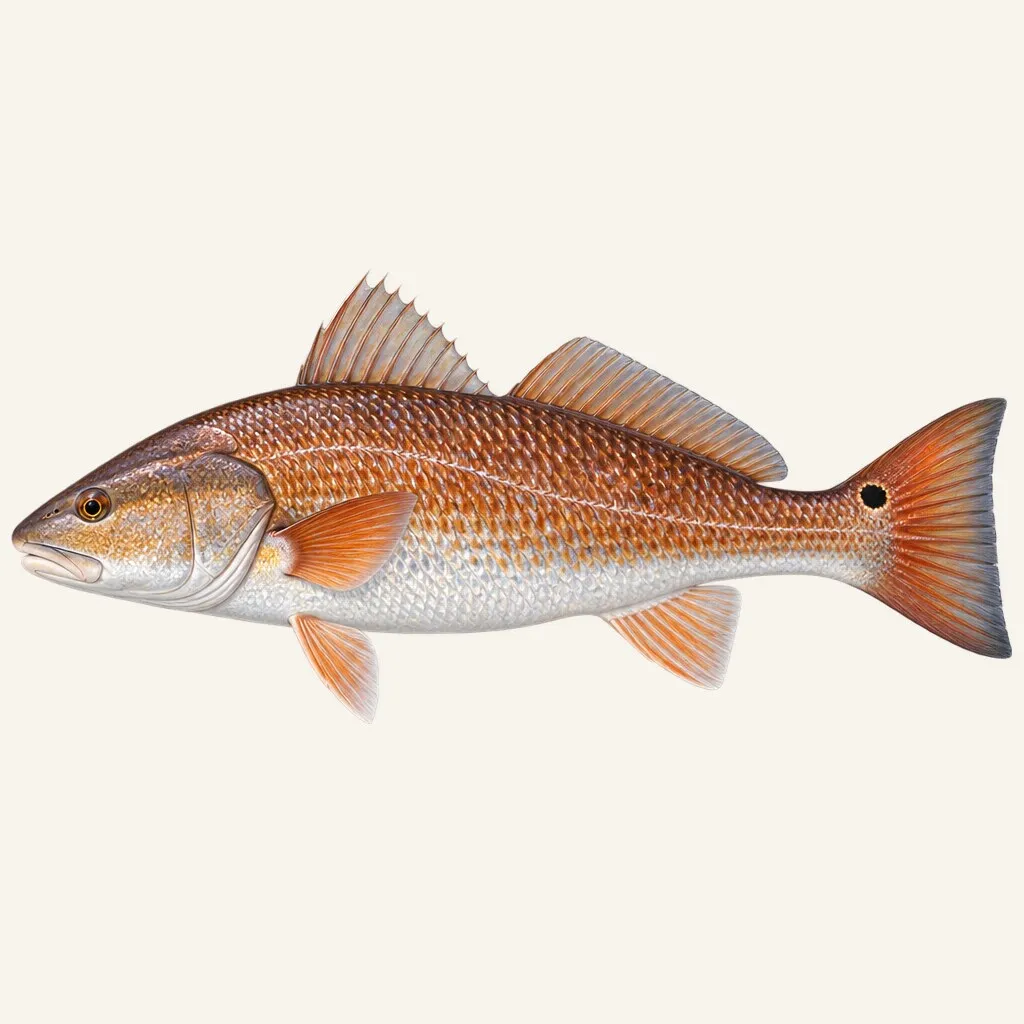
The red drum is a sturdy coastal sciaenid with an elongated, copper-to-reddish body and a whitish belly, recognizable by its distinctive black eyespot at the base of the tail; it can reach 1.5 m and 45 kg. It inhabits shallow coastal waters, estuaries, and seagrass beds along the Atlantic coast and Gulf of Mexico.
Calendar
Recorded in 2 countries
China · United States
GBIF occurrence records — native and introduced populations combined.
Its range
The natural range on record is the western Atlantic: Massachusetts down to northern Mexico, taking in southern Florida and the Gulf. It is a warm range, and the recorded thermal band — 15 to 26 °C — explains why the northern end is seasonal and thin while the Gulf coast holds the fish year-round.
The map carries a second block of colour far outside that, and it does not mean the species swam there. The red drum is farmed commercially, on a scale that put it into Asian coastal aquaculture, and its presence in eastern-hemisphere water is a consequence of that industry rather than of any natural spread. Two very different things are being shown in one colour.
Identifying it
One black eyespot at the base of the tail, ringed and clean-edged against a copper flank. That is the signature of the species and it is visible at a distance, in coloured water, on a fish still in the net.
The useful part is that the number of spots is not fixed. One is the commonest arrangement and it sits on the upper part of the tail root. Plenty of fish carry two or three, some carry a scattered line of them down the flank, a few carry them on one side only, and a small number carry none at all. So the mark confirms an identification and never refutes one: a copper-bodied drum off an American beach with no ocellus is still this fish.
The body is heavy through the shoulder and tapers hard to the tail. Colour runs from bronze to deep copper over the back, whitening underneath, and it deepens in clear water and pales over light sand.
The mouth is set low, under the snout, which is worth noticing because it is the whole feeding posture in one detail. This is an animal built to take things off the bottom with its head down.
The water it needs
Sand and soft mud in shallow coastal water and in estuaries, plus one entry that reorganises the rest: the fish is abundant in the surf zone.
That combination is what makes the species so accessible. It uses the shallowest water on the coast — flats a metre deep, marsh drains, the trough behind the first bar — and it uses it in numbers rather than as strays. Very few fish of this size can be caught standing up.
The estuary is not merely a feeding ground here. It is where the fish spend the first years of their lives, and they stay in it: a bay or a marsh system holds its own population of young and sub-adult fish, on the same flats, through the seasons.
Areas
- Sandy and muddy flats
- Shallow estuaries
- Coastal seagrass beds
- Channels and mouths
Techniques
- Live shrimp fishing on flats
- Casting soft lures
- Sight fishing in clear water
- Blue crab fishing
Baits
- Live shrimp
- Blue crabs
- Soft lures
- Live mullet
What it eats
Crustaceans first, then molluscs, then fish.
Crabs and shrimp are the core of it, and the low-set mouth is the tool for them. A red drum feeding hard on a shallow flat goes head-down onto the bottom to root out a crab, and in a few inches of water the tail comes clear of the surface while it does so. Tailing fish are the single most reliable sighting on the flats, and they are a feeding posture made visible.
The mollusc share explains the willingness to take a bait that does not move at all. A fish that eats clams has no expectation that food should swim away from it, which is why a dead crab on the bottom outfishes a lure on a good many days.
How to catch it
There are two fisheries here, and they take the same species at two ages.
The inshore one is for the young. Sub-adult fish live on the flats and in the marshes, they are visible in clear water, and they are fished with light tackle, sight casting, small crabs and shrimp, and soft plastics worked slowly across the bottom. This is the fishing the species is famous for.
The other is for the adults. Mature fish leave the estuarine ground for the open coast, the passes and the surf, where they are fished with heavy bottom tackle, whole baits and long casts from the beach. Different water, different gear, different fish in the hand — a copper animal weighing more than the tackle used on the flats can handle.
Maturity is where the two connect. The published figures put first spawning between about 55 and 80 cm, with an average around 83. Every fish on the flats below that band has never spawned, and every fish in the surf above it is part of the breeding stock. The size of a red drum is not a trophy scale, it is a life-stage reading.
The last figure to carry is age. The oldest on record reached 50 years. A large fish out of the surf is not a big young fish; it is an animal that has been on that coast for decades.
Conservation
The two-stage life is also the vulnerability, because the two stages are exposed to entirely different things and neither protects the other.
The young are concentrated in estuaries, where they are within reach of everything an estuary receives: dredging, freshwater diversion, marsh loss, and the whole weight of inshore angling. The adults are on the open coast, where they gather and where they are the only fish contributing to the next generation.
The practical consequence is about which fish is worth releasing. A large fish is decades old, it is female as often as not, and it carries a spawning output that no number of flats fish replaces. A slot of intermediate fish removed from a marsh is a different loss and a smaller one. The recovery of this species along the Gulf and south Atlantic coasts was built on management measures that make exactly that distinction, and those measures are set by state and federal bodies whose rules differ from one coastline to the next.
Handling matters more than usual on the flats. A fish caught in warm, shallow water in summer is already working with little oxygen; the release is decided in the first thirty seconds, not at the end of a photograph.
Regulations
Check the local regulations in force (legal size limits, closed seasons, bag limits).
For guidance only. Legal sizes, quotas and open seasons vary by location and season: always check the local regulations in force before fishing.
Other names
Red drum is the name used in fisheries documents. Redfish is what most anglers say, and it is the one that causes trouble: in the North Atlantic, redfish means a Sebastes — a deep-water rockfish sold in fillets across northern Europe — and the two share nothing but a colour word.
Channel bass survives in older American writing and on the mid-Atlantic coast, and it is misleading in the other direction, since this is a drum and not a bass of any kind. Puppy drum is a small one in the Carolinas; bull red is a large one, wherever the fish is caught. Both are life stages of a single animal, which is a distinction that gets lost when the names are heard separately.
Sciaenops means drum-faced, from the classical name of the family. Ocellatus means bearing a little eye, after the mark at the tail — the one part of the naming that describes the fish exactly.
Sources: fishbase.se · api.gbif.org