Xingu peacock bass
Cichla melaniae · Cichlidae
- Freshwater
- Predators
- Hard
- Size
36 cm
- Weight
0.7 kg
- Water temp.
30–32 °C
Where to fish
- Estuary
- River
Habitat icons: Flaticon
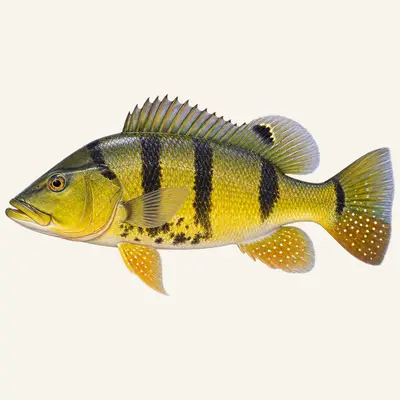
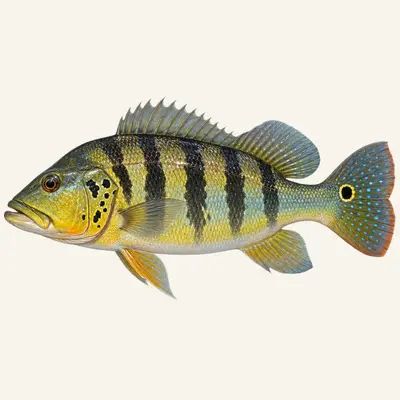
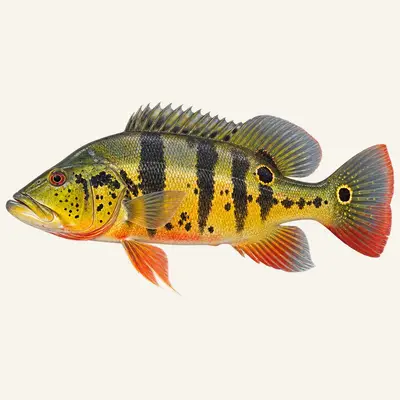
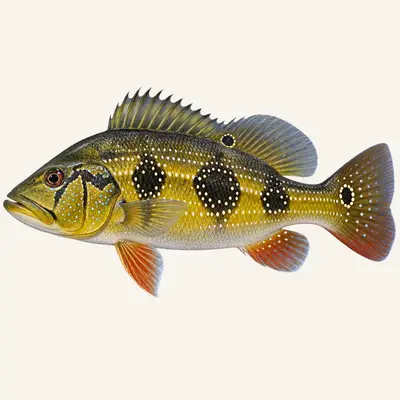
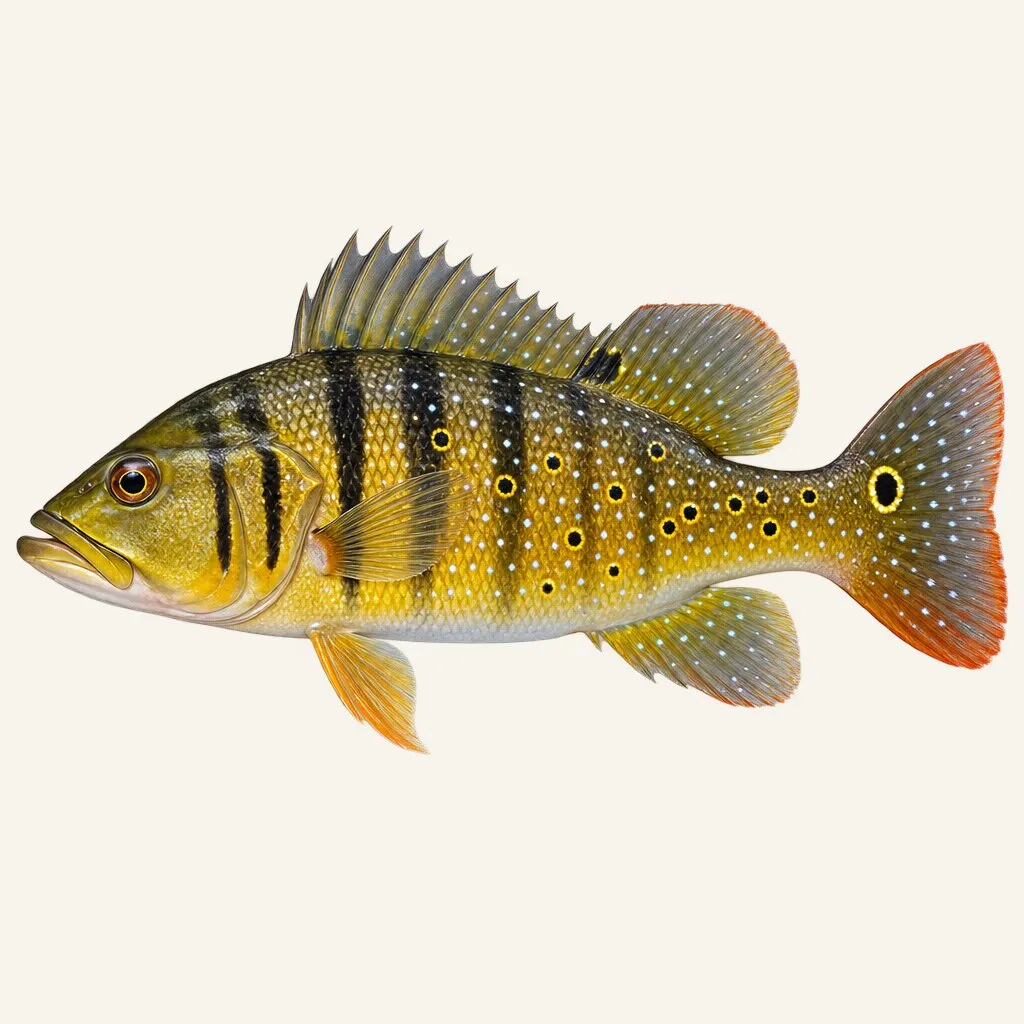
The Xingu peacock bass is a predatory cichlid endemic to the Xingu basin in the Brazilian Amazon. It features a characteristically dark coloration with strongly contrasted vertical bars and well-marked ocellated spots, suited to the clear, rocky waters of this river.
Calendar
Recorded in 1 country
GBIF occurrence records — native and introduced populations combined.
Its range
The lower Rio Xingu, and nothing beyond it.
One river, and only its lower course: among the narrowest ranges in the genus. It is also the reach that has been rebuilt. The lower Xingu has since been dammed, and a change in flow regime acts precisely on rapids over lava rock, which is the habitat the species was described from.
Identifying it
Bars 1 to 3 are narrow, and the flanks are dusted with a great many minute white spots, a good number of them ringed with dark. The intercalary bars are usually present as well, fine and clearly drawn.
The juvenile keeps a complete lengthwise band, unlike several congeners whose band is shortened at that age. The lateral line is not continuous.
The comparison that has to be made is with C. mirianae, and it turns on two absences and a count: no pale spots on the side of the head, no large mid-flank ocelli, and 78 to 85 scales in the counted row against 72 to 80.
The water it needs
The collected specimens came from shallow water at the Balneário do Pedral, where the readings were a pH of 6.5, a hardness below one German degree, and a temperature of 30 to 32 °C, in strong current among lava rock.
Those four values are worth more than a paragraph of description. Water that warm, that acidic and that nearly free of dissolved minerals, moving fast over volcanic rock, is not a broad category of river — it is a short list of reaches. Each figure is a limit rather than a preference, and taken together they explain why the species is where it is and nowhere else.
It is also the opposite of the setting the genus is usually pictured in. Nothing here resembles a still lagoon edge.
Areas
- Rocky Xingu rapids
- Pools downstream of rocks
- Moderate current zones
- Tributary mouths
Techniques
- Cross-current casting
- Jigging in rapids
- Live bait in current zones
- Surface lures
Baits
- Durable minnow lures
- Heavy jigs
- Local live fish
- Sturdy spoons
- Soft plastic lures
How to catch it
Fast water over volcanic rock, shallow and hot. That lie has nothing in common with the lagoon margins the genus is normally fished from, and it is technical water: wading or boat positioning in current over rock decides whether a cast is possible at all.
This is the lightest fish in the genus. Light tackle suits it, and the difficulty comes from the water rather than from the fish.
Conservation
A species confined to one reach of one river, attached to rapids over lava rock, has no redundancy anywhere. Whatever alters the hydraulic regime of the lower Xingu acts on the whole of its known habitat at once, not on a part of it that a population elsewhere could make up for.
The temperature and hardness readings sharpen that further. A fish recorded at 30 to 32 °C in water almost without dissolved minerals has little margin in either direction, and impoundment changes both figures: still water heats differently and holds what the current used to carry away.
It was also named late, which has a second consequence. No long run of survey data predates the name, so there is no baseline for the reach against which present numbers could be read. The habitat was altered at about the same time as the species became countable.
Regulations
Check the local regulations in force (legal size limits, closed seasons, bag limits).
For guidance only. Legal sizes, quotas and open seasons vary by location and season: always check the local regulations in force before fishing.
Other names
Tucunaré in Brazil, peacock bass in English, and no name of its own in either language — a species restricted to one stretch of one river rarely acquires a vernacular that separates it from its neighbours.
The epithet honours Melanie Stiassny, an American ichthyologist who works on cichlid systematics.
Sources: fishbase.se · api.gbif.org