Yellow bass
Morone mississippiensis · Moronidae
- Freshwater
- Predators
- Medium
- Size
24–46 cm
- Weight
0.2–11 kg
- Lifespan
11 years
Where to fish
- River
Habitat icons: Flaticon
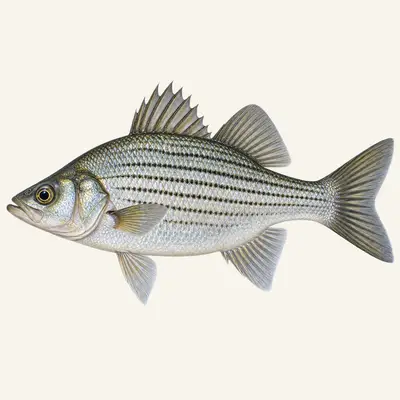
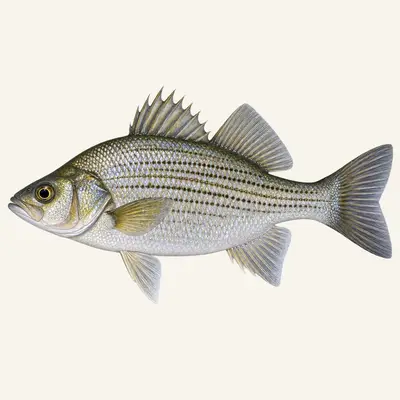
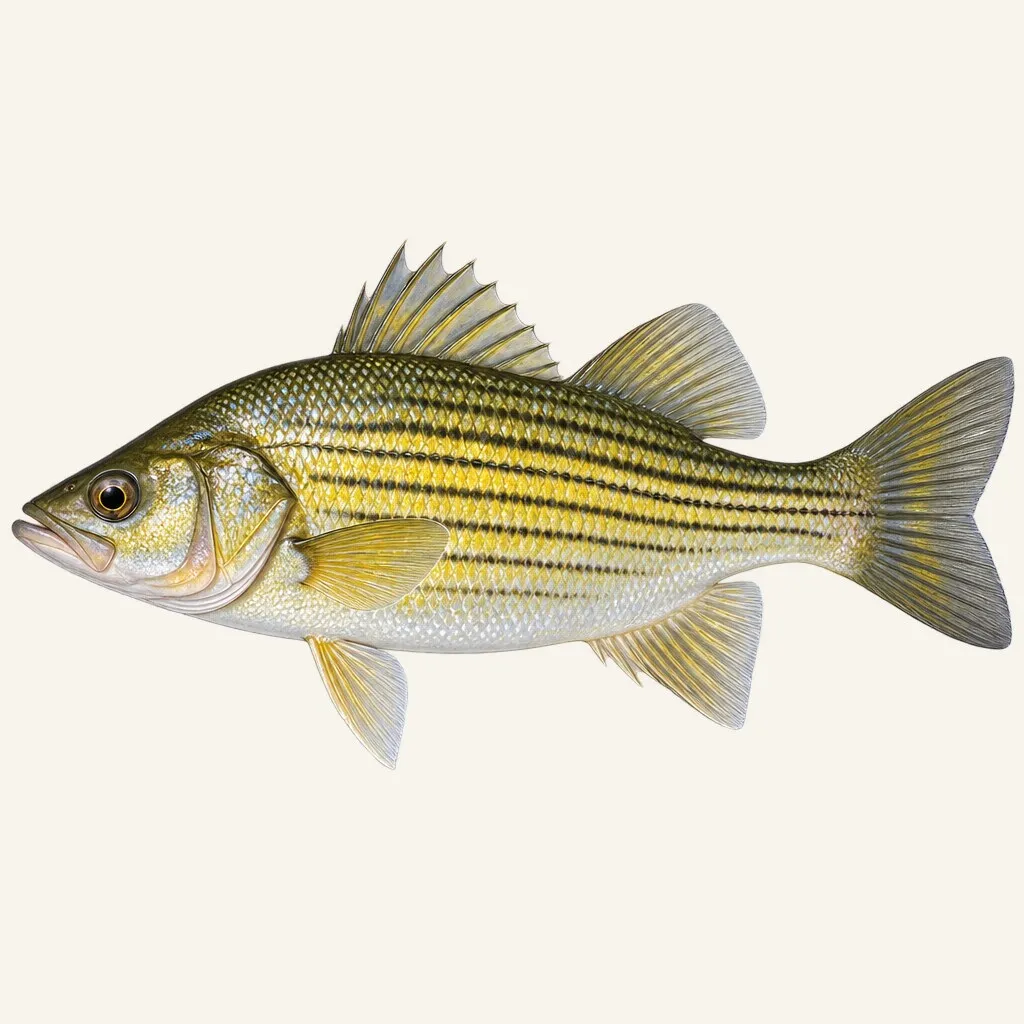
The yellow bass is a freshwater perciform of the Moronidae family, with an elongated golden-yellowish body bearing irregular dark longitudinal stripes; it typically reaches 30 to 45 cm. It inhabits large rivers, lakes, and bayous of the Mississippi basin.
Calendar
Recorded in 1 country
GBIF occurrence records — native and introduced populations combined.
Its range
This is the tightest of the four temperate bass ranges, and it comes in two disconnected pieces.
The core follows the Mississippi basin from Wisconsin and Minnesota down to the Gulf, spilling east into Indiana and Tennessee and west into Iowa and Oklahoma, with Lake Michigan marking the northern extent. That is a single continuous drainage network, which is what a fish that travels only in fresh water can occupy.
The second piece is coastal and separate: the lower Mobile Bay drainage in Alabama, and a string of Gulf rivers from the Pearl in Louisiana across to the Galveston Bay drainage in Texas. None of those rivers connects to the Mississippi. How the species came to be in them is an open question — the remains of an older, wider distribution, or a set of comparatively recent human transfers — and the record does not answer it.
Identifying it
The bottom lines break and step out of true. That is what settles this fish against the white bass, which shares a great deal of the same water: on a yellow bass the lower stripes stop partway along the flank and start again offset from where they left off, instead of running straight through from shoulder to tail.
The ground colour finishes the job. It is frankly brassy — a yellowish gold that no other temperate bass on the continent carries, all of which stay in the silver range. The outline is the usual elongated one, and the fish is small: about 24 cm for a normal adult.
The water it needs
Pools and backwaters of rivers from creeks up to the largest, and ponds and lakes as well. What every one of those has in common is the absence of current: this is a fish of slack or standing water, and that is what separates it most sharply from the percids sharing its range, which hold in the flow.
Backwater in this context means the floodplain features of a big river — the oxbow, the cut-off bend, the side channel with a silted mouth, the sloughs behind a levee. A yellow bass is more likely to be in one of those than in the main stem it belongs to.
Areas
- Moderately flowing rivers
- Mississippi tributaries
- Sandy shallows
- Around submerged structures
Techniques
- Cast-and-retrieve with light lures
- Drift fishing
- Vertical jigging
- Live bait fishing
Baits
- Small soft lures
- Light spoons
- Earthworms
- Small live baitfish
What it eats
The young live on microcrustaceans and midge larvae. Adults turn to fish, principally shad and silversides.
Those are the same open-water shoaling prey the white bass depends on, taken from far quieter water. Two closely related predators, one forage base, two different sets of conditions in which to hunt it — and the yellow bass is the one doing it without the help of current to concentrate anything.
How to catch it
Fish the dead water, not the open lake. The backwaters, the slack pools and the floodplain annexes are where this species holds, while its cousin the white bass works the body of a big reservoir. They are neighbours on a map and they are not found in the same place, and a search pattern that works for one is wasted on the other.
A piscivorous adult feeding on shoaling silver prey points at presentations that imitate exactly that. What limits the choice is the size of the predator: a 24 cm fish is not going to be served by a lure sized for a two-kilogram percid, and scaling down is the main adjustment anyone arriving from another species has to make.
One number is worth carrying. The greatest reported age is 11 years — longer than the nine recorded for the larger white bass. A good yellow bass is an old fish in a small body, which is a different proposition from a young fish still growing, and it is one more reason the numbers in a backwater population rebuild slowly once they have been worked over.
Conservation
Two things about this species leave it less margin than its abundance in a good slough suggests.
The first is the habitat itself. A fish tied to backwaters depends on features that river engineering removes as a matter of course: side channels get cut off, oxbows silt up once they no longer flood, and a levee separates a river from its floodplain permanently. None of that shows in the condition of the main channel, and none of it affects a species that lives in the current.
The second is the disjunct Gulf populations. Whatever their origin, they are the evidence for it, and moving live fish between the Mississippi and those coastal rivers erases the question before anybody has answered it. A stocking that mixes the two makes a distinct population indistinguishable, which is a loss even where no fish is harmed.
Regulations
Check the local regulations in force (legal size limits, closed seasons, bag limits).
For guidance only. Legal sizes, quotas and open seasons vary by location and season: always check the local regulations in force before fishing.
Other names
Yellow bass is the accepted name, and unusually for this genus the other languages that have a name for the fish settled on the same feature — the colour, rather than the stripes, the habitat or somebody's surname.
The confusion it invites is with the yellow perch, which is a Percidae, shares water with it across much of the midwest, and is the fish most people mean when they say something yellow came off the bottom. Barfish is the alternative in parts of the lower Mississippi valley and at least avoids that collision.
The species epithet is as literal as they come, and slightly too modest: mississippiensis names the drainage that holds most of the fish, but not the Gulf rivers that hold the rest.
Sources: fishbase.se · api.gbif.org