Bigeye scad
Selar crumenophthalmus · Carangidae
- Saltwater
- Coastal
- Medium
- Size
70 cm
- Lifespan
3 years
- Depth
0–170 m
Where to fish
- Reef
- Offshore
Habitat icons: Flaticon
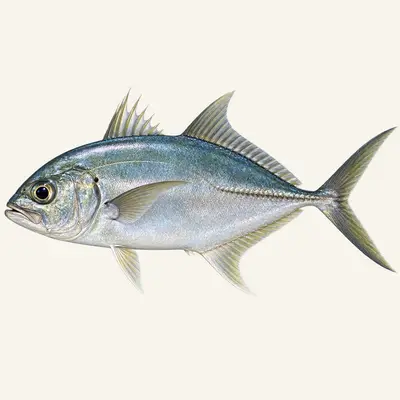
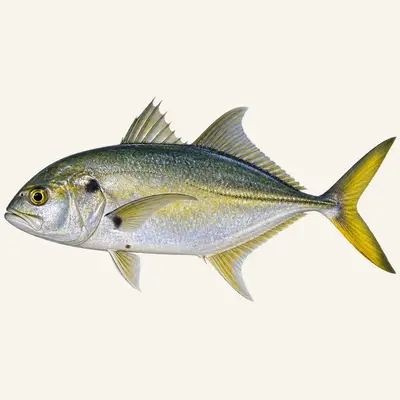
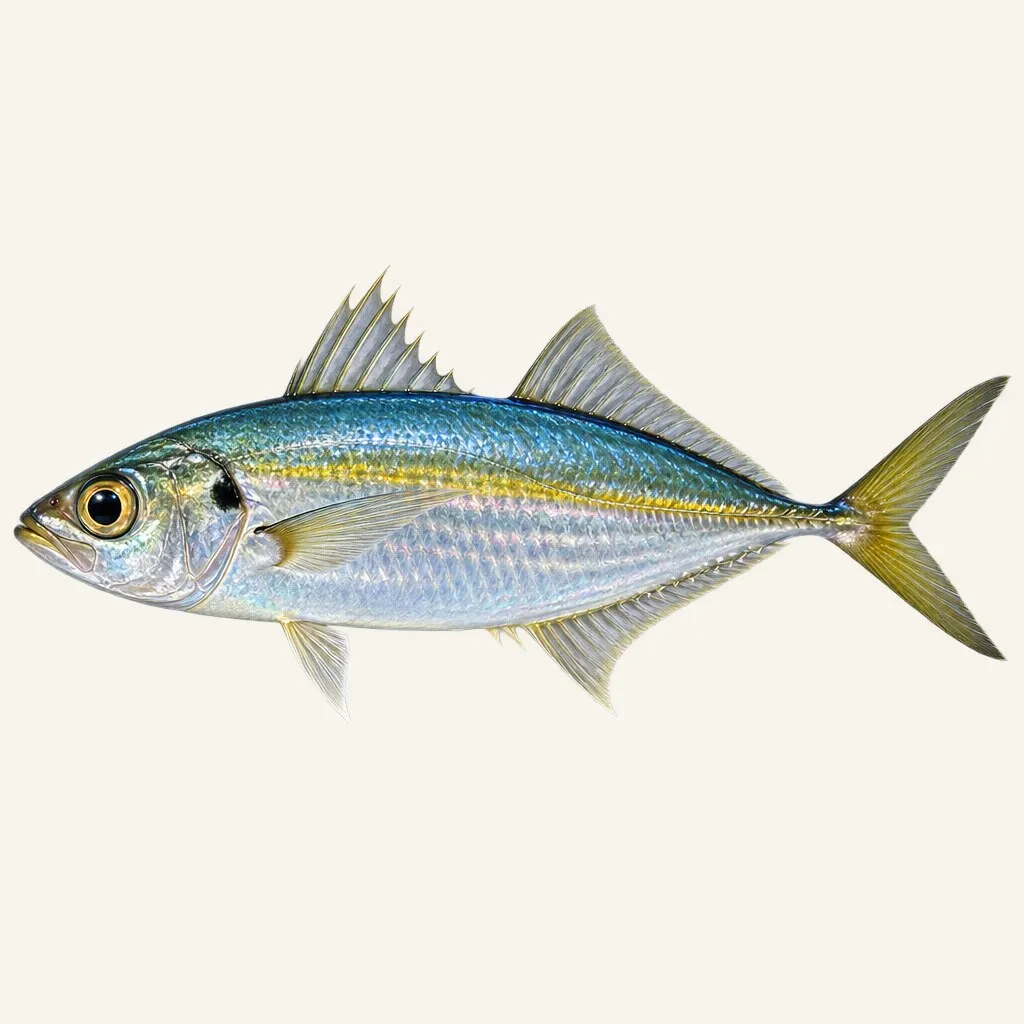
The bigeye scad takes its name from its remarkably large, prominent eyes, a distinctive trait among small Carangidae. Its slender silvery body with a blue-green back makes it a highly sought prey for large predators, and it travels in dense coastal pelagic schools across tropical waters worldwide.
Calendar
Recorded in 25 countries
Australia · Brazil · Cameroon · Caribbean Netherlands · Colombia · Congo - Brazzaville · Côte d’Ivoire · Ecuador · Equatorial Guinea · French Polynesia · Gabon · Ghana · Guinea · Guinea-Bissau · Indonesia · Japan · Liberia · Mexico · Mozambique · Nigeria · Puerto Rico · Senegal · Sierra Leone · United States · Vanuatu
GBIF occurrence records — native and introduced populations combined.
Its range
Circumtropical, with populations in all three ocean basins: East Africa to Rapa in the Indo-Pacific, north to southern Japan and Hawaii, south to New Caledonia; Mexico to Peru with the Galápagos in the eastern Pacific; Nova Scotia and Bermuda through the Gulf of Mexico and the Caribbean to São Paulo in the western Atlantic; Cape Verde to southern Angola in the eastern.
An occupation that wide belongs to an animal that lives in open water and crosses it. The preference for clear oceanic water around islands is the same thing said from the other end: a fish at home in blue water over depth has no obstacle in a mid-ocean gap, and the islands are the parts of the route that get recorded.
Identifying it
The eye is the species, and the scientific name says so outright. Crumenophthalmus is built from the Greek for a purse and the Greek for an eye: a pouch-eye. Bigeye scad in English. Every language that has a name for this fish has named the same organ, and on a landed specimen no further work is required.
The fins are worth a glance because they answer each other. Nine dorsal spines and 24 to 27 soft rays behind them; three anal spines and 21 to 23 rays. Second dorsal and anal are therefore almost the same fin repeated above and below, running the back half of the body, which gives the animal its symmetrical outline.
The body is fusiform and compressed.
Breeding
First maturity is at 17.7 cm, and the oldest fish recorded was three years old.
Three years is the figure that governs the rest of the page. The fish breeds inside its first two seasons, and a stock built that way carries no memory: what is standing on a piece of ground this year is what recruited in the last year or two, and nothing older is holding anything in reserve.
The water it needs
Clear oceanic water around islands is the stated preference — the species takes island water over neritic water, and appears in turbid water only occasionally. It is pelagic. Two to 10 m covers most captures, though the deepest record is 170.
The number that describes this animal is not a measurement of the animal. Individuals travel in compact groups of hundreds of thousands of fish. That is why the species matters twice over: as an object for a purse seine, and as the block of protein that everything larger in the same water is eating.
Areas
- Shallow coastal waters
- Reef edges
- Bays and lagoons
- Coastal pelagic zones
Techniques
- Sabiki rig (multi-hook)
- Light lures
- Mid-water fishing
- Light rod casting
Baits
- Small feather lures
- Pieces of shrimp
- Marine worms
- Tiny jigs
What it eats
The habit is mainly nocturnal, and the school comes apart to feed. What it feeds on depends on where it is. Inshore: small shrimps, benthic invertebrates and foraminiferans. Offshore: zooplankton and fish larvae.
Two menus in one species, and the switch is geographic rather than seasonal. The same fish picks invertebrates off the bottom in one place and takes plankton and larvae out of open water in another, which is a wider operating range than most forage fish have.
The eye and the hours match. The species does its feeding when the light has gone, and the epithet names the organ that makes that possible.
How to catch it
Light is the technique. The fishery works after dark, when the school has broken up and the fish are actually feeding, and it uses lamps to gather them back into a body around the boat. That is a direct application of the animal's physiology: an eye built for low light is an eye a lamp can command.
By day the school is a target of a different kind — compact, enormous, findable — but the fish are not eating, and a bait offered then does far less than the same bait offered at night.
For the angler the standard gear is a sabiki, a string of small hooks dropped through the school, with light lures and a light rod worked in open water as the alternatives. Nothing about the fish calls for size in the tackle.
Its main value is not on a plate. This is the live bait of the region: highly commercial in its own right, sold fresh and salted or dried, and used above all to put a swimming fish in front of something large. Ciguatera has been recorded for it, which is unexpected in an animal this small and this low in the chain, and worth knowing where it is eaten rather than threaded on a hook.
Conservation
A three-year life and a highly commercial fishery is a combination with no slack anywhere in it. There is no old fraction of the stock to fall back on, so a weak recruitment shows in the landings almost at once, and a strong one just as quickly. The fishery is volatile by construction rather than by mismanagement.
The gear compounds that. A purse seine set on a compact group takes the group rather than a sample of it, and a school of hundreds of thousands is a single object as far as a net is concerned. What refills the ground afterwards is next season's recruitment, and that is the entirety of the reserve.
Regulations
Check the local regulations in force (legal size limits, closed seasons, bag limits).
For guidance only. Legal sizes, quotas and open seasons vary by location and season: always check the local regulations in force before fishing.
Other names
Bigeye scad is the standard English name. Goggle-eye is what bait fishermen call it along the Atlantic coast of the United States, and akule is the Hawaiian name, still in daily use there.
"Scad" is the difficulty. In English it covers this fish, the mackerel scad, the yellowtail scad and the horse mackerels — four genera doing four different things — so the word on a market label or in a bait shop narrows the field to a small silver carangid and no further. The eye is the character that does the work, and the purse-eye of the epithet is the most useful name the species has.
Sources: fishbase.se · api.gbif.org