Bigeye trevally
Caranx sexfasciatus · Carangidae
- Saltwater
- Coastal
- Medium
- Size
60–120 cm
- Weight
3.2–18 kg
- Lifespan
11 years
- Water temp.
26–29 °C
- Depth
0–146 m
Where to fish
- Reef
- Beach
- Rocky shore
Habitat icons: Flaticon
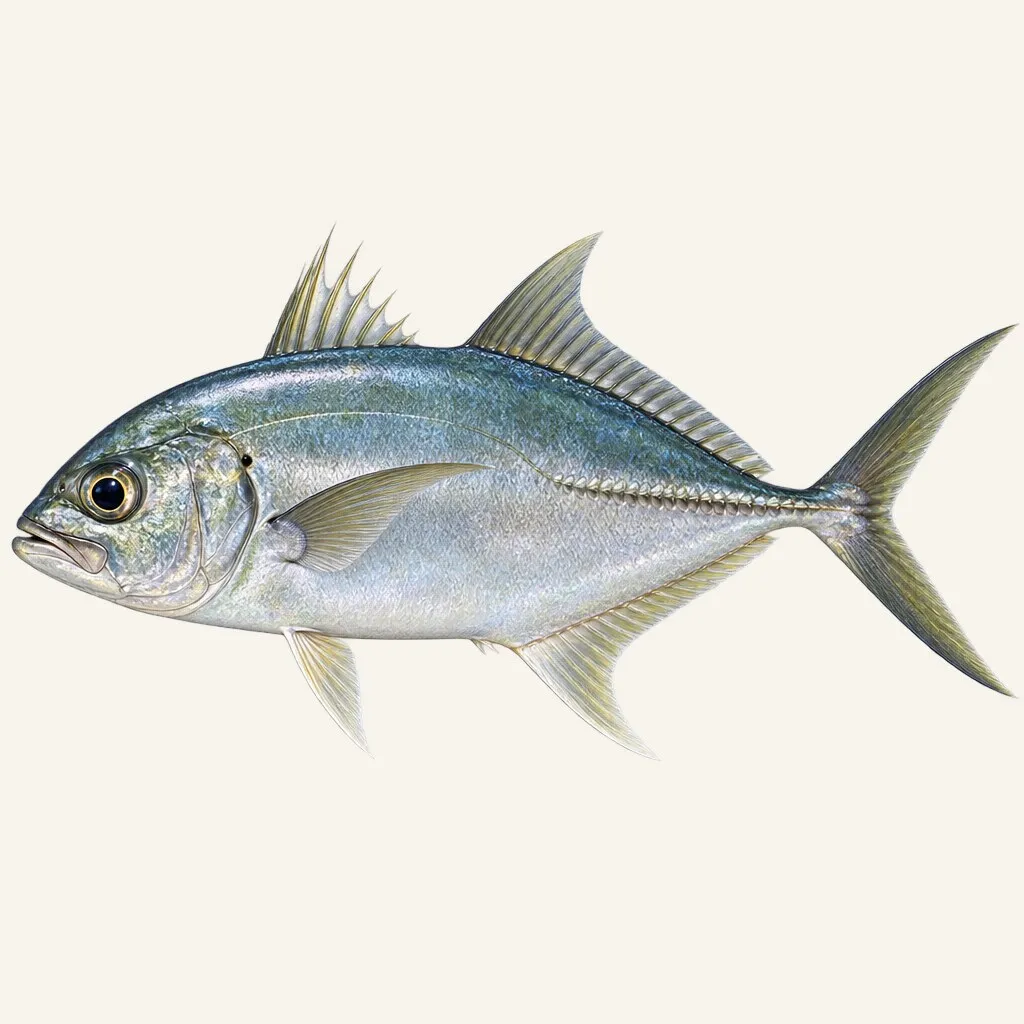
The Bigeye Trevally is easily identified by its noticeably large eyes and streamlined silvery body. A cosmopolitan species of tropical and subtropical waters, it commonly forms large schools around coral reefs and inshore areas.
Calendar
Recorded in 40 countries
American Samoa · Australia · British Indian Ocean Territory · China · Colombia · Costa Rica · Ecuador · Egypt · Fiji · French Polynesia · Guam · India · Indonesia · Japan · Kenya · Madagascar · Malaysia · Maldives · Marshall Islands · Mayotte · Mexico · Micronesia · Mozambique · New Caledonia · Norfolk Island · Northern Mariana Islands · Palau · Panama · Papua New Guinea · Philippines · Saudi Arabia · Seychelles · Solomon Islands · South Africa · South Korea · Sri Lanka · Taiwan · Thailand · United States · Vanuatu
GBIF occurrence records — native and introduced populations combined.
Identifying it
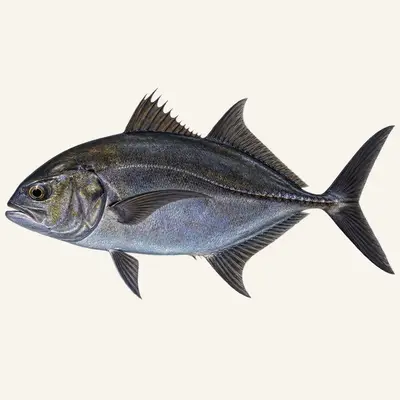
The eye carries a well-developed adipose eyelid — the transparent film that partly covers the eye in many carangids. Here it is moderate at the front and encroaches at the rear as far as the back border of the pupil. No other jack in the same waters has the structure this complete, and it is what the common name refers to.
The second mark is a white tip on the lobe of the second dorsal fin. It is faint in small fish and grows more obvious with size, until on a good specimen it can be seen at a distance through the water.
A small blackish spot sits at the upper angle of the opercle. Its diameter is distinctly less than that of the pupil, and the qualifier is the point: several jacks carry an opercular spot, so it is the relative size that separates them. The mark becomes visible at around 14 cm fork length.
The scutes are dark, 27 to 36 of them, preceded by none to three ordinary scales. That blackish file along the tail shows plainly on a wet fish. The breast is fully scaled.
One internal character is worth knowing for anyone comparing descriptions: 25 vertebrae, in ten plus 15, where several relatives have 24. Otherwise nine dorsal spines, 19 to 22 soft rays, three anal spines, 14 to 17 rays, and 21 to 25 gill rakers.
Live colour is silvery olive to iridescent blue-green above, olive to whitish below, with a moderately convex dorsal profile — less bull-headed than the giant of the genus.
Breeding
Amphidromy shapes the early life of this species: the young move between the sea and fresh water, and the adults live on the reef.
The practical consequence is a nursery that is not one habitat but several. Juveniles are met in estuaries, and they occasionally enter rivers and penetrate a long way inland, which gives the species a range of rearing grounds that a strictly reef-bound fish does not have. Fresh water tolerance of that kind in an animal whose adults hold reef passes is unusual enough to be worth remembering when fishing the lower reaches of a tropical river.
Maturity is reported at 42 cm, and the maximum recorded age is 11 years.
The water it needs
Day and night are spent in opposite formations, and that inversion is the most distinctive thing about the fish. In daylight it gathers in large stationary aggregations that mill in the passes or just outside the reef, sometimes drifting as slow schools. After dark the group breaks up and the fish hunt alone.
Adults live in coastal and oceanic water in association with reef, holding in mid-water between 1 and 96 m. The full recorded range for the species reaches 146 m.
Areas
- Shallow coral reefs
- Lagoon passes
- Sandy flats
- Exposed rocky shores
Techniques
- Surface popper fishing
- Light jigging
- Cast-and-retrieve hard lure
- Live bait fishing
Baits
- Surface poppers
- Small live fish
- Metal jigs
- Soft plastic streamers
What it eats
Adults take fishes, squid and crustaceans.
The cephalopod share is what distinguishes this diet from that of the bottom-oriented jacks. Squid are caught in open water and frequently at night, which coincides exactly with the hours when this species disperses to feed.
How to catch it
The school on view is not a feeding school. That follows directly from the daily rhythm: those dense, stationary clouds of fish encountered in a pass in full sun are resting, and a lure driven through them is very often ignored. Feeding begins when the formation comes apart at dusk.
The constraint has a compensation. A daytime aggregation is fixed and visible, so it can be found in advance — mapping which passes hold fish in daylight means returning to a known spot at the right hour instead of searching in the dark.
Most are taken on hook and line. Common length is 60 cm; at equal length this is a much slimmer fish than bluefin or giant trevally, and the fight reflects that.
Conservation
The rhythm that makes the species findable is also what exposes it. A fish that assembles every day in the same place, motionless, in shallow water and in the open, is available on demand; nothing else in its behaviour offsets that. Gill nets and purse seines are used alongside line gear, and they take the assembly rather than an individual.
A site stripped of its aggregation does not necessarily fill again. These gatherings are faithful to particular passes, and there is no guarantee that another group will occupy a place left empty.
Regulations
Check the local regulations in force (legal size limits, closed seasons, bag limits).
For guidance only. Legal sizes, quotas and open seasons vary by location and season: always check the local regulations in force before fishing.
Other names
Bigeye trevally in English, and most languages have settled on the same character: jurel ojón in Spanish, Großaugen-Stachelmakrele in German. The Australian and New Zealand habit of calling every carangid a trevally, against the American habit of calling them all jacks, means this one fish answers to both words depending on which side of the Pacific the boat is on.
The epithet sexfasciatus means six-banded. Nothing of the kind survives on the adult, whose flanks are plain: the scientific name describes a state the fish grows out of, and it regularly misleads anyone using it to name a catch.
Sources: fishbase.se · api.gbif.org