Pike-perch
Sander lucioperca · Percidae
- Freshwater
- Predators
- Hard
- Size
50–100 cm
- Weight
1.2–15 kg
- Lifespan
17 years
- Water temp.
6–22 °C
- Depth
2–30 m
Where to fish
- River
- Lake
- Canal
Habitat icons: Flaticon
A light-shy predator (hunts at night) with distinctive eyes adapted to low light
Calendar
Spawning: fish are vulnerable. Check local rules — closed seasons vary by country.
Recorded in 21 countries
Austria · Belgium · Czechia · Denmark · Finland · France · Germany · Hungary · Italy · Luxembourg · Netherlands · Norway · Poland · Portugal · Russia · Slovakia · Spain · Sweden · Switzerland · Ukraine · United Kingdom
GBIF occurrence records — native and introduced populations combined.
Its range
The original range is a set of inland seas: the Caspian, Baltic, Black and Aral basins, plus the Elbe on the North Sea side and the Maritza flowing to the Aegean. Northwards it reaches roughly 65 degrees in Finland, which is far for a fish that wants 6 to 22 degrees.
Everything beyond that outline was stocked. Britain is the clearest case for an English-speaking reader: there is no native population anywhere in the British Isles, and every fish in the Fens, the Severn or the midland canals descends from introductions. That history is still argued about. Anglers who fish for them treat the species as an asset; fishery managers count it among the non-native predators whose spread they would rather stop, and several countries report adverse ecological effects following its arrival. The same fish is a prize on one bank of the argument and a problem on the other.
Homing complicates any reading of the map. This species returns to spawn where it was hatched, strongly enough that populations only a short distance apart stay relatively isolated from one another. Individual movements of up to 250 km have been recorded, and fish that feed in brackish water come back into fresh water to breed, so long journeys and genetic separation coexist without contradiction.
Identifying it
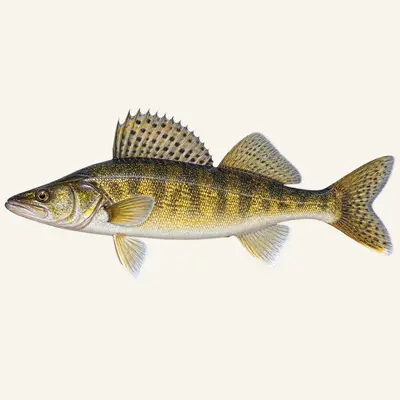
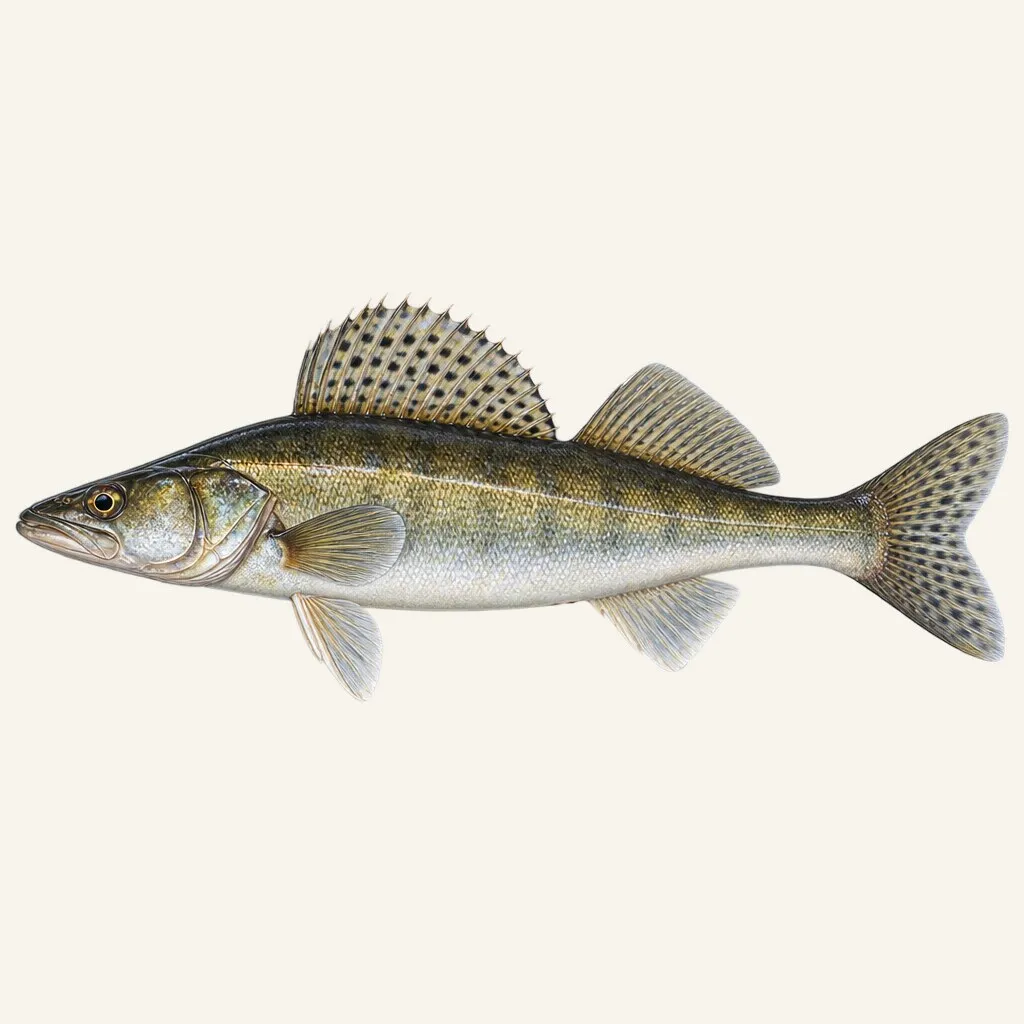
One or two enlarged canines stand at the front of each jaw, set well clear of the smaller teeth around them. No other European percid carries them, and they tell you how the fish feeds: it impales what it takes rather than closing on it.
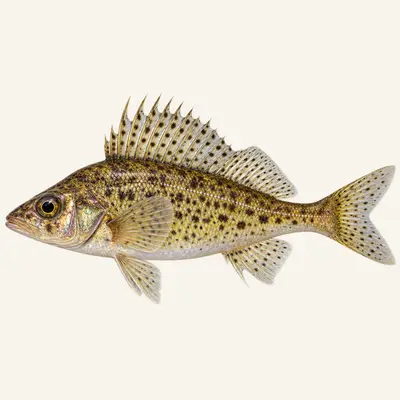
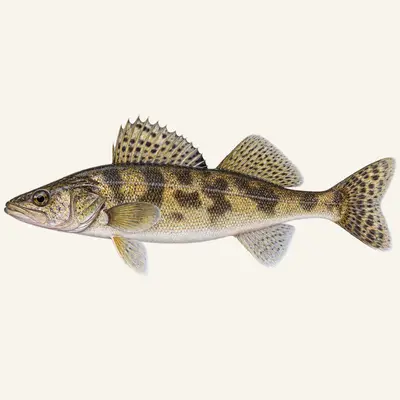
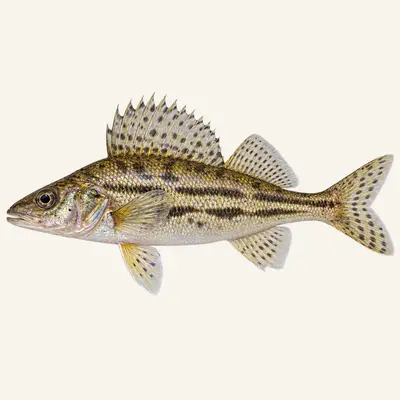
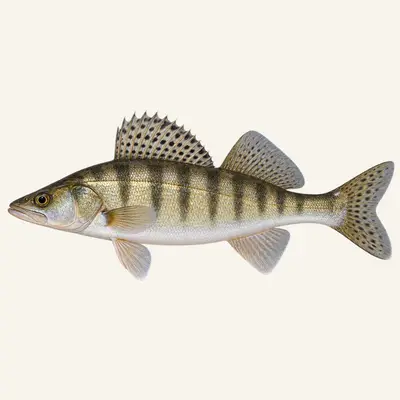
The build is fusiform and noticeably leaner than a perch of the same length, silver-grey with dark vertical bars that fade as the fish ages. Two dorsal fins stand clearly apart, the first spiny with 13 to 20 spines, the second carrying 18 to 22 branched rays. Along the lateral line sit 80 to 97 scales, and the backbone runs to 45 to 47 vertebrae. Those counts are what identification falls back on once the barring has washed out of an old fish.
The eye is the part worth studying. A reflective layer behind the retina throws light back through it, which is why the eye glows milky under a lamp and why the fish can still resolve prey in water where a hand disappears at arm's length. Everything else this species does follows from that one piece of equipment.
Breeding
The male excavates a nest, a habit shared by very few European freshwater fish. He clears a shallow depression roughly 50 cm across and 5 to 10 cm deep in sand or gravel, or scrubs a patch of exposed plant roots down to bare material. The site is over gravel in moving water, in 1 to 3 m, and characteristically in water with some colour in it.
Spawning happens in pairs, at first light or after dark. The female holds station above the nest while the male circles fast about a metre out; he then turns nose-up, the two of them wheel together at speed, and eggs and milt go down in one release. She leaves the moment she is spent. A female spawns once a year and puts everything into that single event, which is the opposite of the repeat-batch strategy most cyprinids use.
He stays. The male defends the nest and drives water over the eggs with his pectorals until they hatch. The larvae then move towards light, leave the nest for open water, and start on pelagic organisms straight away.
The season runs April to May, stretching in exceptional years from late February into July according to latitude and altitude, and it opens when the spawning ground reaches 10 to 14 degrees. First maturity falls anywhere between three and ten years, most often at four.
The water it needs
Turbidity is the requirement, not an accident of where the fish happens to live. Large sediment-laden rivers, eutrophic lakes, brackish coastal lagoons and estuaries all suit it, because poor visibility is exactly the condition in which its eye outperforms the eyes of what it eats. Put the same fish in gin-clear water and it shifts its working hours to the night.
It sits lower in the column than most freshwater predators, between 2 and 30 m and usually around 2 or 3. Drop-offs, deep holes, harbour mouths, bridge piers and clean gravel bottoms concentrate the fish, and open featureless water rarely does.
Brackish water is within tolerance, which is why estuaries and the coastal fringe of the Baltic hold good numbers. The freshwater requirement applies only to breeding.
Areas
- Mixed bottoms
- drop-offs
- deep zones
- riprap
Techniques
- Lure
- Live bait
- Deadbait jigging
Baits
- Soft lures
- Shad
- Jigs
- Crankbaits
- Live baits
What it eats
The diet is built around shoaling fish taken in open water, and that single line separates this species from the pike it is so often fished alongside. A pike waits on a lie for a single fish to pass; a zander follows a shoal and works inside it.
Feeding in the column rather than from ambush explains the streamlined section, the depth it holds at and the hours it keeps. A shoal breaks up less effectively in the dark, and a predator that can still see when its prey cannot has no need of a violent turn of speed. It closes the distance instead of covering it.
How to catch it
Light governs the whole business. The fish hunt as the light drops or as the water colours up, and they become genuinely hard to catch under a high sun in clear water, not because they have stopped eating but because they are waiting for conditions. Dusk, dawn, the night itself and the windy days that stir silt back into suspension are the productive windows, in that order of reliability.
The take is the softest of any freshwater predator. The fish inhales the prey and holds it crosswise before turning it to swallow, so what reaches the rod is often nothing more than dead weight where there was none a second earlier. Striking on that sensation, without waiting for a pull, is the difference between a fish on the bank and a bite nobody understood.
It holds low and moves very little vertically. A lure passing 2 m over its head is ignored where the same lure ticking the bottom draws a response, so keeping contact with the bed is the baseline condition rather than a refinement.
Homing has a practical consequence too. A productive swim tends to stay productive year after year, because the fish coming back to it are frequently the same fish.
Conservation
Whatever presses on this fish, it is not scarcity. The weak point is the nest, and it is weak for a few weeks a year. Breeding needs clean gravel, moderate flow and a narrow depth band, and the male over it is the only thing moving water across the eggs. Lift him off in spring and the clutch silts up. That mechanism, far more than the weight of fish removed, is the argument that close seasons actually rest on.
Habitat change works on the same point. The gravel bars and root tangles used as spawning substrate are the first things to go when a river is dredged or bank-protected, and a population can hold its numbers of adults for years while quietly failing to replace them.
The commercial side adds steady removal. The flesh sells well, the species is farmed as well as netted, and waters within reach of cities carry constant pressure from both the rod and the net. Abundance across the native basins absorbs it; the same adaptability is why the species is filed as a potential pest almost everywhere it has been introduced.
Anything going back needs care in the hands. The canines and the serrated gill covers both cut, and a fish brought up from several metres has no balance for the first minute and needs holding upright until it does.
Regulations
Minimum size 40-50cm depending on the area / Local closure possible
For guidance only. Legal sizes, quotas and open seasons vary by location and season: always check the local regulations in force before fishing.
Other names
English has two names for this fish and uses both. Zander is borrowed straight from German and is what most British anglers say; pikeperch is a loan translation of the same idea found across northern Europe, matching Dutch snoekbaars. Both names describe a pike crossed with a perch, which is misleading twice over. The fish is neither a hybrid nor intermediate: it is a percid, and its closest relative in angling terms is the walleye of North America, another member of the same genus.
That genus name is itself a recent trap in the literature. Older books place the species in Stizostedion, and papers from before the change still use it, so a search under one name misses half the material.
The species epithet is a compound of the Latin for pike and perch, which means the scientific name repeats the same false comparison the common names make.
Sources: fishbase.se · api.gbif.org