Sauger
Sander canadensis · Percidae
- Freshwater
- Predators
- Medium
- Size
36–76 cm
- Weight
0.5–4.0 kg
- Lifespan
18 years
Where to fish
- Estuary
- Lake
- River
Habitat icons: Flaticon
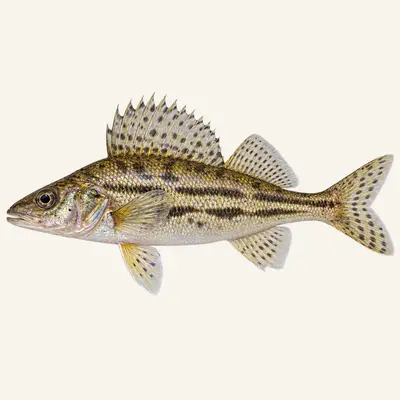
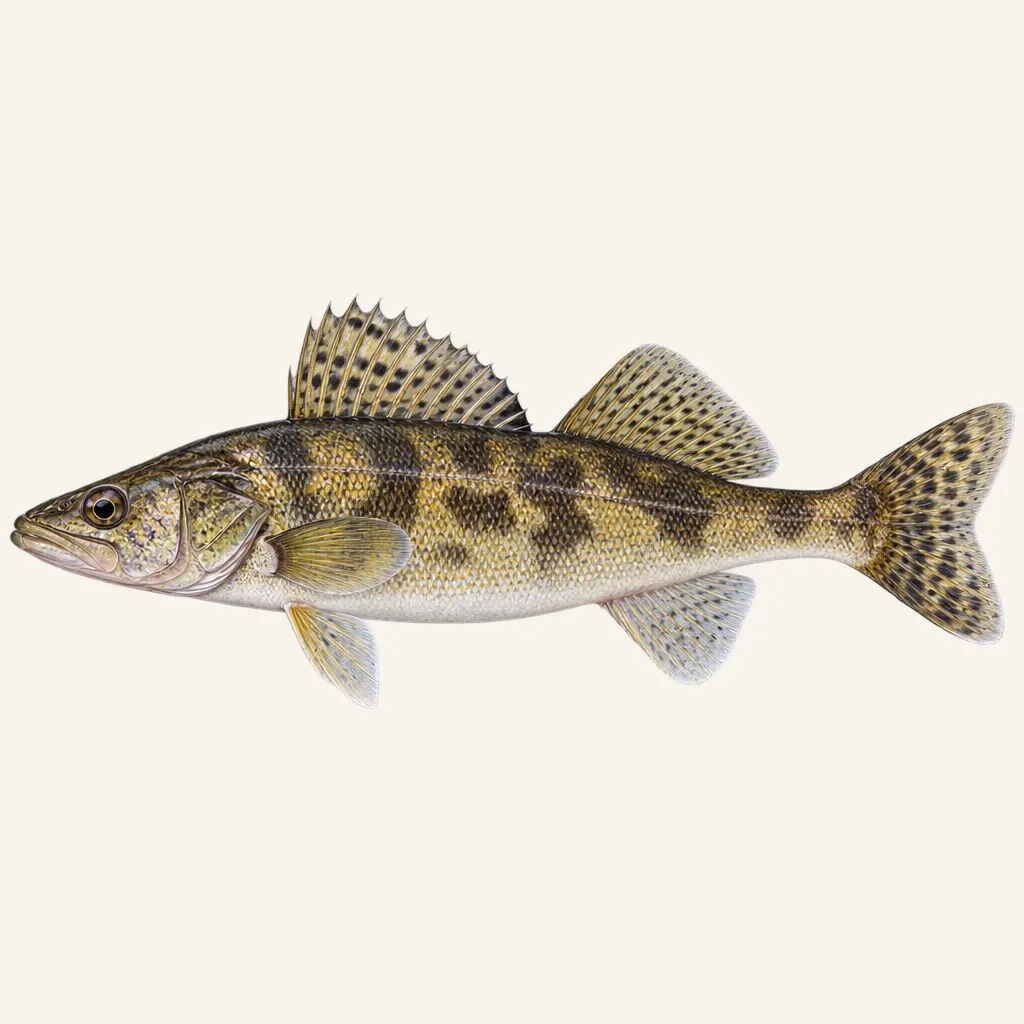
The sauger is a North American percid closely related to the walleye but smaller, recognizable by its irregular dark blotches on the flanks and its first dorsal fin marked with distinct black spots. It favors turbid waters and sandy bottoms in rivers and shallow lakes.
Calendar
Recorded in 2 countries
GBIF occurrence records — native and introduced populations combined.
Its range
The species occupies the St Lawrence and the Great Lakes, the Hudson Bay basin and the Mississippi, from Quebec to Alberta and south to northern Alabama and Louisiana. That is the range of a fish of large continental river systems, not of a fish of lakes.
Transfers have installed it in Atlantic drainages, in those of the Gulf of Mexico and in the southern Mississippi. As with many North American percids, the present map therefore adds a natural distribution to a managed one, with nothing to tell them apart by eye.
Identifying it
Blotches rather than bars. This fish carries irregular dark marks scattered over the flanks that its larger relative does not, and its first dorsal fin is sown with well-separated black spots instead of a plain grey membrane. Both marks read on a wet fish held at arm's length, which is exactly the situation in which the question comes up.
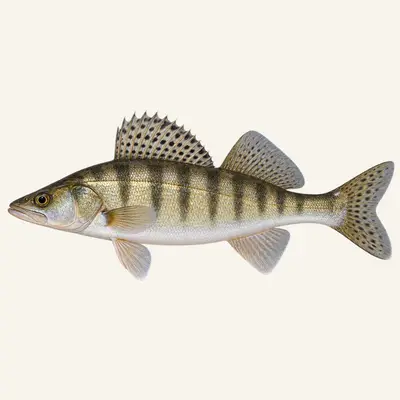
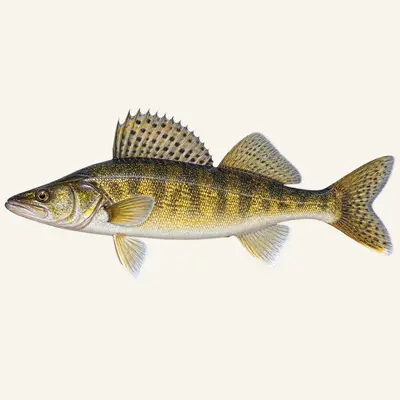
The tail supplies the third check, by absence: the walleye's lower caudal lobe finishes in a white tip, and there is none here.
Size separates the two species as well, but less reliably than people think. The published records for this one fall short of the walleye's, while the fish ordinarily met measures about 36 cm. An individual of average build therefore settles nothing at all. The markings are what has to be looked at.
Breeding
Spawning spreads from March to June according to latitude, in pairs or in small aggregations. That is looser organisation than the walleye manages, with its structured groups putting everything down over a single night.
Maturity arrives at about 32 cm, some ten centimetres earlier than in its congener. The gap is not trivial in water where the two live together: at equal length, a sauger is more likely to have spawned than a walleye. Earlier entry into the breeding population is what offsets a smaller final size.
The water it needs
This is a fish of current and of the bed. It occupies sand and gravel runs, sandy or muddy pools and the backwaters of watercourses from creeks to great rivers, and the shallowest depth on record for it is 5 m: it is not a margin fish.
It uses lakes and impoundments less willingly. That is the substantive difference from the walleye, which prospers in large standing water — where one makes do with a lake, the other needs a river that is still flowing.
Areas
- River currents
- Holes below rapids
- Sandy shoals
- River mouths
Techniques
- Light jig near bottom
- Spinner rig
- Soft plastic drift
- Slow dead-bait
Baits
- Nightcrawler
- Live minnow
- Soft jigs
- Grub
What it eats
The switch to fish is early and abrupt. Larvae feed on cladocerans, copepods and midge larvae; from the juvenile stage on, the diet is piscivorous. There is no long intermediate phase on bottom invertebrates as there is in other percids.
That precocity has a cost. A young fish that has to find prey scaled to itself in its first season depends closely on the abundance of other species' fry, and a year without forage is paid for immediately, on that year class.
How to catch it
Everything happens on the bed and in the flow. A demersal fish holding in sand and gravel runs does not come up for a presentation at mid-depth, so contact with the substrate is the condition of entry, and a controlled drift down a run beats broad prospecting of a body of water.
Reading the river counts for more than the choice of rig. The breaks between sand and gravel, the heads and tails of pools, backwaters still connected to the main flow: there are few such situations on a given stretch, and they are found with a sounder or a lead long before a lure goes in the water.
Longevity is worth keeping in mind when deciding the fate of a catch. The maximum age reported reaches 18 years, in a fish whose ordinary length gives no hint of how old it is.
Conservation
The vulnerability of this species is written into its habitat rather than into its numbers. It needs flowing runs over sand and gravel, and it becomes scarce in lakes and impoundments.
That is precisely the transformation many large North American rivers have undergone: a succession of dams replaces a river with a chain of slow pools. The adults put up with it for a while, but the habitat that defines the species disappears reach by reach, and the population retreats towards the sections left free.
Transfers into other basins do not make up for that loss. They move fish about; they do not recreate gravel runs.
Regulations
Check the local regulations in force (legal size limits, closed seasons, bag limits).
For guidance only. Legal sizes, quotas and open seasons vary by location and season: always check the local regulations in force before fishing.
Other names
Sauger in English, a word of obscure origin with no built equivalent in other languages — German and Portuguese have taken it over unchanged rather than translate it.
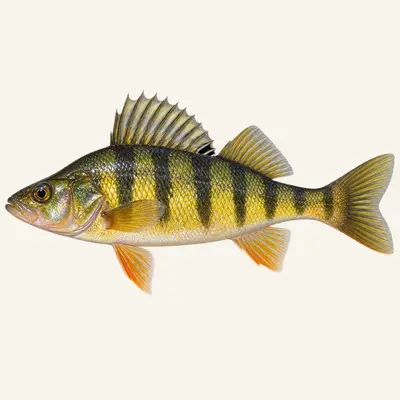
The names that cause trouble are the pike names. In river country the fish picks up sand pike and river pike, which attach an esocid label to a percid exactly as pikeperch does in Europe, and neither name is worth anything in a record.
Saugeye is the English name of the cross with the walleye, and it appears in stocking literature and in catch reports across the American Midwest. A document using it is not referring to this species on its own, and a fish reported under it cannot be assigned to either parent.
Sources: fishbase.se · api.gbif.org