Ruffe
Gymnocephalus cernua · Percidae
- Freshwater
- Predators
- Easy
- Size
12–29 cm
- Weight
0.0–0.4 kg
- Lifespan
10 years
- Water temp.
10–20 °C
- Depth
2–85 m
Where to fish
- Estuary
- Lake
- Pond
- River
Habitat icons: Flaticon
Small spiny perch - Prominent eyes - Often unwanted
Calendar
Recorded in 21 countries
Austria · Belarus · Belgium · Canada · Czechia · Denmark · Estonia · Finland · France · Germany · Italy · Luxembourg · Netherlands · Norway · Poland · Russia · Sweden · Switzerland · Ukraine · United Kingdom · United States
GBIF occurrence records — native and introduced populations combined.
Its range
Caspian, Black, Baltic and North Sea basins, Great Britain, and north to about 69 degrees in Scandinavia; in Asia the Aral basin and the Arctic drainages eastward as far as the Kolyma.
The shape of that range is the shape of a tolerance rather than of a preference. Nothing in the list is a specialised habitat, and the eastern and northern limits belong to a fish whose adults cope with cold, turbid, enriched and mildly saline water in almost any combination. What stops it is the larval band, not the adult one.
Where it has been introduced, more than one country has recorded damage to the fish fauna already in place.
Identifying it
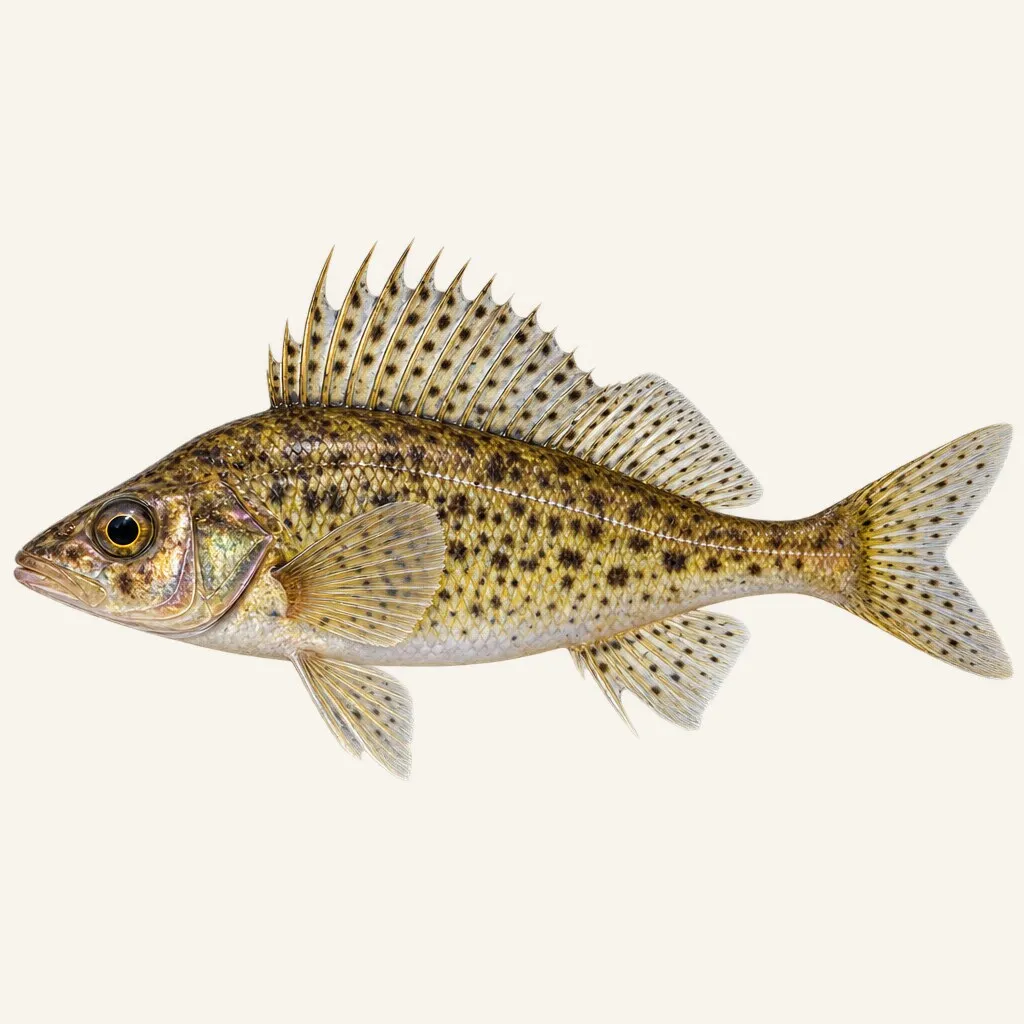
Body depth between 24 and 27 per cent of standard length. That single proportion is what the literature uses to hold this fish apart from the rest of its genus, and it is the only character it treats as unique to the species.
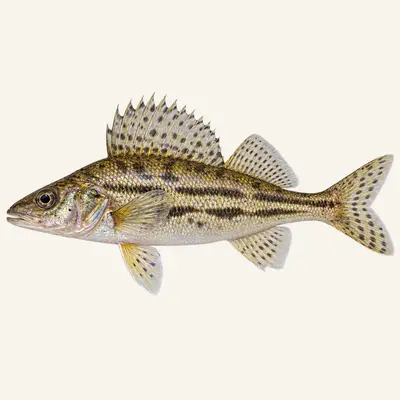
At the waterside the working combination is different: a yellowish flank sown with numerous small irregular dark blotches, and 11 to 16 spines in the dorsal. The two together finish the job.
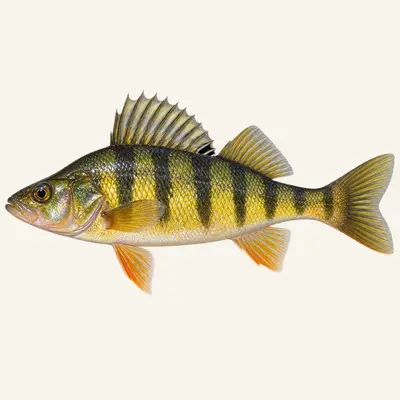
The confusion that actually happens is with the perch, and two features settle it. The dorsal fins here are fused into one continuous structure where the perch carries two clearly separate ones, and the bold vertical bars of the perch are replaced by mottling with no pattern to it.
The full ranges are wider than the diagnostic figure: 11 to 19 dorsal spines, 11 to 16 soft rays, two anal spines and five or six rays, 35 or 36 vertebrae, 16 or 17 rays in the tail. The head is bare of scales, which is what the genus name records.
Breeding
The clutch comes out in instalments. A female lays in two portions or more, the episodes separated by about 30 days in summer, and the first portion is larger than the second. That is a rare detail in the documentation of any fish, and it says the investment tapers across the season: an accident in early summer costs a population more than the same accident a month later.
The eggs turn adhesive on contact with water and fasten to stones or plants. They are white to yellow, laid in sticky strands on rock and weed in shallow water, and spawning takes place on a variety of substrates at about 3 m or less. No substrate specialisation, therefore, and none of the bottlenecks that go with one.
The larvae have no pelagic stage, or only a very brief one. They switch early to life on the bottom, secretive and solitary, and form no shoals — unusual in a percid, and the reason young fish are rarely seen at all.
Larval survival is poor below 10 degrees and above 20. That narrow band is what genuinely bounds the species, far more than anything the adults will or will not tolerate. Maturity comes at around 10.5 cm. Females reach 10 years, males 7.
The water it needs
Eutrophic lakes, lowland and piedmont rivers. It is most abundant in the estuaries of large rivers, in brackish lakes up to 10 or 12 parts per thousand, and in reservoirs.
The central point sits there: abundance increases as eutrophication increases. This is a fish that the degradation of a water body favours, not one that suffers it, and it will put up with a good deal of other damage besides.
Within those waters it wants calm or slow flow, a soft bottom without vegetation, and deep water over deposits of sand and gravel. The recorded band runs from 2 to 85 m.
Deep lakes hold it alongside the perch, and the two split the water column: both occur through the depth range, with this species the more abundant in the lower layers. Two percids in one lake, stacked rather than mixed.
Areas
- Muddy river bottoms
- Deep lake areas
- Cluttered margins
- Stream mouths
Techniques
- Worms
- Small live baits
Baits
- Earthworms
- Bloodworms
- Small red worms
- Maggots
What it eats
Zooplankton, chironomids, oligochaetes and amphipods. In coastal lakes and tidal estuaries it leaves the bottom altogether and works the open water for zooplankton and small fish.
The mechanism behind that menu is what makes the species formidable. The external walls of its head canals are membranous, which gives the lateral line a high directional sensitivity, and the fish can feed at night in complete darkness. It does not need light to locate prey.
Put that beside the preference for enriched, turbid, deep water and the pieces fit: a fish that hunts by pressure rather than by sight is at work in exactly the conditions that blind a sight feeder, at the depths and hours where the competition has stopped.
How to catch it
This is mostly a fish taken without being looked for. Common length is 12 cm, and where it is numerous it will mouth any bait resting on the bottom.
Where it is sought deliberately, it is on the bottom in calm deep water, over soft ground or over sand and gravel — and by preference in a rich lake, since enrichment is what favours it. Night is the non-obvious window: an animal that needs no light is available after dark, deeper down than the perch in the same basin.
The dorsal spines are sharp and the gill covers cut. For a fish of that size the grip deserves some care, and it is taken with the spiny fin folded flat rather than gripped across.
It has one long-standing use beyond its own capture: it is a standard bait for pike across its range, which is also one of the ways it has travelled.
Conservation
Nothing threatens this species, and its expansion is the subject instead. The mechanism is precise enough to be worth stating.
A fish whose abundance rises with eutrophication profits from exactly what makes others retreat. Introduced into an enriched lake, it takes the deep bottom, feeds in the dark on the lateral line, and works a layer that the resident percids use less — and it does so in water where their own feeding is getting harder. The advantage is not aggression, it is the absence of any need for light or clarity.
The larval band from 10 to 20 degrees remains its only serious brake, and it explains where the expansion stops: too cold a spring or too warm a summer and the year class fails, however many adults are present.
The practical corollary belongs to anglers rather than to managers. This fish moves between waters as live bait, and the surplus tipped out at the end of a session is a founding population. Nothing about the species is fragile enough to make that harmless.
Regulations
Check the local regulations in force (legal size limits, closed seasons, bag limits).
For guidance only. Legal sizes, quotas and open seasons vary by location and season: always check the local regulations in force before fishing.
Other names
Ruffe is the English name, and it belongs to this species alone — a convenience in a group where the names overlap constantly. Pope is an older English name for the same fish. In North America, where it reached the Great Lakes and is treated as an invader, it is usually written Eurasian ruffe to remove any ambiguity.
Kaulbarsch in German, ersh in Russian, grémille in French.
One bibliographic detail matters for anyone searching. The specific name appears both as cernua and as cernuus depending on the source, and a literature search on one spelling will silently miss part of the record. The genus name is built on the Greek for naked head, after the scaleless head.
Sources: fishbase.se · api.gbif.org