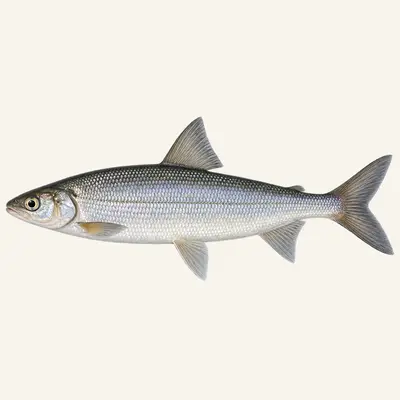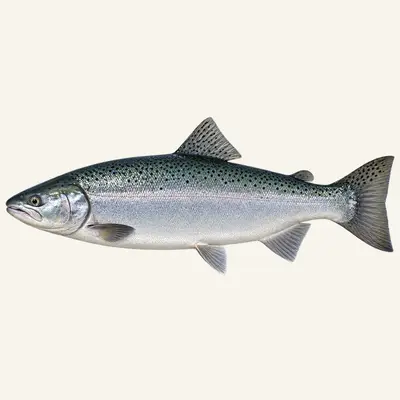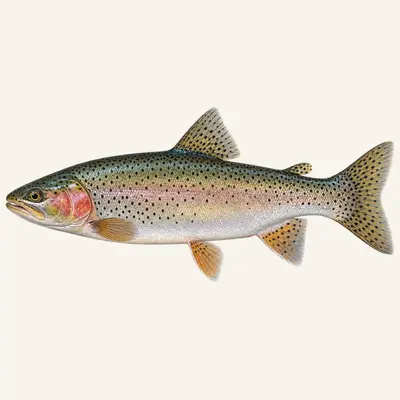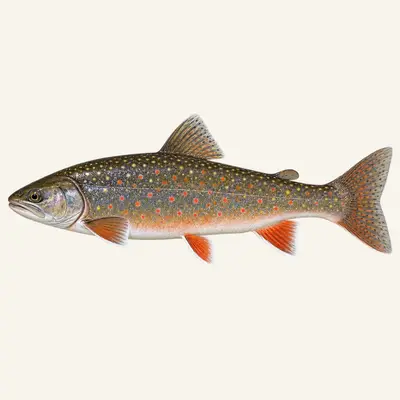
Chum salmon
Oncorhynchus keta · Salmonidae
- Saltwater
- Salmonids
- Medium
- Size
58–100 cm
- Weight
4.2–18 kg
- Lifespan
7 years
- Water temp.
0–24 °C
- Depth
0–250 m
Where to fish
- Estuary
Habitat icons: Flaticon
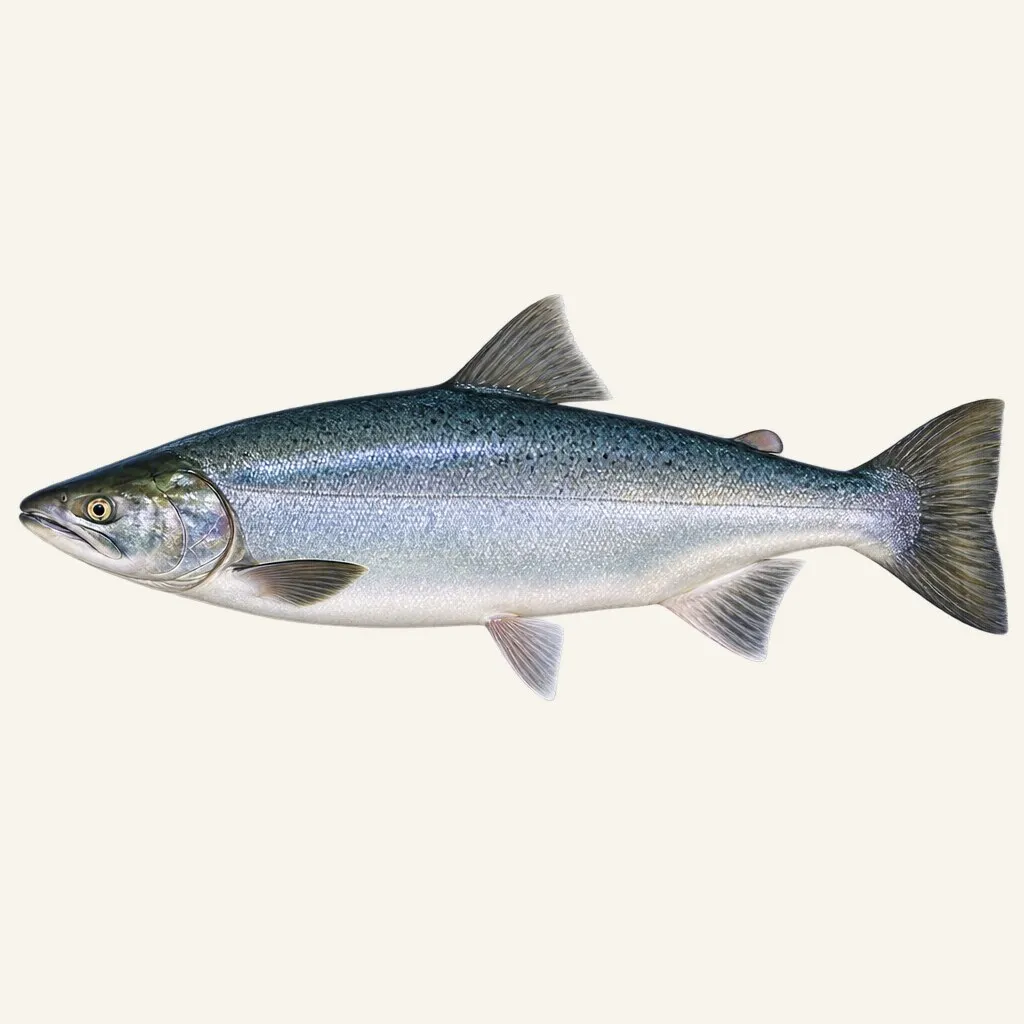
The chum salmon is the most abundant Pacific salmonid, recognized by its distinctive tiger-stripe purple and black markings on the flanks at spawning. An anadromous species, it migrates from the North Pacific to rivers of North America and Asia to spawn in freshwater.
Calendar
Recorded in 5 countries
Canada · Japan · Russia · South Korea · United States
GBIF occurrence records — native and introduced populations combined.
Its range
This is the salmon that asks least of the river. Juveniles leave it in February at 27 to 45 mm, in water around 4 °C, without having spent a single season feeding there. They school in the estuaries, hold along the coast for a few months, then disperse offshore.
That complete absence of a freshwater growing phase explains the reach of the range and the presence of the species in Arctic streams too poor or too short to feed a salmonid for a year. What is needed is an accessible sandy bed and an open way down for a few weeks.
The return comes three to four years later, to the exact place of birth. The cost of the strategy shows there: spawning is done near the tops of the basins, which means the longest possible journey inside the drainage network.
Identifying it
Eighteen to 28 short, stout, smooth rakers arm the first arch. That is the lowest count and the coarsest equipment in the genus, the opposite of the fine serrated comb of the sockeye, and the difference is obvious on an opened fish.
No distinct black spot marks either the back or the tail. A large individual is steel blue above with a scatter of black speckling, silver along the sides, silvery white beneath; males show black tinges at the tips of the caudal, anal and pectoral fins.
The tail is truncate to barely emarginate and the pelvic fins carry an axillary process. Ten to 14 soft rays in the dorsal, 13 to 17 in the anal, 59 to 71 vertebrae.
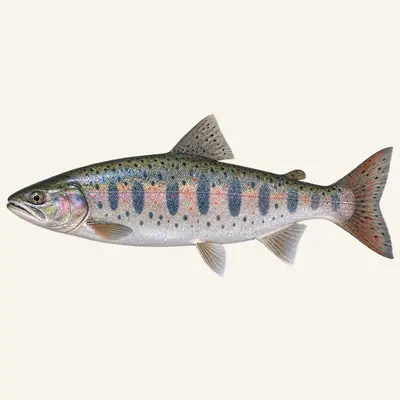
The breeding dress is the most recognisable in the group. The back goes dark olive to black, the flanks grey-red and barred vertically with green, the belly dark grey. The anal and pelvic fins take a clean white tip, a constant detail that lets a spawning fish be named at a distance. Females repeat the pattern more faintly.
Common length is 58 cm, and this is the second heaviest salmon in the genus. Maturity arrives around 70 cm and between two and four years, and the oldest recorded fish was seven.
Breeding
The egg measures about 6.7 mm. It is the largest in the genus, and the rest of the strategy follows from it: a reserve that size produces a larva of 16 mm, advanced enough to do without a growing season in the river.
The site chosen bears no resemblance to the riffles the other Pacific salmons use. Spawning happens near the headwaters, under roughly 3 m of water, in a weak current of about 20 cm per second, over sand and pebbles, at 4 to 11 °C.
The female excavates a hole around a metre across and half a metre deep, lying on her side and lashing her tail to shift the sand and silt off the bed. The pair settle into it, the mouths open, a fast vibration lets go eggs and milt, and she then covers the lot. Males are aggressive and move between females; females do the same and build several separate excavations as a result.
Seven hundred to 7,000 eggs go down in two or three releases of 300 to 3,500 each. Incubation is long: 60 days to hatching at 8 to 10 °C. A week after spawning the adults are dead.
The fish also enters fresh water at an advanced stage of maturation and spawns almost at once. There is no long wait in the river of the kind the big mainstem species make.
The water it needs
Most of the life is spent at sea, between the surface and 250 m and usually above 61 m, in water from 0 to 24 °C.
The larvae do not move away from the spawning site. The juveniles then occupy the coastal fringe, which exposes them to any alteration of the estuary during the few months they stay in it — the only transitional habitat the species genuinely depends on.
Adults come back through open water. The shallow depths they normally use, a few tens of metres, put them in the same layer as most inshore gear.
Areas
- River mouths
- River rapids and riffles
- River holding pools
- North Pacific coastlines
Techniques
- Lure fishing (spoons, spinnerbaits)
- Fly fishing (colorful streamers)
- Bait fishing (shrimp, eggs)
- Natural drift fishing
Baits
- Salmon eggs
- Marine shrimp
- Bloodworms
- Colorful soft lures
What it eats
Copepods, tunicates and euphausiids make up the bulk of the ration, with pteropods, squid and small fishes alongside. The diet changes little between juvenile and adult, which is unusual here: most of its congeners turn to fish as they grow, and this one stays largely a plankton feeder for life.
The thick smooth rakers match that food — prey that is small without being microscopic. Growth is nonetheless considerable, and it comes from the length of the marine stay, three to four years, rather than from the size of what is eaten.
How to catch it
One fact governs the rest: the adult stops feeding the moment it leaves salt. Since it enters the river already ripe and spawns almost immediately, the period during which a fish in good condition is available in fresh water is extremely short, shorter than for any other species in the genus.
The effort therefore sits downstream, in estuaries and along the coast, ahead of the change. A fish still silver, with fins simply edged in black, is worth taking; the same animal barred with green and tipped with white is inside its last month.
Spawning lies are not found where other salmon's are. Sand and pebble in quiet water under 3 m, close to the headwaters, has nothing in common with the fast riffles of the neighbouring species, and prospecting modelled on those misses the fish entirely.
The roe, finally, is worth as much commercially as the flesh. That concentrates effort on ripe females at the precise moment they carry the next generation, which is worth knowing before deciding what to do with one.
Conservation
The weak point is not the quality of the spawning beds but access to them. Because spawning happens near the tops of the basins and the young need the river only for a few weeks, everything turns on free movement from one end of the network to the other, upstream and down. A river degraded through its middle but passable still produces; the same river cut produces nothing.
The roe trade is the second pressure. A market that values the eggs as highly as the flesh steers effort structurally towards females that have reached maturity, and the intensity of that removal does not read in landed tonnage.
The third point is genetic. Occasional hybridisation with pink salmon yields fertile offspring here, which opens a channel for gene flow between two species wherever the two runs overlap.
Regulations
Check the local regulations in force (legal size limits, closed seasons, bag limits).
For guidance only. Legal sizes, quotas and open seasons vary by location and season: always check the local regulations in force before fishing.
Other names
Chum salmon is the North American name and dog salmon the older one, taken from the heavy teeth of spawning males and from the traditional use of the dried catch as sled-dog feed. Keta, transcribed from Russian, serves as the international trade name, and ocean-caught silver fish are also sold as silverbrite to separate them from coloured river fish. German has Ketalachs. The flesh goes mainly into cans, with smaller outlets fresh, dried and salted, smoked and frozen; the eggs supply the salmon-roe market.
Sources: fishbase.se · api.gbif.org