Coho salmon
Oncorhynchus kisutch · Salmonidae
- Saltwater
- Salmonids
- Medium
- Size
71–108 cm
- Weight
4.4–15 kg
- Lifespan
5 years
- Water temp.
0–25 °C
- Depth
0–250 m
Where to fish
- Estuary
Habitat icons: Flaticon
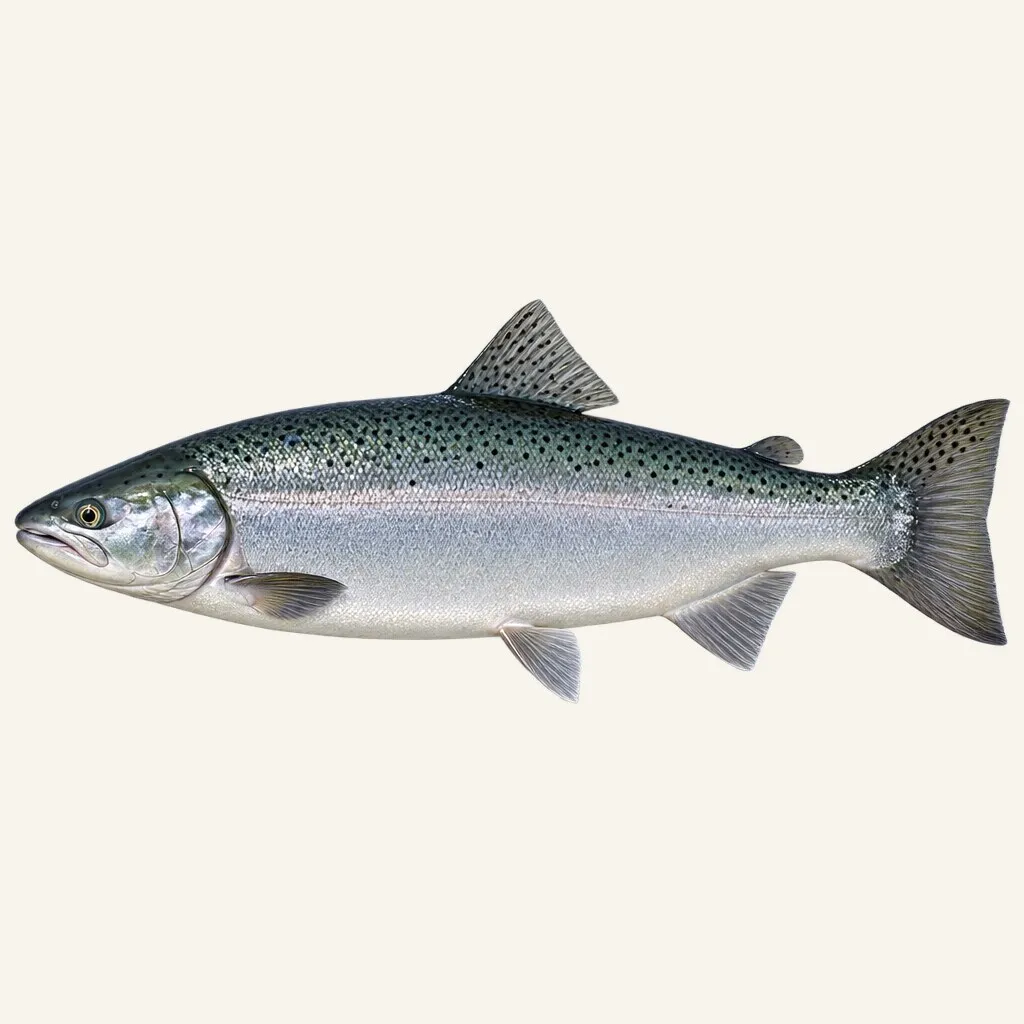
The coho salmon is a streamlined anadromous salmonid with a metallic blue-green back and bright silver flanks that give it its common name. Native to the North Pacific coast, it migrates upstream in autumn to spawn, developing a vivid red breeding coloration.
Calendar
Recorded in 5 countries
Canada · Chile · Japan · Russia · United States
GBIF occurrence records — native and introduced populations combined.
Its range
The constraint shaping this range is fluvial, not marine. Fry emerge in spring and normally spend one to two years in fresh water, occasionally as long as four, before moving to a lake or to the sea. That residence is compulsory, and it is passed in the deep parts of the river, where each fish quickly turns strongly territorial.
The consequence is direct. A river's capacity to produce coho is measured in the number of deep holding stations it offers, not in the area of spawning gravel it has. A drainage well supplied with riffles but straightened, without pools or side channels, keeps its returning adults and stops making juveniles.
The seaward run happens at night, which makes it nearly invisible to direct observation and awkward to count.
A further fraction stays in fresh water beyond two years and ripens sexually without ever reaching salt. These fish, called residuals, do not reproduce: they mature and are lost. Anything that lengthens the freshwater stay therefore feeds a sterile part of the population.
Identifying it
Only the upper lobe of the tail is spotted. The small black points cover the back and upper sides, stop at the top of the caudal fin and leave the lower lobe plain; that division is the first thing to look at and in most cases it is enough.
The second character is inside the mouth. The gum line of the lower jaw carries no dark pigment, which separates a sea-bright fish from a chinook of much the same appearance.
Gill rakers rough and widely spaced, lateral line nearly straight, adipose fin slender, pelvic fins with an axillary extension. Nine to 13 soft rays in the dorsal, 12 to 17 in the anal, and 61 to 69 vertebrae.
At sea the back and upper sides are dark metallic blue or greenish, the middle and lower body a hard bright silver — the source of the second English name. Spawning turns the head and back green, dark or vivid, the flanks a clear red, and often the belly dark; females stay more restrained.
Size differs sharply between the sexes, and the common lengths show it plainly: 71 cm for a male against 59.5 for a female. The oldest fish on record was five.
Breeding
Entry answers to rainfall. Adults leave the sea or the lake, gather in schools off the river mouths, and commit only when rain lifts the flow. Without a rise they wait outside the bar.
The calendar then follows latitude, and it is better learned than deduced: December and January entries belong to the south of the range, and the date moves earlier the further north a river lies.
On the gravel the female cuts a pit and keeps other females off while her attendant works on his rivals. The two go down into it together, side by side, gape, shiver and spawn; further males rush the nest to release as well. The next pit, cut immediately upstream, closes the last, and the round repeats over several days.
The sexes end differently. The male goes as soon as his part is done and may look for another female. The female does not stop. She keeps working the gravel until she dies over it.
The water it needs
The species holds between the surface and 250 m in water from 0 to 25 °C, and occupies the ocean and large lakes indifferently.
The juvenile in the river looks for depth and shade rather than current, which sets this salmonid apart from the riffle species. It defends a station and tolerates no neighbour on it, so juvenile density reaches a ceiling early even in rich water.
Smolts arriving in the sea stay hard against the coast at first and work offshore as they grow. Adults in the open sea are epipelagic and cover long distances before turning back.
Areas
- Shallow flats in coastal rivers
- River mouths
- Coastal sea zones
- Pools downstream of obstacles
Techniques
- Bright fly streamer
- Spinner
- Twitched spoon
- Surface lure
Baits
- Silver-flash streamers
- Bright spinners
- Artificial eggs
- Flashy spoons
What it eats
Young fish in rivers and lakes live mostly on insects. The diet changes as soon as they reach salt: smolts begin on planktonic crustaceans close inshore, then, working out from the shore, take much larger prey — jellyfish, squid and fish.
That shift to bulky prey accounts for the fast growth and for the final size of the males. It also places the species in the middle of a crowded chain: it is hunted by other fish, by diving birds — mergansers, loons, kingfishers — by mammals, and by lampreys, which leave the round scars often seen on the flanks.
How to catch it
The trigger is meteorological. Rain that swells the river moves schools that have been holding off the estuary, and the days following a rise in flow are worth weeks of settled conditions. Watching the rainfall over the catchment tells more than anything seen at the water the day before.
The second point concerns lies. A fish that spent one or two years defending a pool keeps a close relationship with depth, and that is where it stops on the way up. Pools, side channels and undercuts hold the fish; riffles serve for passage.
The third is condition. A fresh-run silver fish, still metallic, has nothing in common with the same individual a fortnight later, green and red and committed to its change. The useful window sits between entry and colour.
Residuals raise a last question. A ripe fish taken far upstream that never migrated may belong to that fraction, which contributes nothing to the next generation; its presence points to a blocked descent rather than to a healthy population.
Conservation
This is the most river-dependent salmon of the genus, and its fate is decided there. It needs one or two years of deep, shaded, partitioned pools, and that is the first resource river works remove: re-profiling, cutting off backwaters, clearing woody debris, evening out flows.
The second factor is an open descent. A juvenile held past two years ripens where it stands and joins the residuals, contributing nothing to the generation after it. A population can look abundant in juveniles while producing very few breeding adults.
The third is the entry cue. Flow management that smooths freshets removes the signal the species responds to, and ripe fish can stall off a river mouth for want of the rise that would start them.
Regulations
Check the local regulations in force (legal size limits, closed seasons, bag limits).
For guidance only. Legal sizes, quotas and open seasons vary by location and season: always check the local regulations in force before fishing.
Other names
Coho reached English through the fishing trade of the northwest coast, from Halkomelem. Silver salmon, silvers for short, is the ordinary Alaskan term and describes the sea-bright fish; neither word marks any biological distinction, and both are used interchangeably in the Great Lakes, where the species was introduced in the 1960s and now carries a large sport fishery of its own. German has Silberlachs, Italian salmone argentato.
Sources: fishbase.se · api.gbif.org