Bluefin trevally
Caranx melampygus · Carangidae
- Saltwater
- Coastal
- Medium
- Size
60–117 cm
- Weight
3.1–44 kg
- Depth
0–190 m
Where to fish
- Reef
- Rocky shore
Habitat icons: Flaticon
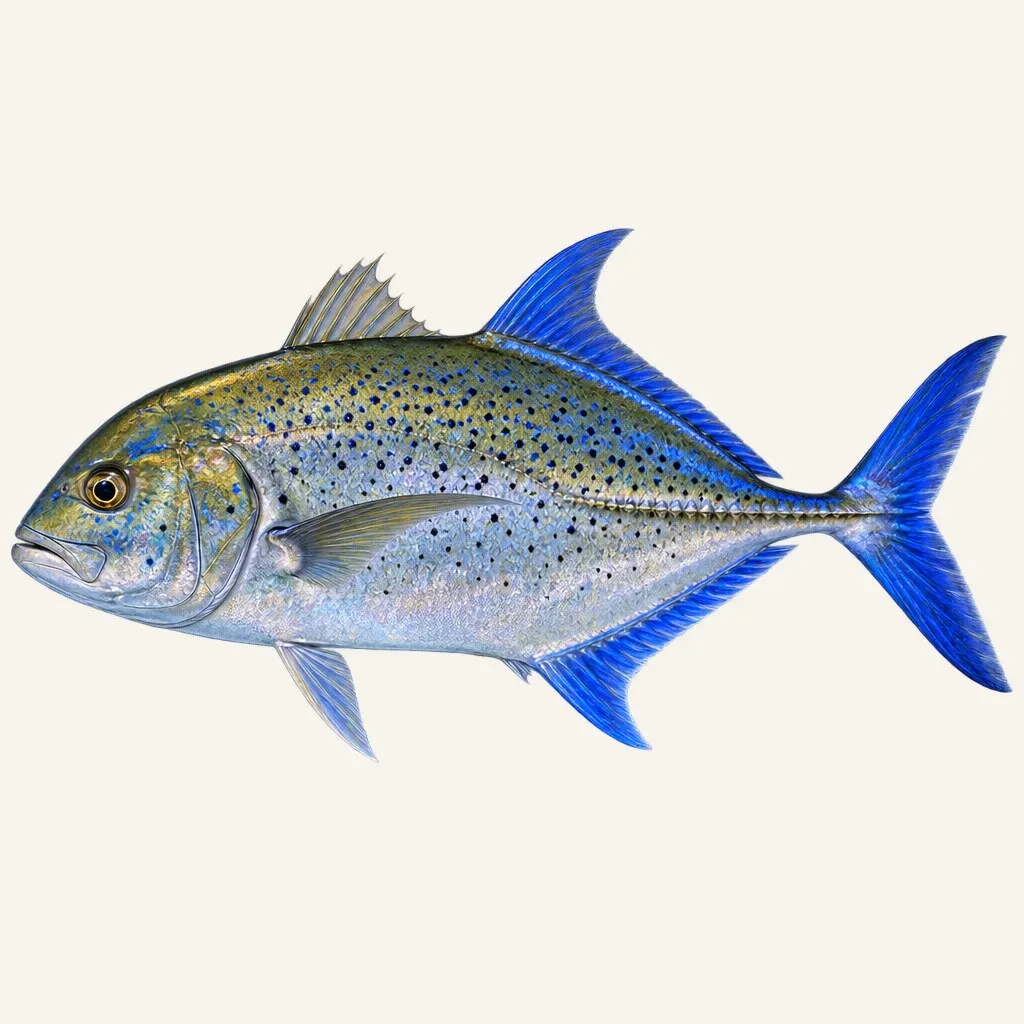
The Bluefin Trevally is a striking tropical carangid adorned with vivid blue and black spots on a silvery background. Agile and fast, it inhabits coral reefs and lagoons, actively hunting small fish and crustaceans.
Calendar
Recorded in 48 countries
American Samoa · Australia · Christmas Island · Cocos (Keeling) Islands · Colombia · Cook Islands · Costa Rica · Ecuador · Egypt · Fiji · French Polynesia · French Southern Territories · Guam · India · Indonesia · Japan · Kiribati · Malaysia · Maldives · Marshall Islands · Mauritius · Mayotte · Mexico · Micronesia · Mozambique · Myanmar (Burma) · New Caledonia · Niue · Northern Mariana Islands · Palau · Panama · Papua New Guinea · Philippines · Réunion · Saudi Arabia · Seychelles · Solomon Islands · South Africa · Sri Lanka · Taiwan · Tanzania · Thailand · Timor-Leste · Tonga · Tuvalu · United States · Vanuatu · Wallis & Futuna
GBIF occurrence records — native and introduced populations combined.
Its range
Two blocks, not one. The main range runs from the Red Sea and East Africa to Ducie Island, north to the Ryukyus and south to New Caledonia; a second occupation sits on the American side, from Mexico to Panama.
Crossing the eastern Pacific barrier is what stands out. Thousands of kilometres of open water with no reef in it stop most coral-reef fishes at the central Pacific islands, and this one is established on both sides of that gap where its larger relative is not. The described habits fit: adults are pelagic in oceanic as well as coastal water, so the species is not confined to the reef it feeds over.
Identifying it
Scales cover the breast completely, and that is the character to check first. Giant trevally, the species most often mistaken for this one on the same reef, has a bare belly in front of the pelvic fins. Nothing about colour is needed to separate them once the underside has been looked at.
The raker count gives the same answer independently. Including rudiments, the first arch bears five to nine above and 17 to 21 below, for a total of 25 to 29 and usually 26 or 27. The giant reaches only 20 to 24. Two characters that agree are worth more than either alone, and these two are easy on a fish in hand.
The straight part of the lateral line carries none to ten anterior scales and then 27 to 42 strong scutes. The adipose eyelid is weakly built, small at the front, its rear portion creeping over the eye as far as the back edge of the pupil in large adults.
The jaws are worth a look for their own sake. The upper carries an outer row of strong canines, widely spaced in adults, backed by an inner band of small villiform teeth that is widest at the symphysis; the lower limb of the first gill arch has a single row of stout conical teeth, likewise well spaced with age.
Nine dorsal spines, 21 to 24 soft rays, three anal spines, 17 to 21 rays, 24 vertebrae.
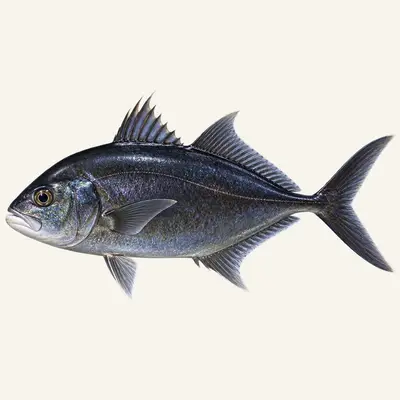
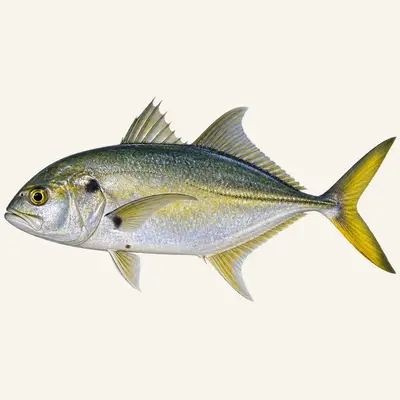
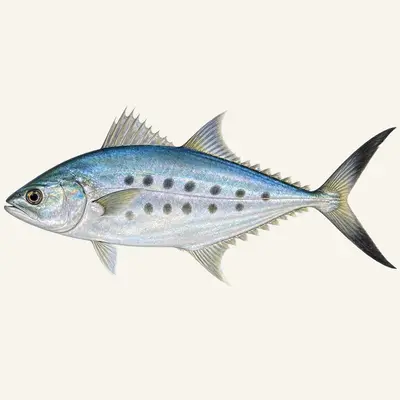
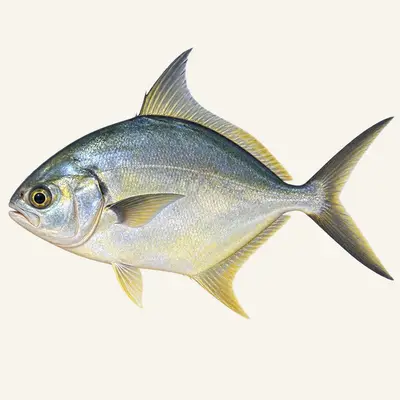
The blue is not there from the start. Adults are brassy over the head and upper body, washed with blue and peppered with small blue-black spots that begin to appear at 16 to 22 cm fork length and multiply as the fish grows; the second dorsal, anal and caudal fins turn electric blue. Juveniles and young adults are plain silvery grey with dusky fins and yellow pectorals, so the fish that gave the species its name is the adult one.
The water it needs
This is the commonest trevally on coral reefs, found alone or from time to time in schools, and the difference from the strictly solitary giant is the practical part: a hunting group is a real possibility here.
Adults are pelagic in coastal and oceanic water, always in association with reef, over a depth range from the surface to 190 m.
Juveniles appear seasonally in shallow sandy inshore water and in rivers. A reef predator whose young tolerate fresh water has a much wider set of nurseries than the reef alone provides.
Areas
- Reef passes and drop-offs
- Coral flats
- Coastal open waters
- Wrecks and artificial structures
Techniques
- Fast jigging
- Popper fishing
- Stickbait cast-and-retrieve
- Live bait fishing
Baits
- Chrome or coloured jigs
- Surface poppers
- Floating stickbaits
- Small live fish
What it eats
Adults feed mainly on other fishes and on crustaceans.
That is a mid-water diet taken over reef, and it fits a fish built for pursuit rather than for grubbing: the canines in the upper jaw are spaced for holding something that swims, not for breaking shells.
How to catch it
Sociability is what changes the fishing compared with its larger relative. A strike here can be one of several, and a group working the surface is a situation to be exploited for as long as it lasts rather than a single chance. Fish found alone are still the rule, but the exception is frequent enough to plan for.
Rod and line takes most of them, and spearfishing takes a substantial share as well; traps and gill nets account for the rest of the commercial catch. Maturity is early, around 35 cm, and the common length is 60 — so most fish met with are mature and mid-sized.
There is one hard number on the health side, and it is specific to this species: fish over 50 cm are often toxic. That threshold sits barely above the size at which the species breeds and well below what an angler would call a good one, which makes the origin of the ground the deciding question for anybody keeping fish here.
A hybrid with bigeye trevally has been recorded in Hawaii, where the two are fished side by side.
Conservation
Two gears work on different parts of the population and neither counts what the other removes. Hook and line takes fish across the size range; spearing selects visually, which in practice means the largest and boldest animals on a given piece of reef.
Because the species is the most abundant trevally on coral reefs over an enormous range, pressure registers locally long before it registers anywhere else. The unit that empties is a reef, and the fish that refills it has to come from the next one.
The juveniles' use of shallow sand and river mouths adds a pressure of a different kind, since those are the first habitats to go when a coast is developed.
Regulations
Check the local regulations in force (legal size limits, closed seasons, bag limits).
For guidance only. Legal sizes, quotas and open seasons vary by location and season: always check the local regulations in force before fishing.
Other names
Bluefin trevally in English, which collides awkwardly with bluefin tuna in ordinary conversation and has left the fish widely known by its Hawaiian name instead: ōmilu, kept distinct from ulua, the giant. Two Hawaiian words for two animals that English and French both file under one heading.
The epithet melampygus means black-rumped. It refers to the dark upper body of the adult rather than to the blue that the English name picked out.
Sources: fishbase.se · api.gbif.org