Cottonmouth jack
Uraspis secunda · Carangidae
- Saltwater
- Coastal
- Medium
- Size
40–50 cm
- Weight
0.7–2.0 kg
- Depth
1–50 m
Where to fish
- Reef
- Offshore
Habitat icons: Flaticon
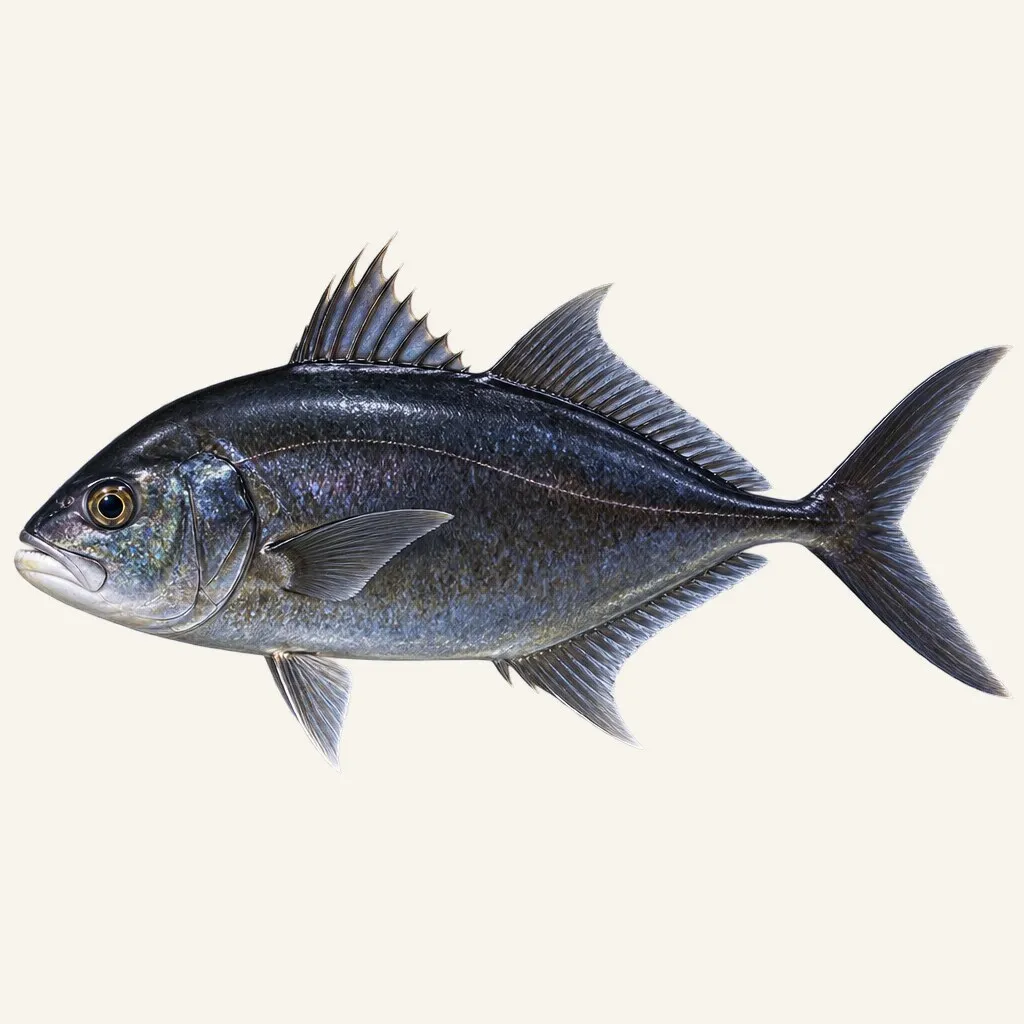
The whitetongue jack is a robust carangid of tropical and subtropical waters across Africa, the Americas and Oceania, recognisable by the whitish colouration of the inside of its mouth and tongue, a unique distinguishing feature among carangids. Its silver, streamlined body reflects an active pelagic lifestyle.
Calendar
Recorded in 20 countries
Australia · Brazil · British Indian Ocean Territory · Cameroon · Congo - Brazzaville · Côte d’Ivoire · Equatorial Guinea · Gabon · Ghana · Guinea · Guinea-Bissau · Liberia · Madagascar · Mauritius · Mozambique · Nigeria · Senegal · Seychelles · Sierra Leone · United States
GBIF occurrence records — native and introduced populations combined.
Its range
"Worldwide in warm waters," the account announces, and then it lists. Tanzania. California down to Costa Rica. Hawaii. Massachusetts and the northern Gulf of Mexico to Brazil. Mauritania to Angola, plus Algoa Bay.
The distance between the claim and the list is the informative part. An entire western Indian Ocean summarised by one country, an African Atlantic seaboard held between two endpoints: this is not a broken range, it is a poorly recorded one. The species lives offshore, in modest numbers, in a surface layer that few gears sample and no fishery pursues. The map is largely a record of where anyone has looked.
Identifying it
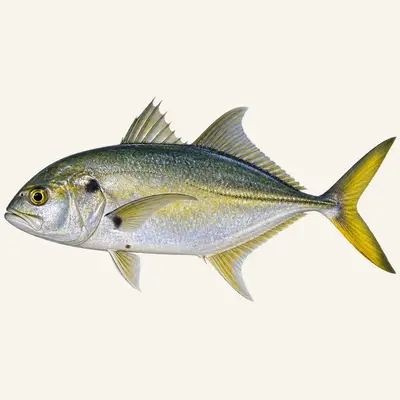
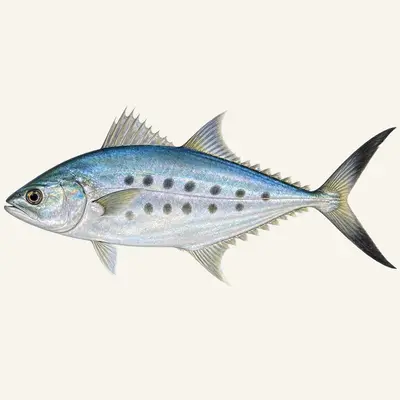
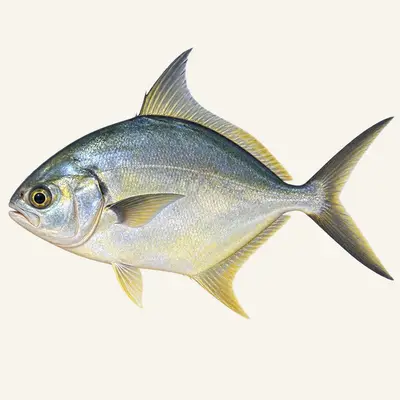
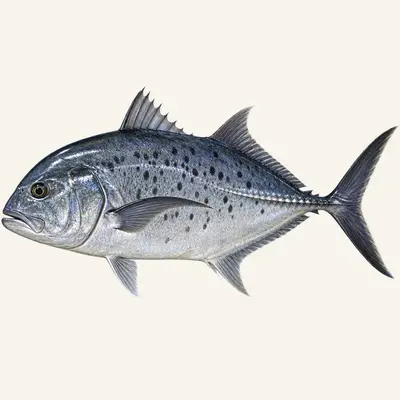
The adult and the juvenile do not resemble each other. The adult is dark, running to a bluish black, and the colour is uniform: there is nothing on it to read. The juvenile carries six or seven dark bars separated by pale interspaces — a barred fish, unmistakable at a glance, that loses the entire pattern on its way to adult size.
The soft-rayed fins are long. Twenty-seven to 32 rays follow the nine dorsal spines; 19 to 23 follow the three anal spines.
The character that actually names this species is not in that description. The entry above gives it: the inside of the mouth and the tongue are whitish, against the dark body. All six common names are built on it, and the published diagnosis reproduced here stops at body colour and fin counts without mentioning the mouth at all. It is a character carried by the naming and by the catalogue text rather than by the formal account, and it is checked with the fish in hand rather than in the water.
The water it needs
The band of water is narrow, and it is the most usable line in the record. Recorded depths run from 1 to 50 m, but the species is usually between 2 and 15.
Fifteen metres in open oceanic water, over a bottom that may lie a thousand metres below. The depth of the fish has nothing to do with the depth of the sea under it, and looking for it on structure is looking in the wrong dimension altogether.
Adults are oceanic and pelagic, sometimes near the bottom, and often around islands. They occur alone or in small schools.
A dark fish living in the first fifteen metres is an odd combination worth pausing on. That is the most strongly lit layer of the ocean, and the animal holding it is close to black.
Areas
- Coastal hard bottoms
- Reef edges
- Semi-pelagic zones
- Open bays
Techniques
- Vertical jigging
- Metal lures
- Live bait fishing
- Light trolling
Baits
- Small live fish
- Metal jigs
- Soft lures
- Shrimp
How to catch it
Between 2 and 15 m, offshore, in the vicinity of an island. The window is thin, which also means it is covered quickly — there is no need to search the column, only to cross the right water.
The solitary habit changes the method more than the depth does. One fish, or three or four together, forms no concentration that can be found on a sounder or from the surface. This animal is crossed rather than sought, which makes it a chance capture during a session aimed at something else, and which explains a commercial fishery that has stayed minor despite a presence in every warm ocean.
Common length is 40 cm, so the tackle is scaled to a moderate fish rather than to the heavy jacks. And the identification is finished on deck rather than at the boatside: for a dark, unmarked, medium carangid taken in blue water, the answer is inside the mouth.
Regulations
Check the local regulations in force (legal size limits, closed seasons, bag limits).
For guidance only. Legal sizes, quotas and open seasons vary by location and season: always check the local regulations in force before fishing.
Other names
Six languages out of six name the same thing. Cottonmouth jack in English, carangue bouche blanche in French, jurel boca blanca in Spanish, Weißmaul-Stachelmakrele in German, carangide boccabianca in Italian, xaréu-boca-branca in Brazilian Portuguese.
A convergence that complete is rare, and it rests on a feature invisible until the jaws are parted. Every naming tradition independently reached for the one character that requires handling the animal, which is a fair indication of how little the rest of the fish offers.
English has two names in use, and the second is the more literal: whitetongue jack. It is worth knowing because the first one collides badly. In North America, cottonmouth is above all a snake — the venomous water moccasin of the southern states — and a jack sharing that name with a pit viper is not a coincidence anybody explains, only a whiteness inside the mouth described twice.
Secunda is the Latin for second, and the epithet says no more than that.
Sources: fishbase.se · api.gbif.org