Crevalle jack
Caranx hippos · Carangidae
- Saltwater
- Coastal
- Medium
- Size
75–124 cm
- Weight
5.8–32 kg
- Depth
1–350 m
Where to fish
- Estuary
- Reef
- Beach
- Rocky shore
Habitat icons: Flaticon
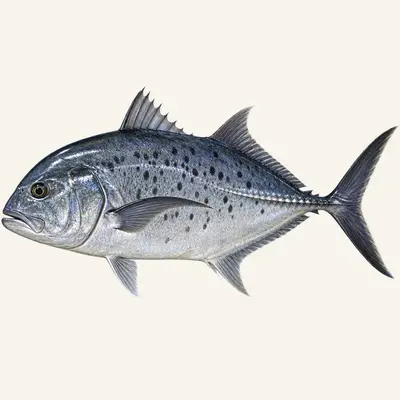
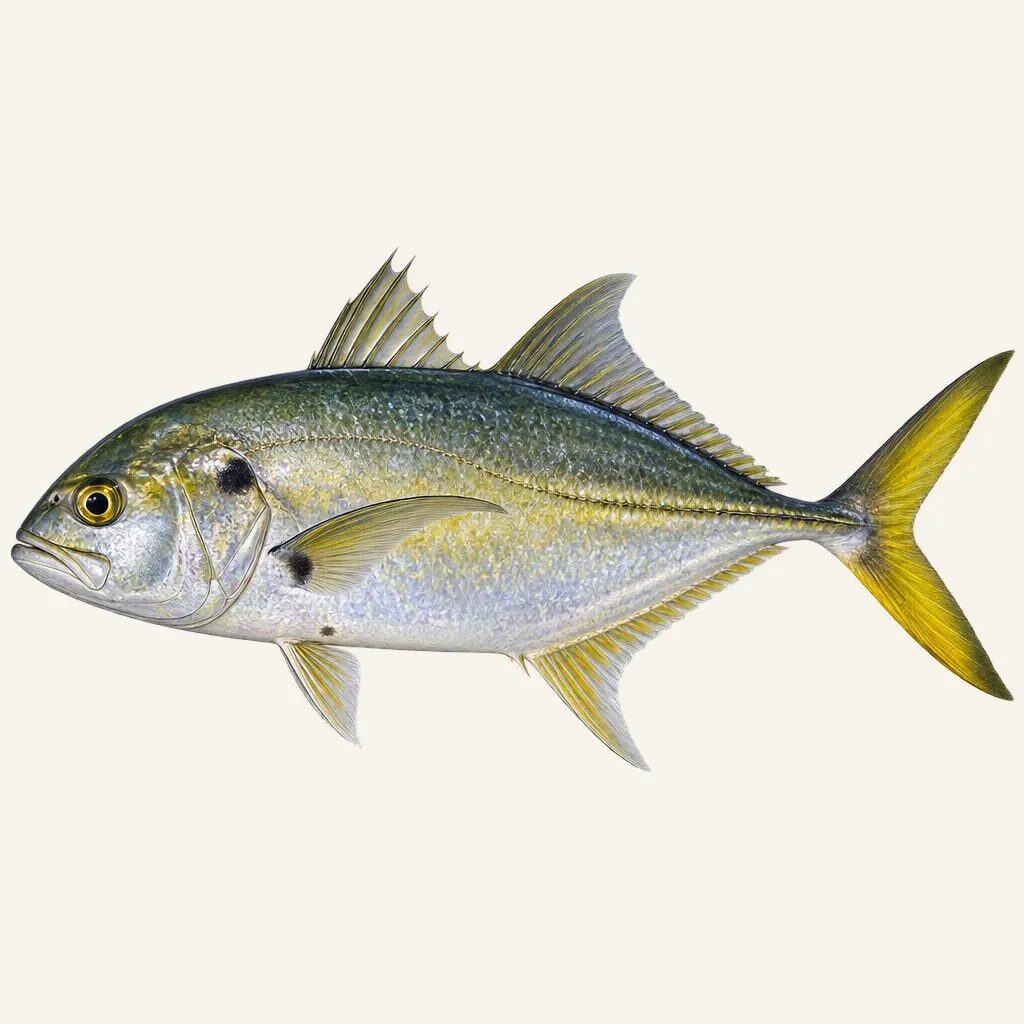
Powerful pelagic jack with a deep, compressed body and steep head profile, marked by a black spot on the gill cover and at the base of the pectoral fins.
Calendar
Recorded in 35 countries
Angola · Bahamas · Belize · Benin · Brazil · Cameroon · Canada · Colombia · Congo - Brazzaville · Congo - Kinshasa · Costa Rica · Côte d’Ivoire · Cuba · Ecuador · Equatorial Guinea · French Guiana · Gabon · Ghana · Guadeloupe · Guatemala · Guinea · Guinea-Bissau · Honduras · Indonesia · Liberia · Mexico · Nigeria · Panama · Puerto Rico · Senegal · Sierra Leone · South Africa · Trinidad & Tobago · United States · Venezuela
GBIF occurrence records — native and introduced populations combined.
Its range
The species occupies the Atlantic and is confined to continental shelf areas. The Mediterranean is formally excluded from its range.
That exclusion is unusually explicit, and it is useful precisely because it is negative. A jack of this build in Mediterranean water is another species, and the identification can be closed on geography alone before any character is examined.
Identifying it
The head rises steeply, almost abruptly, and in profile that blunt forehead is the first thing to register on a fish coming out of the water. In adults the maxilla ends about below the rear edge of the eye or a little past it.
There are no scales on the chest apart from a small mid-ventral patch immediately in front of the pelvic fins. Along the lateral line sit 23 to 42 scutes.
Those scutes are the genus character, and they are worth understanding rather than just counting. Scutes are keeled, spiny, bony scales armouring the rear of the flank, and their presence puts a fish in Caranx straight away. The reverse does not hold: amberjacks lack them, but so do the pompanos of Trachinotus, so a smooth tail says only that the fish is not a jack of this kind.
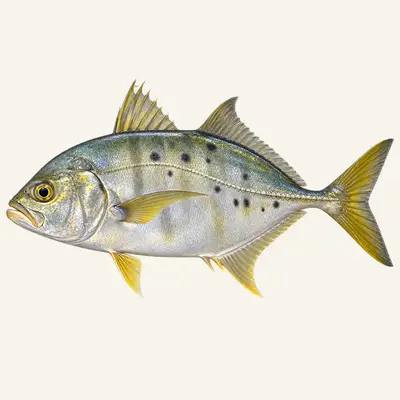
The front of the soft dorsal and of the anal fin is raised into a distinct lobe. The back is olivaceous to bluish green, the flanks silvery to brassy, and a prominent black spot marks the gill cover at the level of the eye, with a second at the upper axil of the pectoral fin and often a third on the lower pectoral rays. The caudal fin is yellowish.
Nine dorsal spines, 19 to 22 soft rays, three anal spines, 15 to 18 rays.
The water it needs
The amplitude here has no equal among the jacks in this catalogue. The recorded depth range runs from 1 to 350 m, with the ordinary band confined to the top 200; the same animal is common on shallow inshore flats a few metres from dry land.
Adults ascend rivers. Juveniles are abundant in brackish estuaries over mud, along sandy beaches and on seagrass beds, and they enter lagoons, mangrove and the lower courses of rivers.
So a single species spans mangrove to shelf edge, and fresh water to 350 m. A generalist diet is the logical price of that: smaller fishes, shrimp and other invertebrates, nothing specialised, because a predator moving between habitats that different cannot depend on any one prey being there.
Areas
- Estuaries and river mouths
- Exposed beaches
- Coastal reefs
- Jetties and harbors
Techniques
- Surface lure fishing
- Light to medium spinning
- Drift live bait fishing
- Coastal trolling
Baits
- Surface poppers
- Small live fish
- Metal lures
- Shrimp
How to catch it
Fast-moving schools are the normal formation, and larger individuals may be solitary. The two cases call for opposite approaches — intercepting a school on the move, or working structure for a single big fish — and telling which of the two is present accounts for most of the decision.
Presence on shallow coastal flats makes this jack reachable from the beach, which is rare for a fish of the size: the common length is 75 cm, and maturity comes around 66.
River-running adults produce the other unusual encounter. This is one of very few marine species in the catalogue that a freshwater angler may meet a long way up a river, in water with little salt left in it.
One detail belongs to the moment of capture rather than to any tactic: fish out of the water often grunt or croak audibly. A sound coming from a landed jack is normal for the species and not a sign of anything wrong with the animal.
Eggs are pelagic.
Conservation
The nursery is estuarine and mangrove ground, and it is separate from the habitat the adults use. A coast that loses its mud flats, its seagrass and its mangrove stops producing recruits without any change being visible offshore for several years.
The freshwater habit adds an exposure that most carangids do not have. Barriers on rivers and the water quality of lower reaches bear directly on a fish whose adults run upstream, which brings this species into the scope of decisions about dams and abstraction that no reef fishery ever touches.
Regulations
Check the local regulations in force (legal size limits, closed seasons, bag limits).
For guidance only. Legal sizes, quotas and open seasons vary by location and season: always check the local regulations in force before fishing.
Other names
Crevalle jack in English, jurel in Spanish. In much of the Atlantic it is simply the jack, a word that has been attached to so many carangids on both sides of the ocean that it identifies nothing on its own; on the eastern side, horse mackerel does the same job with as little precision.
The name history matters for the records rather than the language. The Caranx hippos complex was revised in 2007 and a new species from West Africa was described in the process, so older reports from that coast may refer to either animal and cannot be assigned without re-examination.
Sources: fishbase.se · api.gbif.org