Bluefish
Pomatomus saltatrix · Pomatomidae
- Saltwater
- Coastal
- Medium
- Size
60–130 cm
- Weight
2.0–14 kg
- Lifespan
14 years
- Depth
0–200 m
Where to fish
- Estuary
- Beach
- Rocky shore
- Offshore
Habitat icons: Flaticon
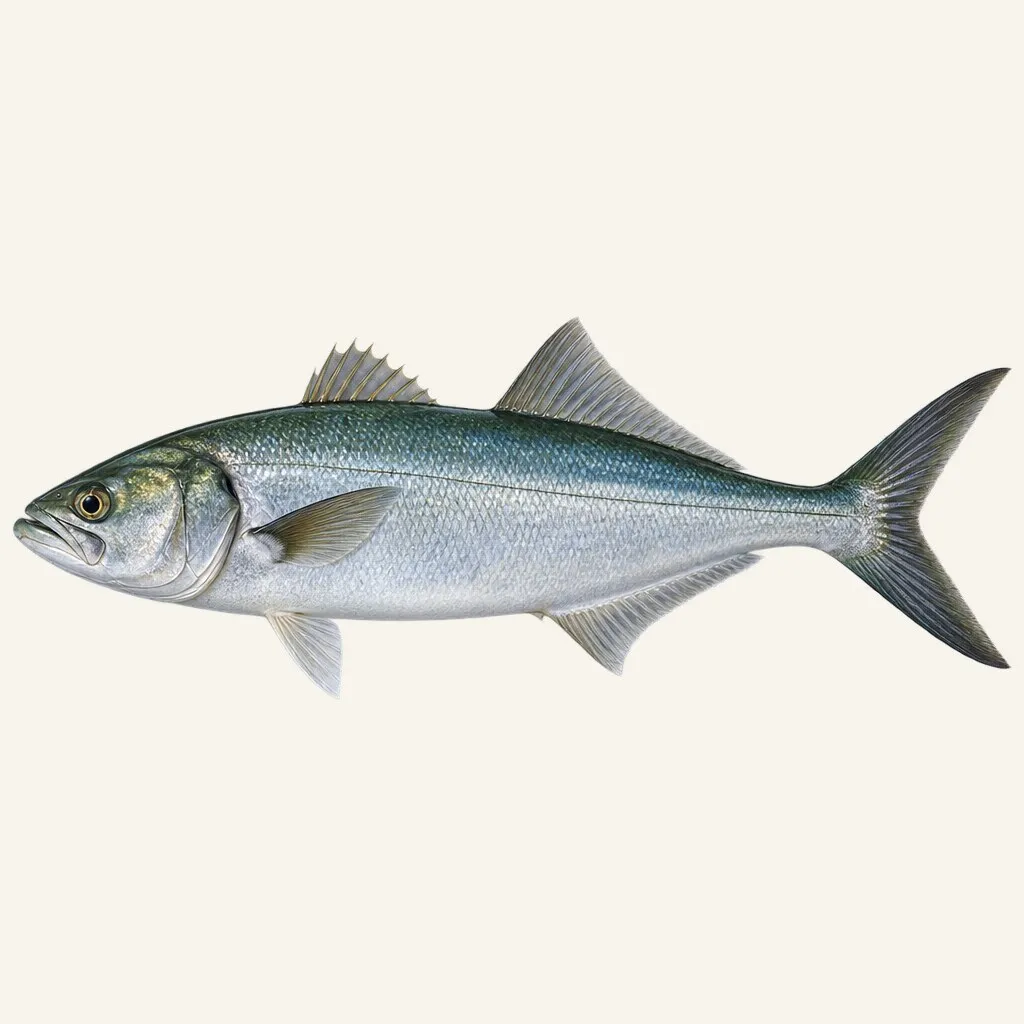
The bluefish is a stocky, muscular coastal pelagic predator with a powerful jaw armed with sharp triangular teeth. Its back is blue-green and its flanks are silver. An aggressive, gregarious hunter, it forms dense schools that attack herring, sardines, and anchovies with remarkable ferocity.
Calendar
Recorded in 39 countries
Albania · Angola · Argentina · Australia · Benin · Brazil · Cameroon · Canada · Colombia · Congo - Brazzaville · Côte d’Ivoire · Croatia · Equatorial Guinea · France · Gabon · Ghana · Greece · Guinea · Guinea-Bissau · Israel · Italy · Lebanon · Liberia · Mauritania · Mexico · Mozambique · Namibia · Nigeria · Portugal · Senegal · Sierra Leone · South Africa · Spain · Tunisia · Türkiye · Ukraine · United States · Uruguay · Venezuela
GBIF occurrence records — native and introduced populations combined.
Its range
Circumglobal through tropical and subtropical seas, with two clean holes in it. The eastern Pacific has none, and neither does the north-west Pacific; the species barely enters the western central Pacific at all.
Everywhere else it is continuous along coasts. Portugal to South Africa in the eastern Atlantic, taking in the Mediterranean, the Black Sea, Madeira and the Canaries. Canada and Bermuda to Argentina in the west. Along East Africa, Madagascar, southern Oman, south-west India, the Malay Peninsula and Western Australia in the Indian Ocean. Australia except the Northern Territory, and New Zealand, in the south-west Pacific.
Several records sit outside that and are treated as unreliable rather than as extensions: the Northern Territory and Indonesia appear to be erroneous, and the occurrences in Taiwan and Hawaii still need verification. A coastal fish this conspicuous does not go unnoticed where it lives, so the gaps in the map are real gaps.
Identifying it
The jaw teeth are prominent, sharp and compressed, set in a single series. One row, not a band and not a pad: a rank of flat blades along the edge of each jaw, and everything else on this page follows from them.
Behind that, two dorsal fins of very unequal build. The first is short and low, its seven or eight spines feeble and joined by a membrane — a fin that looks half-abandoned. The second is long, carried on 23 to 28 soft rays, and the anal answers it almost symmetrically with 23 to 27 rays behind two or three spines. The overall count for the spiny dorsal is given as eight or nine.
The back is greenish, the sides and belly silvery. The body is fusiform and compressed.
Length at first maturity is 30 cm and a common fish measures 60. Maximum reported age is 14 years.
Breeding
Fecundity is between 400,000 and 2,000,000 eggs and it scales steeply with the fish: 370,000 in an individual of 31 cm against 1,240,000 in one of 54.
Twenty-three centimetres for a more than threefold increase. That ratio is the single most consequential number on this page, because it means the reproductive value of a fish is not proportional to its weight — it climbs much faster than that.
The species is a serial spawner, releasing in successive batches through a season rather than all at once. That spreads the risk: a bad week of weather or a badly placed current takes out one batch instead of a year.
The water it needs
Oceanic and coastal water down to 200 m, but the concentration is very specific: this fish is most common along surf beaches and rock headlands, in clean, high-energy water. Adults will also use estuaries and go into brackish conditions.
Small fish hold shallow coastal water from about two metres, in schools that pursue and attack smaller fishes. Adults break that pattern and travel in loose groups rather than tight shoals.
The seasonal movement is a straight thermal one: towards warmer water in winter, towards cooler water in summer. The fish is following a band, and the band moves.
Areas
- Beaches and surf zones
- Estuaries
- Current edges
- Harbors and jetties
Techniques
- Metal lure casting
- Coastal trolling
- Drift live bait fishing
- Surf fishing
Baits
- Shiny metal lures
- Sardines
- Squid
- Soft plastic lures
What it eats
The record describes the feeding of this species in terms worth reproducing closely, because a paraphrase softens them: adults attack shoals of mullet or other fishes and destroy numbers apparently far in excess of their feeding requirements.
That is not a figure of speech, and the dentition explains how it is possible. A single row of blades cuts on the pass without any need to swallow, so a fish can go on attacking long after it has stopped eating. What is left behind is a shoal of mutilated prey and water full of debris.
Otherwise the diet is fish, crustaceans and cephalopods. The species is recorded as associated with sharks and billfishes, which is a different sort of company from the one it keeps with its own kind.
How to catch it
The feeding is what finds the fish. Whitened water, debris on the surface, birds working over it: the signal here is more legible than for any other coastal predator, precisely because the destruction exceeds the requirement and leaves visible wreckage. What is being searched for is the feed, not the fish.
The ground is fixed and it is reachable from land. Surf beaches and rock headlands in broken water are where the species concentrates across its whole range, which makes it one of the few predators of this class available to an angler standing on the shore.
The single row of blades dictates the terminal tackle, and there is no negotiating with it. Ordinary monofilament is cut clean through by a fish of moderate size, and the same edge is waiting at the unhooking stage — the record notes that the species is voracious and aggressive and bites when handled. A fish that will bite the hand holding it is not one to be gripped by feel.
The seasonal thermal movement decides when a coast holds fish at all. A stretch of shoreline is productive for the part of the year in which its water is in the right band, and empty for the rest of it, which is why the same beach can be transformed from one month to the next.
Conservation · Vulnerable (IUCN) — This species is threatened with extinction. Always release it (no-kill), handle it with the utmost care and check local rules — fishing for it may be prohibited.
Conservation
The relation between length and fecundity is the mechanism to understand, and it works against the fishery. A fish of 54 cm spawns more than three times what a fish of 31 cm spawns. Any fishery selecting for the larger individuals therefore removes a share of the reproduction far greater than its share of the numbers, and a catch limit expressed in fish or in weight does not capture that at all.
The second pressure is diffuse rather than concentrated. The species is most common exactly where shore anglers stand — surf beaches, rock headlands, the mouths of estuaries — so it is fished from the land along the whole of its range, by an effort that no landings statistic records well. It is also highly commercial and farmed commercially, so the pressure from the other direction is not small either.
What works in its favour is the serial spawning and the early maturity. Thirty centimetres is well below the size at which a fish becomes interesting to anyone, and releasing across a season rather than in one event means a year class is rarely lost whole.
Regulations
Check the local regulations in force (legal size limits, closed seasons, bag limits).
For guidance only. Legal sizes, quotas and open seasons vary by location and season: always check the local regulations in force before fishing.
Other names
Bluefish in the United States and in most technical writing, tailor in Australia — the record itself uses the Australian name in describing the spawning. Neither is used in the other country, so a catch report has to be read against where it was written.
Two names in this catalogue are a genuine trap for an English speaker. The Brazilian Portuguese is anchova, which is not the anchovy; the Spanish anjova is the same word and the same warning. A fish of 60 cm that cuts wire leaders shares nothing but a name with the small clupeid an English reader will picture. German Blaubarsch and Italian pesce serra stay clear of it, the Italian naming the saw.
The species is the sole member of its family, which is worth knowing because it removes the usual question. There is no congener to be confused with, no closely related species sharing the ground, and no genus-level identification problem — anything that looks like this fish and cuts line like this fish is this fish.
Saltatrix means the leaper.
Sources: fishbase.se · api.gbif.org