Giant trevally
Caranx ignobilis · Carangidae
- Saltwater
- Coastal
- Medium
- Size
100–170 cm
- Weight
14–80 kg
- Water temp.
26–29 °C
- Depth
10–188 m
Where to fish
- Reef
- Beach
Habitat icons: Flaticon
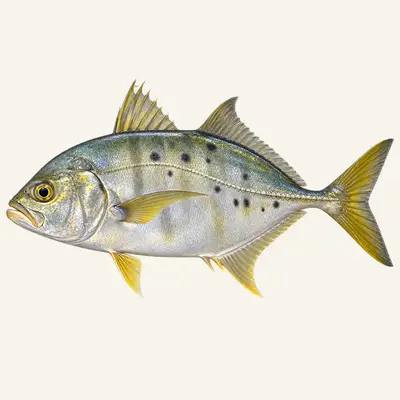
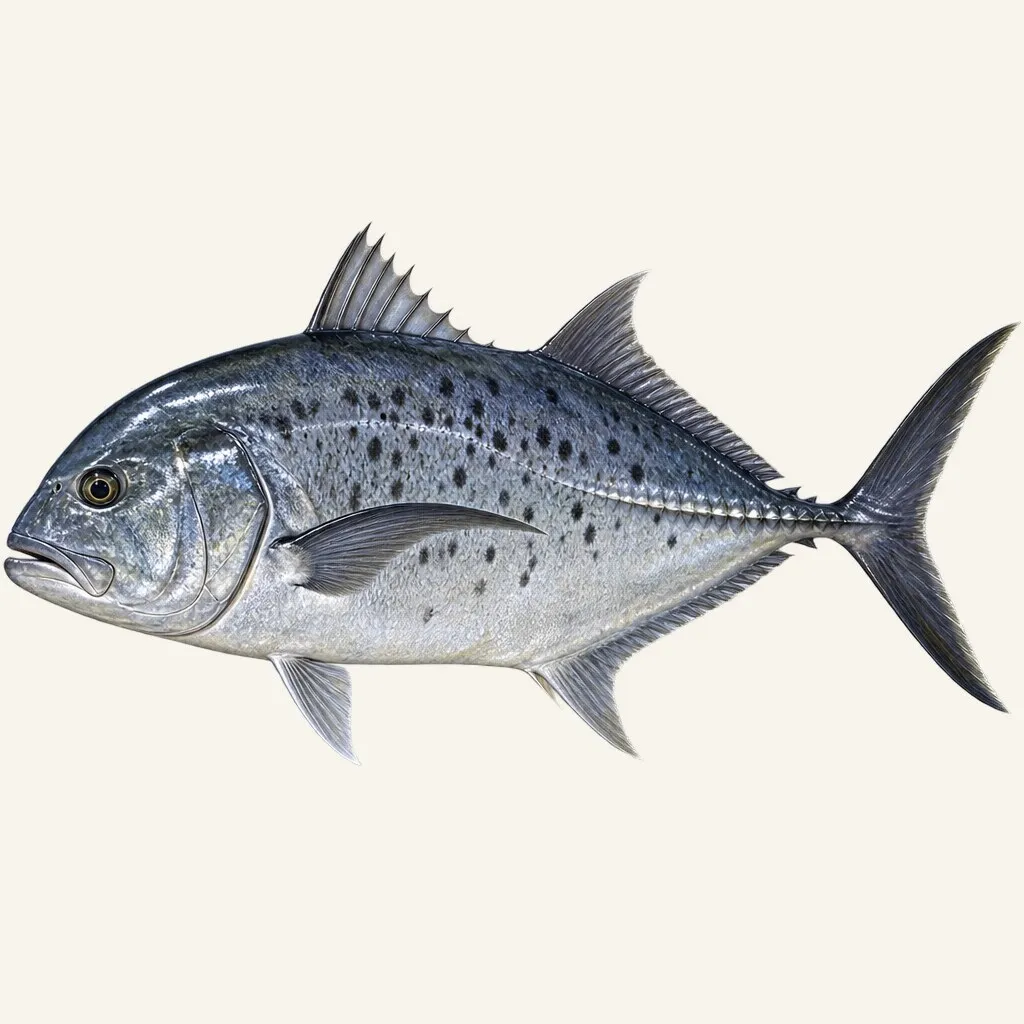
The Giant Trevally is the largest member of the jack family, distinguished by its powerful build and steep forehead profile. It is a top reef predator across the Indo-Pacific, hunting in shallow flats and open water alike.
Calendar
Recorded in 25 countries
American Samoa · Australia · Christmas Island · Cook Islands · Egypt · Fiji · French Polynesia · India · Indonesia · Japan · Malaysia · Maldives · Marshall Islands · Mayotte · Mozambique · New Caledonia · Northern Mariana Islands · Papua New Guinea · Philippines · Saudi Arabia · Seychelles · South Africa · Taiwan · Thailand · United States
GBIF occurrence records — native and introduced populations combined.
Its range
The Indo-Pacific occupation is complete, from the Red Sea and the East African coast out to Hawaii and the Marquesas, north to southern Japan and the Ogasawara Islands, south to northern Australia.
Where it stops is the informative part. The eastern boundary falls in the central Pacific, and the species does not reach the American coast — unlike bluefin trevally, which crosses to Mexico and Panama. Two reef predators with nearly identical ranges over most of the ocean part company at the last gap, and the Hawaiian archipelago is the far end of the line for this one rather than a staging post.
Identifying it
The breast is naked on its underside. That one character settles the commonest confusion in the genus, because bluefin trevally, which works the same reefs, is scaled right across the breast. Here the skin in front of the pelvic fins carries at most a patch of prepelvic scales, small in some fish and large in others, and bare ground around it.
The gill rakers confirm it, and they confirm it without judgement. Rudiments included, the total runs 20 to 24 — five to seven on the upper limb and 15 to 17 on the lower. Bluefin trevally runs 25 to 29. The two ranges do not touch, so a count on a landed fish decides the question outright.
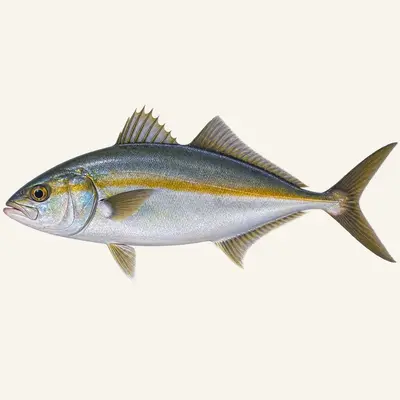
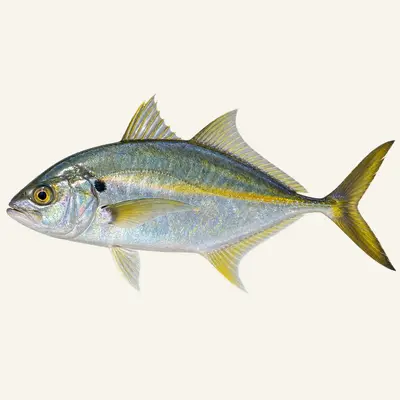
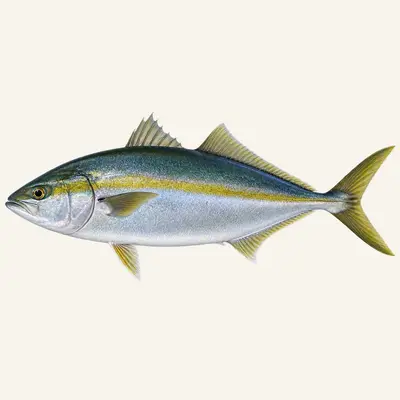
Adults are silvery grey to black above and paler beneath, the fins uniformly grey to black. Fish taken out of turbid coastal water break that rule: their fins come up yellow, the anal fin brightest of the set. The same species therefore looks like two different animals depending on whether it was hooked on a muddy inshore flat or over a clean outer reef.
Nine dorsal spines, 18 to 21 soft rays, three anal spines, 15 to 17 rays, 24 vertebrae.
Breeding
Spawning takes place on shallow seaward reefs and on offshore banks — moving water in the open, not the sheltered lagoons where the young of the year are found.
Maturity arrives around 60 cm, against a common length of 100. A metre-long fish has bred already, and still has most of its growth in front of it. The animals at the top of the size range are old animals, and they carry a disproportionate share of the spawning.
A hybrid with bluefin trevally has been found in Hawaii. Two species that a naked breast and a raker count separate cleanly still interbreed where their ranges overlap most heavily, which is worth remembering when a fish answers neither description exactly.
The water it needs
Adults are pelagic over sand and rock, from 10 to 188 m, in water between 26 and 29 °C. They hold above open bottom rather than inside the coral, and the recorded ground is clear lagoon and seaward reef.
They occur singly. This is not a schooling animal, and that changes the whole approach to it: there is no mass of fish to intercept, only individuals spread thinly over a lot of favourable ground.
Juveniles use estuaries instead, which puts the nursery in a different water body from the adult range — brackish, shallow, and far more easily destroyed than a reef slope.
Areas
- Coral reef passes
- Exposed reef edges
- Strong current zones
- Exposed sandy beaches
Techniques
- Heavy popper fishing
- Intensive vertical jigging
- Large live bait fishing
- Shore casting
Baits
- Heavy poppers
- Heavy metal jigs
- Large live bait (jacks, mullet)
- Large soft plastic lures
What it eats
The diet is crabs, spiny lobsters and other crustaceans, together with fish, and it is taken at night.
Both halves of that sentence matter. A menu built on spiny lobsters and crabs is a menu of armoured prey, worked over hard bottom in the dark, which is a very different living from chasing baitfish through open water at midday.
How to catch it
Three things at once account for the standing of this fish among sea anglers: the size it reaches, which no other trevally matches, the power that goes with it, and the fact that it will attack at the surface in almost no water at all.
The solitary habit sets the tactics. Ground has to be covered — clear lagoon, outer reef, offshore bank — and each fish found is found on its own account. A spot that produced last week produces again only if another animal has moved in.
Put the nocturnal feeding next to those daylight surface attacks and they do not add up as hunger. A fish that eats crustaceans at night and charges a lure across a shallow flat at noon is answering an intrusion, not looking for a meal. That is why provocation works on this species where imitation fails, and why a refused pass is worth repeating with a noisier retrieve rather than a smaller lure.
Very large fish can be ciguatoxic. Neither the look of the flesh nor any cooking or freezing gives an indication, and the burden depends on the reef the fish came from, so the answer has to come from people who work that reef.
Conservation
The nursery is the part that no fishing decision touches. Juveniles grow up in estuaries; coastal reclamation, dredging and mangrove clearance remove those fish before any boat has a chance at them, and the adult population on the reef shows nothing for years afterwards.
Breeding at 60 cm and then growing on for years has a second consequence. Fishing that concentrates on the biggest animals is fishing on the oldest and most productive fraction of a population that already lives at low density, one fish to a stretch of reef. A local stock thinned out that way is not refilled from a school somewhere else, because there is no school.
The species is taken commercially and farmed, and sold fresh or dried and salted.
Regulations
Check the local regulations in force (legal size limits, closed seasons, bag limits).
For guidance only. Legal sizes, quotas and open seasons vary by location and season: always check the local regulations in force before fishing.
Other names
Giant trevally in English, abbreviated to GT wherever sport fishing is discussed — one of the few fish better known by its initials than its name. Hawaiian keeps ulua for it, a word that carries far more weight locally than any translation.
The epithet ignobilis means base or ignoble, which describes nothing about the animal and has produced some odd literal renderings in other languages.
Sources: fishbase.se · api.gbif.org