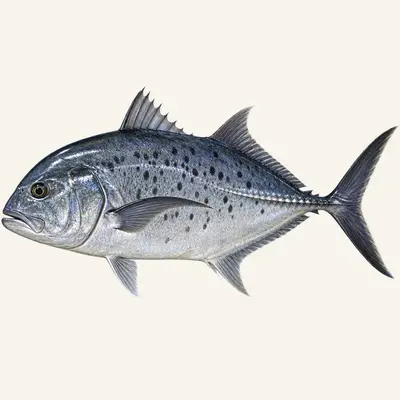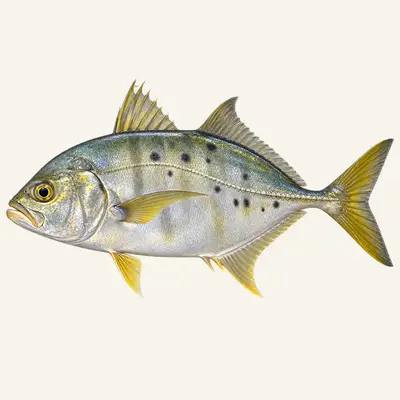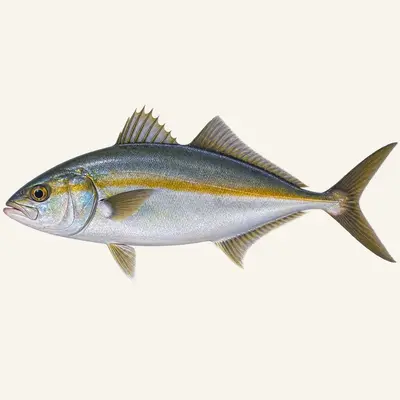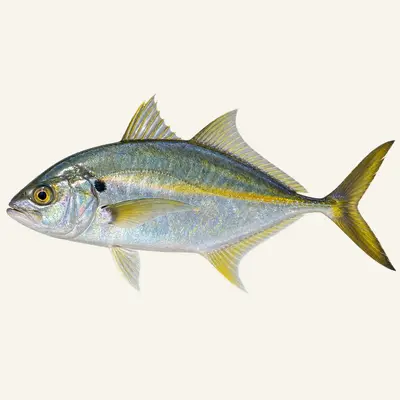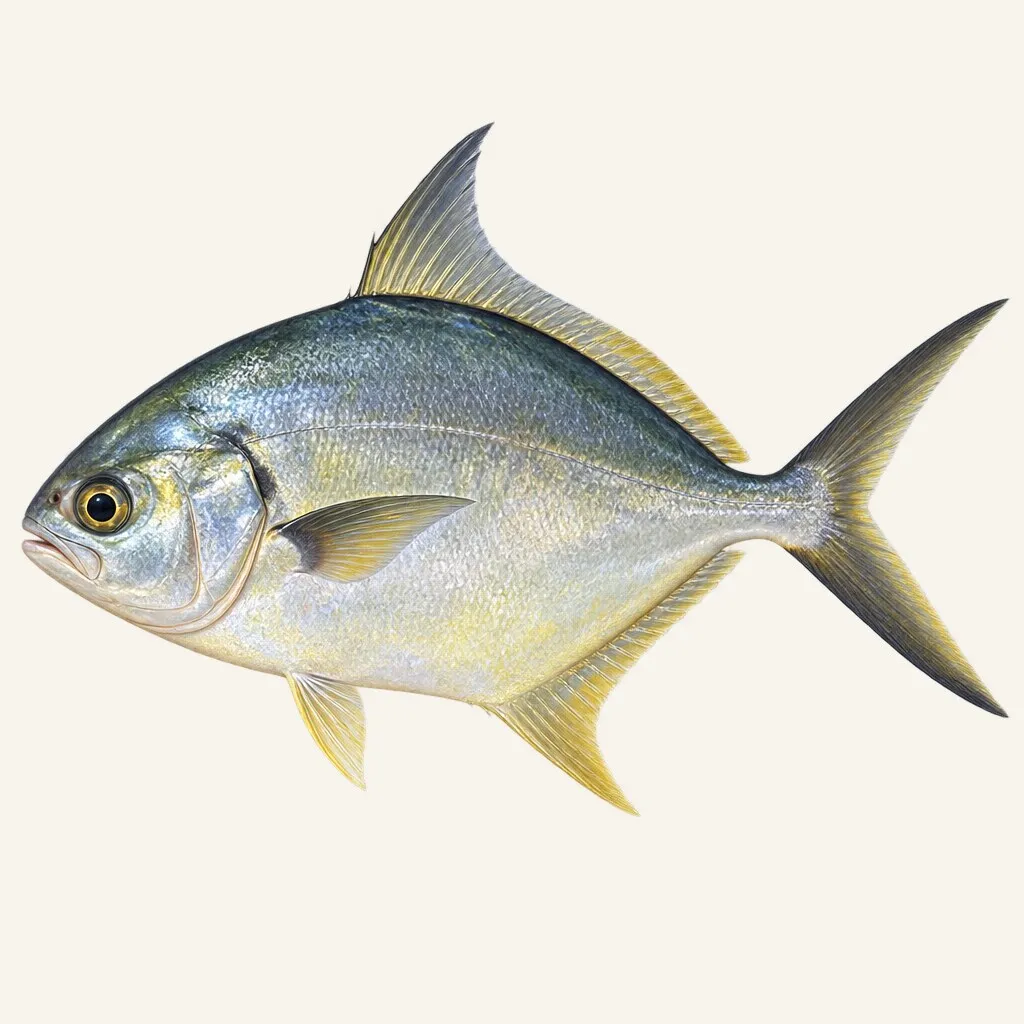
Florida pompano
Trachinotus carolinus · Carangidae
- Saltwater
- Coastal
- Medium
- Size
40–64 cm
- Weight
0.5–3.8 kg
- Lifespan
7 years
- Depth
1–70 m
Where to fish
- Estuary
- Beach
Habitat icons: Flaticon
The Florida pompano is a coastal carangid with an oval, compressed body and silvery flanks with golden hues. It inhabits shallow inshore waters along sandy beaches and coastlines of the western Atlantic, from Florida to Brazil.
Calendar
Recorded in 3 countries
GBIF occurrence records — native and introduced populations combined.
Its range
The Bahamas are missing, and that absence explains the species. It runs along the American seaboard from Massachusetts through the Gulf of Mexico, then in scattered localities through the West Indies to Brazil, and again off Argentina. The clear water of the Bahamas and comparable islands holds none of it, although those islands sit in the middle of the latitudes it occupies.
Sediment is the reason. This fish follows continental sand — the material rivers deliver and swell keeps stirred — and a carbonate bank offers it nothing: transparent water over ground no river feeds. The outline is therefore a map of shorelines rather than of temperatures. Where a coast is supplied with sediment the species is there; where the water stays clear it is not.
That is the opposite requirement from several of its close relatives, which will not leave clean water.
The water it needs
The depth record spans 1 to 70 m, but the animal lives against the bottom in the coastal fringe. Adults occupy inshore water and commonly move up into bays and estuaries; they are absent from island ground with coralline bottoms.
The young are somewhere else entirely, and in harder conditions: on sandy beaches exposed to wave action. That means inside the break itself, where sand is permanently in suspension and few species can hold station.
The fish travels in schools, from a handful of individuals to large bodies of fish depending on circumstances. Recorded longevity is seven years, which matters below.
Areas
- Sandy beaches with surf
- Shallow nearshore flats
- Coastal pass mouths
- Breaker zones
Techniques
- Surf fishing from the beach
- Light lure cast-and-retrieve
- Bottom fishing with natural bait
- Wave-edge fishing
Baits
- Sandworms (nereid worms)
- Small crustaceans
- Fresh shrimp
- Light beach lures
What it eats
Molluscs, crustaceans, other invertebrates and small fish. This is a sifter's diet, taken off the bed and out of the loaded water immediately above it.
The link to the habitat is direct. A wave collapsing on a bar digs out and suspends exactly what this fish eats, so a beaten beach is a table rather than a constraint, and being in the break is a tactic rather than a tolerance. The fish in the list are incidental; the invertebrates are what the animal is equipped for.
How to catch it
The usual rule inverts here. Looking for clean water is the reflex of most shore fishing; on this species it is the loaded water that has to be found. A sandy coast supplied with sediment, water the colour of tea after a blow, a break that is working — those conditions are not endured, they are the mark of the spot.
Two grounds divide the species. Exposed beaches, in the wave itself, hold the young; bays and estuaries take the adults, which enter them regularly. The first is fished a few metres from dry sand, the second means following the brackish water inland.
Bait comes off the bottom rather than out of mid-water. Shellfish, crustaceans and worms match what the fish sorts out of churned sand, and a rig that presents the bait hard on the bed, in the backwash, works with the way it feeds rather than against it.
The species is gregarious. A fish taken in the break almost always means a group, and the stretch is worth reworking straight away.
Conservation
This is the highest-priced marine food fish in the United States. That looks like a piece of trivia and is in fact the main pressure on the species, because a high price guarantees that fishing effort will not fall away on its own, whatever the abundance.
What offsets it is biology. Maturity is reached from 25 cm, while the length commonly landed is 40. The fishery therefore works largely above the breeding threshold, and a seven-year lifespan lets a stock rebuild over a few seasons.
The species is also reared in captivity, which opens a supply independent of the wild stock — on a market driven by price, that is the most effective lever available.
The point to watch is the shoreline itself. Juveniles depend on sandy beaches worked by swell, and nourishment, revetment and the general fixing of coastlines alter precisely that band.
Regulations
Check the local regulations in force (legal size limits, closed seasons, bag limits).
For guidance only. Legal sizes, quotas and open seasons vary by location and season: always check the local regulations in force before fishing.
Other names
Florida pompano is the standing English name, and the fish extends from Massachusetts to Argentina across two hemispheres. The name records a market, not a range; the specific epithet does the same thing with the Carolinas.
Pompano on its own is the word to distrust. It is attached to several members of this genus in different oceans, and it means this fish on an American menu while naming a smaller eastern Atlantic relative in European sources. On the same coast, permit names a third and much larger member of the genus, so all three names have to be read together with a scientific name before a record is worth anything.
Sources: fishbase.se · api.gbif.org