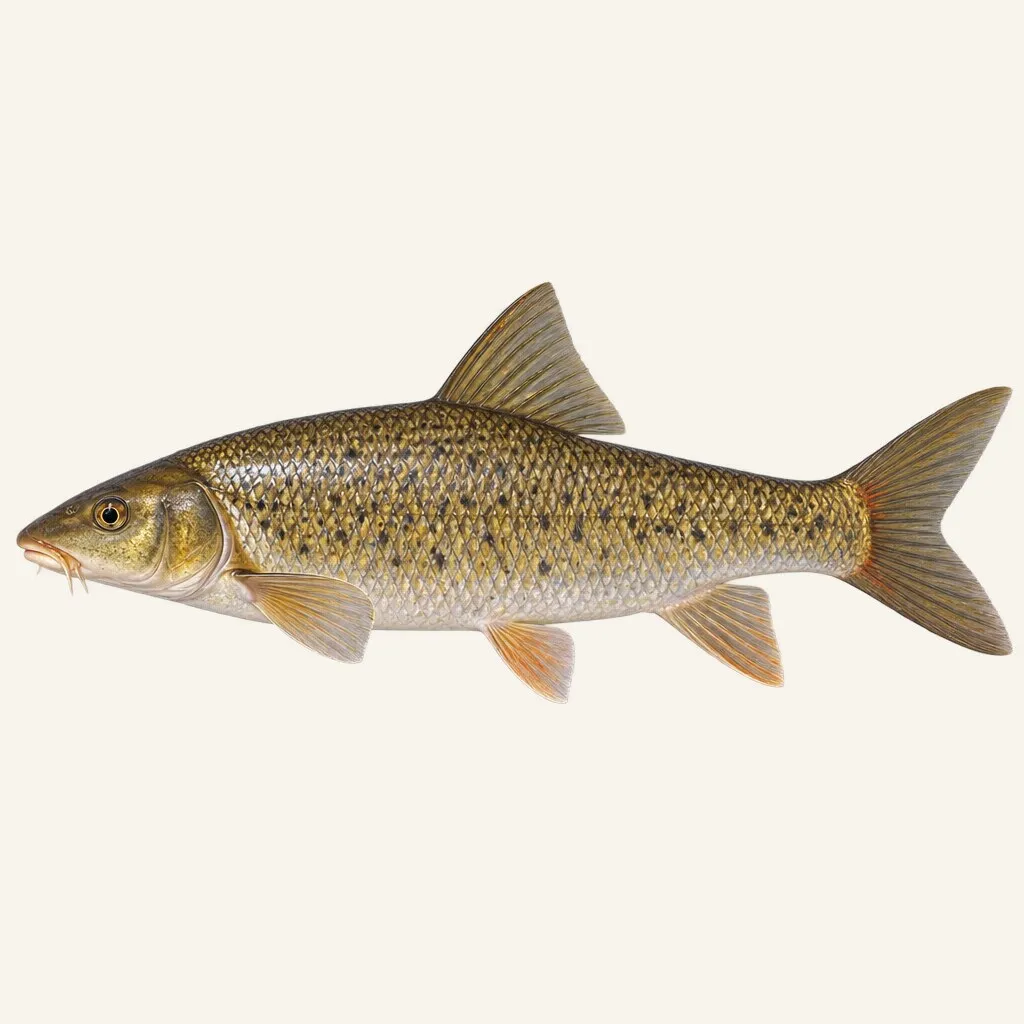
Bocage's barbel
Luciobarbus bocagei · Cyprinidae
- Freshwater
- Carp & coarse
- Hard
- Size
40–90 cm
- Weight
0.7–10 kg
- Lifespan
11 years
Where to fish
- River
Habitat icons: Flaticon
A large Iberian barbel - Excellent fighting power
Calendar
Its range
The Atlantic face of the peninsula, from the Lima down to the Sado. That band takes in the ocean side of Portugal over its whole length, Tagus included.
The Tagus is where identification stops being an academic exercise. The comizo barbel lives there too, and the two reach the same maximum size. Two characters separate them without argument: the lower jaw, bare on one and covered on the other, and the dorsal armature, partial here and strong along its full length there.
Identifying it
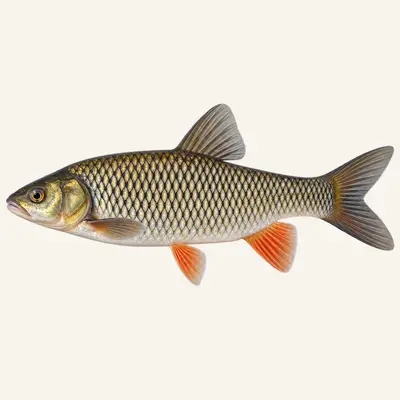
Turn the head over. The tip of the lower jaw stands bare, clear of the lip; on the other three barbels of the peninsula it vanishes underneath it. One look at the underside of the snout, with nothing counted and nothing measured, and the species is fixed.
The rest is confirmation. The lower lip bears neither lobe nor pad. The head is 25 to 28 per cent of standard length, and the lateral line runs 44 to 49 scales with three more at the tail.
The dorsal repays being spread open by hand. Its first ray is moderately spinous and toothed over roughly half its length in adults, the teeth fine and only rarely missing altogether. Held out, the fin's rear edge is slightly hollowed, and the top of that edge sits at an angle to the line of the back — a detail visible only on a fin somebody has opened.
It reaches about 80 cm standard length, matures at around 19 cm, and the highest age on record is 11 years.
The water it needs
Middle and lower courses with slow flow. That is the same half of the network the comizo uses, without the pronounced appetite for depth and weed beds.
Living low down describes the fish as much as it describes the water. A barbel that finishes near 80 cm needs volume, and the volume is downstream.
Areas
- Gravelly shallows
- Pools below obstacles
- Vegetated margins
- Moderate current zones
Techniques
- Feeder
- Bolognese
Baits
- Worms
- Pellets
- Maggots
What it eats
This is the broadest diet of the four: benthic invertebrates, detritus, plant material and fish. None of the four categories dominates, and that is what marks the species out — the comizo tips over onto fish, this one tips over onto nothing.
The detritus share deserves attention. A fish able to make a living from the organic matter lying on a river bed does not depend on any particular abundance of prey, so its presence says nothing about how rich a stretch is in invertebrates. That is the reverse of what a strictly carnivorous barbel tells you about the same reach.
How to catch it
A diet that wide opens the bait list rather than narrowing it. Worm, maggot and pellet are the recorded choices, and nothing rules out a plant bait or a heavier mouthful: the animal takes all four of the categories it feeds on.
The lies are those of a big cyprinid in a slow river — scoured holes below obstructions, weeded margins, water of moderate flow, and the gravel shallows for smaller fish. Feeder where the bait is laid, float where it is travelled.
Handling sits between the two extremes of the group. The dorsal armature occupies only half the ray and the teeth stay fine, which makes the fish easier to hold than the comizo without making it a matter of indifference.
One caution about age. The literature calls this a long-lived species, and the maximum on record is 11 years — well below the figure read from a smaller relative further south. Either it is less long-lived than the description implies, or nobody has yet aged an old one. The difference matters, because long life is the assumption on which a population gets left to recover by itself.
Conservation · Near Threatened (IUCN) — This species is in decline. Release your catch quickly and handle it with care — wet hands, as little time out of the water as possible.
Conservation
The risk to this fish runs downstream of a change in the books. Until recently all the Iberian barbels sat in Barbus, the same genus as the barbel of France and central Europe, and moving barbel between basins to improve a fishery was an ordinary thing to do. The revision that created Luciobarbus replaced one widespread fish with several narrowly endemic ones, each holding a basin or two of its own.
The transfers already made did not become harmless in the process. Fish close enough to have been filed under one name are close enough to interbreed, and a stocked population that hybridises with a resident one erases it without reducing the number of barbel in the river. Counting fish would show nothing at all. That is a pressure a species restricted to the Atlantic drainages of one peninsula has no room to absorb.
A commercial fishery also works on this species, which is unusual in the group. It takes the largest individuals, and the largest individuals are what a fish that ends near 80 cm needs a long time to become.
Regulations
Check the local regulations in force (legal size limits, closed seasons, bag limits).
For guidance only. Legal sizes, quotas and open seasons vary by location and season: always check the local regulations in force before fishing.
Other names
Bocage's barbel is the English name, honouring the Portuguese naturalist Barbosa du Bocage, and English is unusually content to leave a possessive standing in a fish name where the other languages turn it into a phrase — barbo de Bocage, barbo di Bocage, Bocages Barbe.
The result is a name that is stable in every language and empty in all of them. Nothing in it says where the fish lives, what it looks like, or which of its neighbours it might be confused with. For a species that shares the Tagus with a relative of identical maximum size, a name carrying one word of description would have been worth more than a name carrying none.
Sources: fishbase.se · api.gbif.org