Common pandora
Pagellus erythrinus · Sparidae
- Saltwater
- Coastal
- Medium
- Size
25–60 cm
- Weight
0.2–3.2 kg
- Depth
20–320 m
Where to fish
- Rocky shore
Habitat icons: Flaticon
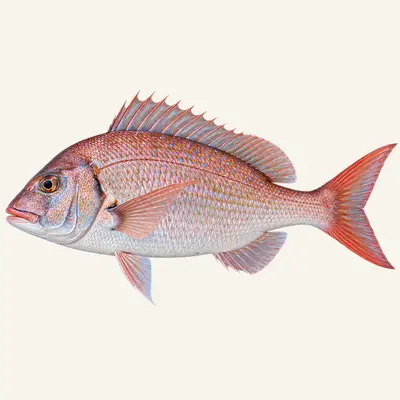
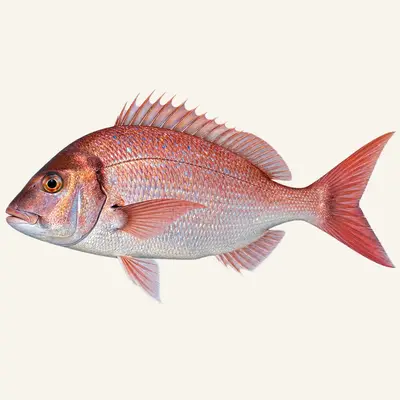
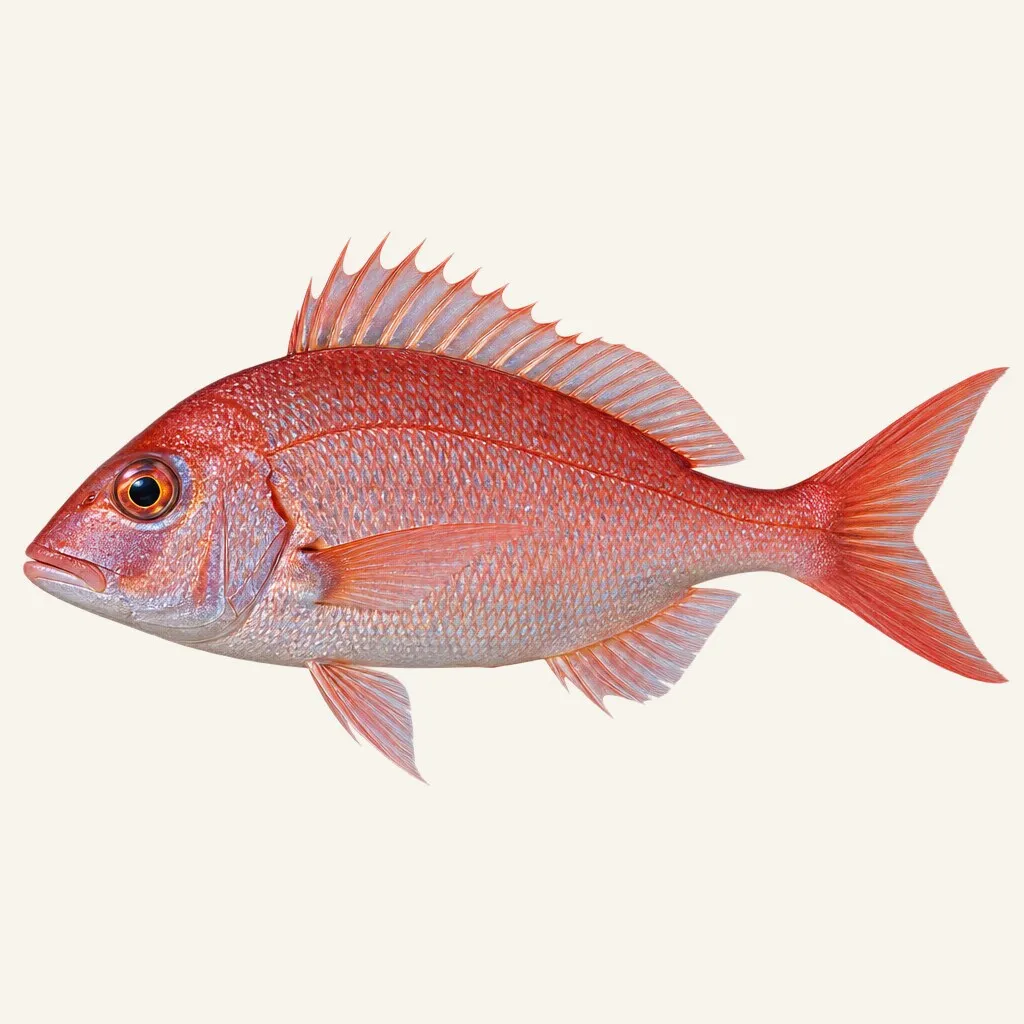
The common pandora is a sparid with pinkish to reddish flanks, adorned with a characteristic silvery-blue spot at the base of the pectoral fin. Its oval, compressed body is found over sandy and muddy coastal bottoms of the eastern Atlantic and Mediterranean, between 20 and 200 m depth.
Calendar
Its range
The eastern Atlantic from Norway to Guinea-Bissau, taking in Cape Verde, Madeira and the Canaries, plus the whole Mediterranean.
The northern end of that list needs reading carefully. Scandinavian occurrences are described as rare, and the species is subtropical: the belt it actually occupies runs from roughly 10 to 63 degrees north, with the population weighted heavily towards the warm end. A Norwegian record is a record. It is not evidence of a fishery.
Identifying it
Plain red, and that is the whole description: no stripes, no bars, no dark mark at the shoulder or above the pectoral base. Nearly every other sparid working the same ground carries a spot or a stripe somewhere, so an unmarked red flank settles the question before anything is measured.
Measure anyway, because one proportion separates this fish from the pandora it is most often filed alongside. The snout is at least twice as long as the eye is wide. In the blackspot seabream it is shorter than the eye. There is no overlap between those two states, and no lighting condition in which one looks like the other.
Twelve dorsal spines, then 10 or 11 soft rays. Three anal spines, then eight or nine.
Breeding
Female first, male afterwards. This species is a protogynous hermaphrodite: it matures as a female, spawns as one, and turns male during its third year at around 17 cm. Individual switches have been recorded from 12.8 to 20.3 cm fork length, so the threshold is a band rather than a line.
First maturity arrives at about 14 cm, within a range of 13 to 16. That is a small fish by the standards of the family, and it is already breeding.
In the southern Mediterranean there may be two spawning periods in the year rather than one.
The gilt-head bream, on the same coast and often over the same bottom, runs in the opposite direction. It begins male and becomes female. Two sparids, one shore, two hermaphroditisms pointing opposite ways.
The water it needs
Substrate barely matters. Rock, gravel, sand and mud are all listed, and the fish is taken over all four, which is unusual in a family where most species are tied to one kind of ground. Depth runs to 200 m in the Mediterranean and 300 in the Atlantic, but the working band is 20 to 100.
The seasonal movement is vertical and it is the fact that organises the whole fishery. In warm water the fish sits on ground a shore or small-boat angler can reach. In winter it drops into deeper water and goes out of reach. The same mark yields everything or nothing depending on the month, and neither result says anything about how many fish there are.
Areas
- Coastal detrital bottoms
- Marine seagrass beds
- Deep sandy areas
- Edges of rocky structures
Techniques
- Baited bottom fishing
- Handlining
- Drift fishing
- Float fishing
Baits
- Shrimp
- Sandworms
- Squid
- Mussels
- Crabs
What it eats
Omnivorous on paper, in practice a feeder on bottom invertebrates with a real share of small fish.
That share is the point. This family is full of shell-crushers carrying rows of heavy molars, and their diet stops at whatever they can break open. The common pandora takes mobile prey as well, which means it can be caught on things that move and that its foraging is not confined to what sits still on the bottom.
How to catch it
Three facts do the work, and the third changes what a capture means.
The first is the calendar. The fish comes up onto accessible ground as the water warms and withdraws when it cools, so the timing of a session matters more than the choice of mark.
The second is the ground itself. Because rock, gravel, sand and mud all hold this species, it can be searched where the more specialised sparids simply are not, and a featureless sand bottom that would be written off for other fish is legitimate here. The mixed diet then leaves the bait open: sediment baits work, and so do small lures, which is not true of the strict crushers.
The third is sex. A large common pandora is a male, because a fish that size has passed the switch. A large gilt-head bream is a female, because that species switches the other way. Both are deep-bodied, both are silver-to-warm-toned sparids of the same coasts, and nothing on the outside of either fish announces which rule it obeys. The species identification is what supplies the sex, and getting the species wrong inverts the answer rather than blurring it.
One consumption note belongs on the page: ciguatera poisoning has been reported from this species. It is not a general property of the fish but of particular waters, and it is a question to put locally rather than to settle from a book.
Conservation
Protogyny reverses the standard argument about large fish, and the reversal is worth following through.
In a species that matures female and stays female, cropping the top of the size range removes eggs. Here it removes males. A stock fished down so that few individuals get past 17 to 20 cm is a stock running short of the only sex that can fertilise anything, and it arrives at that state while still looking healthy — plenty of fish, all of them female, none of them large.
Against that sits the early maturity. At 14 cm, most fish entering a commercial or recreational catch have already spawned at least once as females, which protects the base of the recruitment in a way that late-maturing species do not enjoy.
The species is an important food fish across its whole range, and that is the pressure. It is not a targeted collapse but a steady, everywhere removal of the larger end of the size range, which in a protogynous fish is a removal aimed precisely at the males.
Regulations
Check the local regulations in force (legal size limits, closed seasons, bag limits).
For guidance only. Legal sizes, quotas and open seasons vary by location and season: always check the local regulations in force before fishing.
Other names
Common pandora in English. The qualifier is not decoration: pandora is applied to several Pagellus that live at completely different depths and are in completely different situations, and the bare word identifies a genus rather than a fish.
Erythrinus is from the Greek for red, which is the one thing the name and the animal agree on without qualification.
Spanish has breca, Italian pagello fragolino, French pageot commun. On an English-language fish counter the label is likelier to read sea bream, a trade term covering a large number of unrelated sparids, and it settles nothing about which one is on the ice.
Sources: fishbase.se · api.gbif.org