Common two-banded seabream
Diplodus vulgaris · Sparidae
- Saltwater
- Coastal
- Medium
- Size
22–45 cm
- Weight
0.2–1.3 kg
- Depth
0–160 m
Where to fish
- Beach
- Rocky shore
Habitat icons: Flaticon
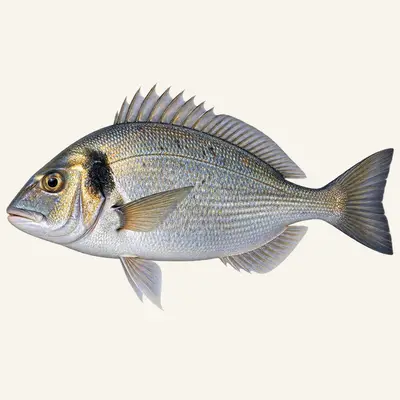
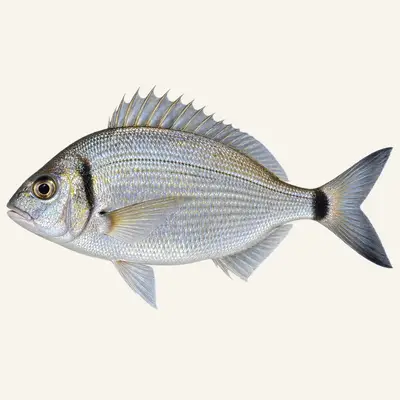
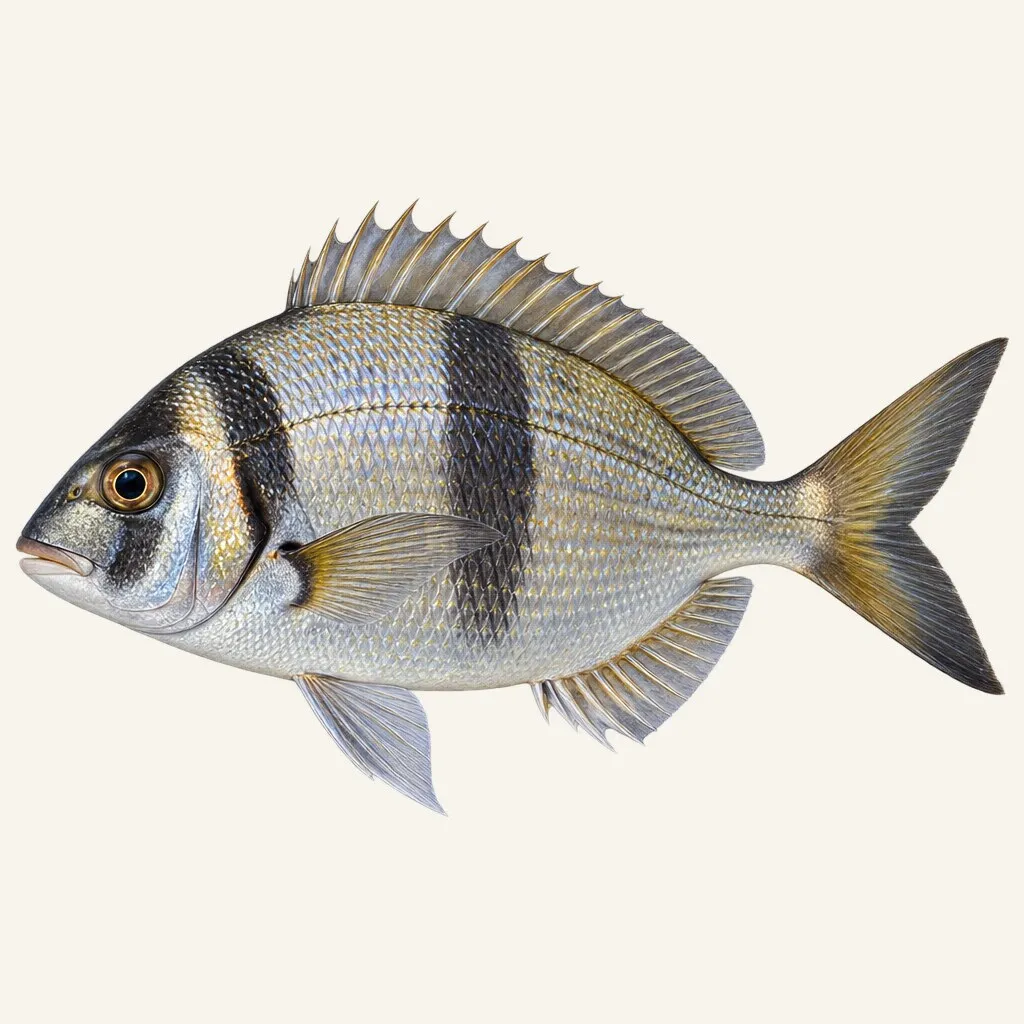
The two-banded sea bream is identified by its distinctive black patch on the nape and two dark bands at the tail base. A robust coastal sparid, it inhabits rocky reefs and posidonia meadows across the Mediterranean and eastern Atlantic.
Calendar
Its range
From the Bay of Biscay south to Cape Verde and the Canaries, right through the Mediterranean, into the Black Sea off the Bulgarian coast, and again from Angola down to South Africa.
What that spread rests on is tolerance rather than preference. This is a euryhaline fish, at home across a wide range of salinity, and it works rock and sand alike. Its congeners each hold a narrower slot; this one takes whatever a coast offers it.
Identifying it
Two broad black bars, and their placement is the character. One sits across the nape, immediately behind the head; the other crosses the root of the tail. Between them the flank is silver with a gold cast and carries nothing comparable.
English, German and Italian name this fish for those two marks; French calls it for its black head, and Spanish and Brazilian Portuguese name neither. The number is the easy part. What identifies it is where they sit — at the two ends of the body rather than spread along it.
Breeding
The documentation calls the species potentially hermaphroditic, and that phrasing is worth passing on as it stands instead of being converted into a mechanism. No sequence has been established for it, which is unusual in a family where changing sex is the norm and where the direction of the change is generally known.
Maturity, by contrast, is precise and early: 16.6 cm. That is the earliest of these sea breams, and it is the figure to hold on to when comparing their condition, because a fish that spawns at 16 cm has already bred before it reaches a size anyone would keep.
The water it needs
Rocky bottoms, sometimes sandy, down to 160 metres — but far more commonly inside 50, and usually inside 30. Young fish turn up in seagrass.
The comparison is what makes that useful. Where the white seabream holds the breaking waves and the zebra seabream sits well below the reach of a shore rod, this one occupies the entire inshore slice and then pushes on into the desalinated water of estuaries and lagoons, where the rest of the genus does not go.
Areas
- Rocky coastal bottoms
- Posidonia seagrass beds
- Moderate current areas
- Pebble beaches
Techniques
- Baited bottom fishing
- Float fishing
- Surf casting
- Light trolling
Baits
- Sandworms
- Shrimp
- Crabs
- Mussels
- Tube worms
What it eats
Crustaceans, worms and molluscs.
The worm is the item its relatives do not give the same weight to, and it matches the sand this species uses alongside rock. Soft ground holds polychaetes and a rock face does not, so a fish feeding over both has a food source the strictly rock-bound cannot reach.
How to catch it
The breadth of habitat is the starting information. This sea bream is taken from the shore and from a boat, over rock and over sand, and up into brackish lagoons where its relatives are absent. There is no single sort of ground to search, which cuts both ways: nothing is ruled out and nothing is indicated either.
Lugworm and ragworm are what distinguish the bait list. They work better here than on the strictly rocky species, for the same reason the diet includes worms at all.
Early maturity explains the size of the average catch. Fish of 20 to 25 cm make up most of what comes in, the common length being about 22. At that size the fish on the hook has usually spawned at least once already, and anything much larger is a rarity.
Conservation
Not much presses on the adults. This is an important food fish across the whole range, and its tolerance protects it better than its relatives are protected: something that accepts rock, sand, deep water and brackish lagoons has somewhere to go when one of them degrades.
The exposure is at the other end of the life cycle. The young use seagrass, and a nursery that disappears does not show in the adult catch for several years. The lag is the whole difficulty — by the time landings move, the cause is several seasons old and no longer obvious.
Regulations
Check the local regulations in force (legal size limits, closed seasons, bag limits).
For guidance only. Legal sizes, quotas and open seasons vary by location and season: always check the local regulations in force before fishing.
Other names
Common two-banded seabream is the full English name: four words, three of them doing necessary work, and nobody uses it. "Two-banded" is the identification, "common" translates the epithet vulgaris, and "seabream" is the family.
The word to watch is "common". It is a claim about abundance made in Latin, not a statement that this is the sea bream an English speaker will meet most often — and in French the same adjective belongs to a different species, Diplodus sargus, as sar commun. So two fish of one genus both carry "common" in a name, in different languages, on the same coast. When precision is needed the bars settle it and the adjective does not.
Sources: fishbase.se · api.gbif.org