Gilthead seabream
Sparus aurata · Sparidae
- Saltwater
- Coastal
- Medium
- Size
35–70 cm
- Weight
0.6–17 kg
- Lifespan
14 years
- Depth
1–150 m
Where to fish
- Estuary
- Beach
- Rocky shore
Habitat icons: Flaticon
Found over seagrass beds and sandy bottoms as well as in the surf zone, commonly down to about 30 m, though adults may reach depths of 150 m. A sedentary fish, either solitary or in small groups.
Calendar
Recorded in 14 countries
Albania · Algeria · Croatia · France · Greece · Israel · Italy · Montenegro · Netherlands · Portugal · Slovenia · Spain · Türkiye · United Kingdom
GBIF occurrence records — native and introduced populations combined.
Its range
The species holds the eastern Atlantic from the British Isles south through the Strait of Gibraltar to Cape Verde, taking in the Canaries, and the whole of the Mediterranean. There are records from the Black Sea.
The shape of that range is a temperature envelope rather than a history. This is a subtropical fish, and the Mediterranean plus the warm eastern Atlantic margin is precisely the water it is built for; the British Isles mark the cold end, where it occurs rather than abounds, and where a capture is an event rather than a routine.
One correction is worth carrying, because it recurs in English-language sources. Reports of this species from New Zealand are not this species. They refer to Pagrus auratus, the Australasian snapper, whose scientific name is close enough to invite the mistake and whose life is nothing like it.
Identifying it
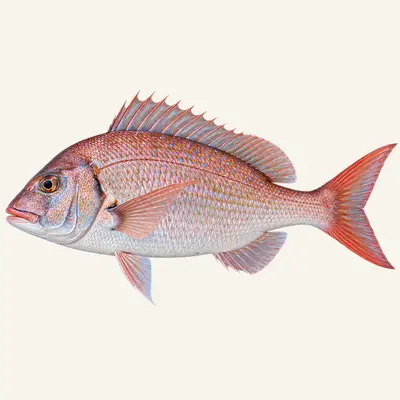
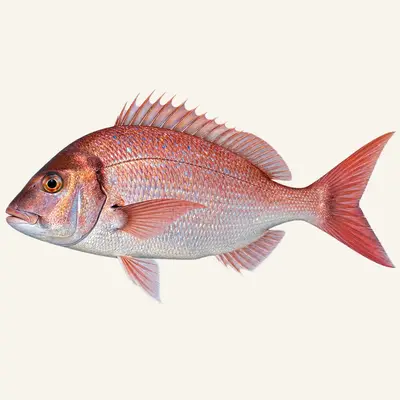
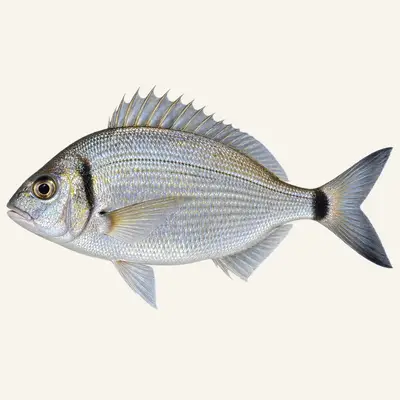
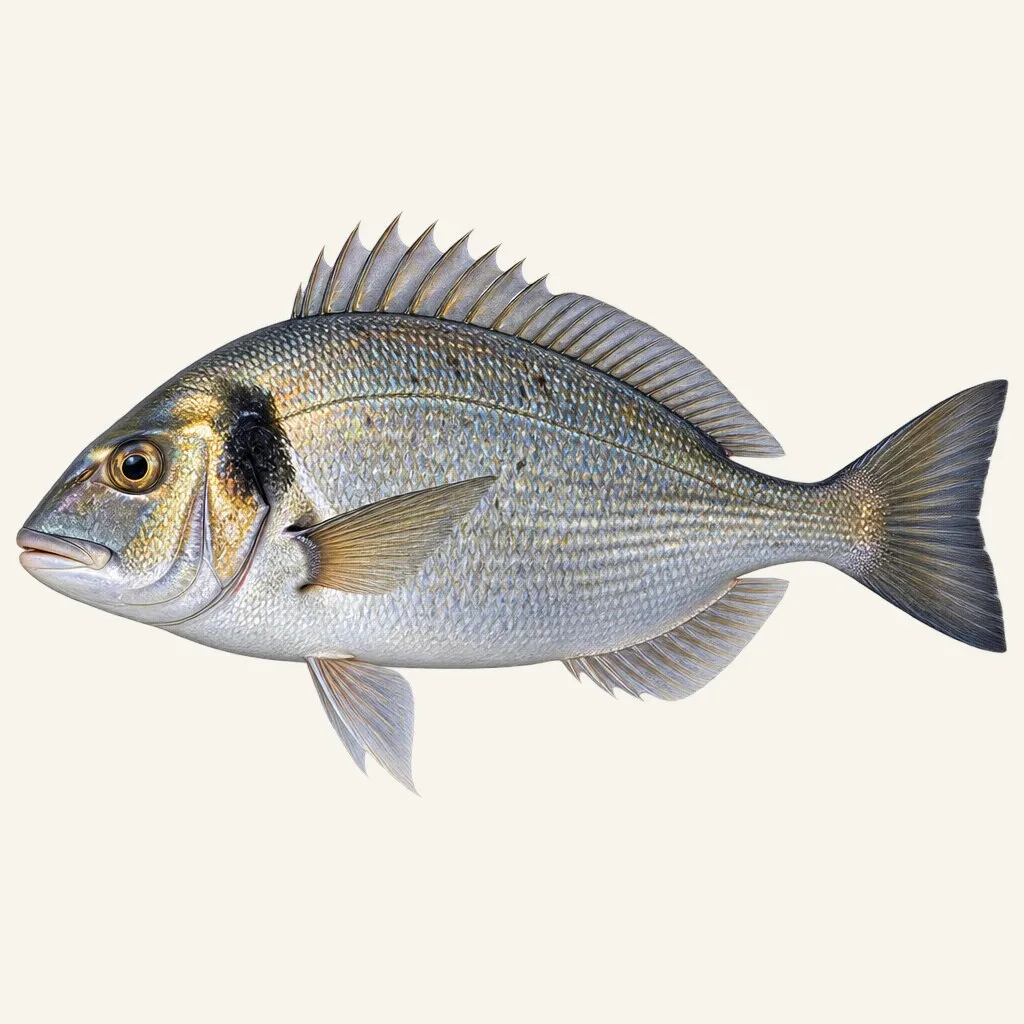
The gold bar across the forehead, between the eyes, is what the fish is named for in nearly every language that has a name for it. On a fresh fish it is bright and unmistakable. It fades within hours of death, which is why a specimen on ice can look like a different animal from the one that came over the gunwale.
The character that does not fade is the black blotch on the gill cover, large and well defined, sitting where the lateral line starts. Once the gold has gone, that mark is what identification works from.
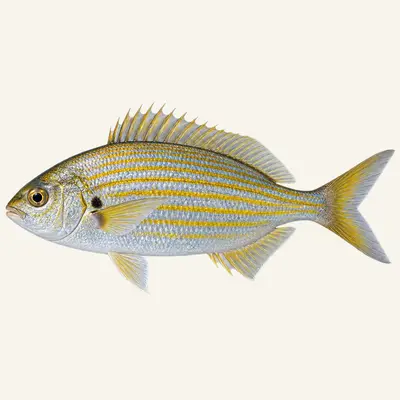
The body is deep and strongly compressed in the standard sparid pattern, silver with a grey-blue wash over the back. The snout measures more than twice the diameter of the eye, a proportion worth using: it gives the head a longer, less abrupt profile than the other deep-bodied fish sharing the same ground.
The dorsal fin carries 11 spines with 13 or 14 soft rays, the anal three spines and 11 or 12. Inside the mouth is the equipment that explains the rest of the animal — cutting teeth at the front, heavy rounded molars behind them, in rows, on both jaws.
Breeding
A gilt-head changes sex partway through life, and in one direction only. It matures first as a male, during its first or second year, then turns female after its second or third — around three years old in most accounts. This is protandry, and it is not an anomaly or an accident. It is how the species is built.
The consequence is simple and it governs everything downstream: small gilt-heads are males and large ones are females. A population's entire egg production is carried by its biggest fish. Where a species with fixed sexes loses a mixture when large individuals are taken out, this one loses only females, and there is no reservoir of large males waiting to take over.
Spawning runs from October to December, in sequence rather than as a single event, with batches released across the whole period. Eggs are around a millimetre and hatch in about two days at 16 to 17 degrees. The larval stage is long for a fish of this coast — roughly 50 days at 17.5 degrees, dropping to about 43 at 20 — and larvae hatch tiny, at 2.5 to 3 millimetres. There is evidence pointing to simultaneous hermaphroditism as well, which would make the arrangement more flexible still.
The water it needs
Seagrass beds and sand are the two habitats, with the surf zone as the third. Most fish sit in the top 30 metres and many in the top few, though adults will go to 150 when it suits them.
It is a sedentary fish, alone or in small groups, which sets it apart from the shoaling species working the same ground. A spot that holds a gilt-head tends to keep holding one, and that is the single most useful thing to know about where it lives.
The seasonal move is into low salinity. In spring the fish push into brackish coastal lagoons and estuaries, following food into water most marine fish of their size will not enter. That behaviour is old news to the people of those coasts: the extensive lagoon fisheries of the Mediterranean, which trap fish on the way in and harvest them on the way out, are built on it and have been for a very long time.
Areas
- Seagrass meadows
- Rocky coastal bottoms
- Sandy beaches
- Estuaries
Techniques
- Baited bottom fishing
- Surf casting
- Light trolling
- Soft lure fishing
Baits
- Shrimp
- Crabs
- Sandworms
- Mussels
- Cuttlefish
What it eats
Mainly carnivorous, incidentally herbivorous, and specifically a crusher of shells. Mussels and oysters are on the list, along with the rest of the hard-shelled fauna of sand and seagrass.
The molars explain the diet and the diet explains the molars. Very few fish in this water can open a mussel, and the ones that can have access to a food source that is abundant, stationary and almost uncontested. It is an efficient way to make a living, and it has an obvious corollary for anyone growing shellfish on the same coasts: a fish that opens cultivated mussels and oysters is a working problem rather than a curiosity.
How to catch it
Two facts organise the fishing. The fish crushes shells, and the fish does not travel.
The first sets the tackle. Baits matching the natural diet — crab, prawn, mussel, razorfish — outfish everything else, and terminal tackle has to survive a mouth that deals with oyster shell as a matter of routine. A light hook comes back straightened. Against that, the bite is unnervingly soft for an animal this powerful: it inspects, mouths, crushes, and the first indication is often no more than the line drawing tight.
The second sets the search. A gilt-head holds a patch of ground, so a mark that has produced one is worth returning to, and groundbait works by settling a fish that is already there rather than by pulling fish in from a distance. Seagrass edges, channel margins, the lips of sandbanks and any bottom carrying shellfish are the ground to work.
Season follows the fish. Spring, as they move into the lagoons and estuaries, and autumn, immediately before spawning, are the two dependable windows.
Then there is the fact that changes what a decision means. A large gilt-head is a female carrying that population's eggs, and there is no way for it to be anything else. That is worth knowing before deciding whether a big one goes in the box or back over the side.
Conservation
Farming is what complicates the picture here. This is one of the most heavily produced species in Mediterranean marine and hypersaline aquaculture, and that has two effects worth separating. It has decoupled the market from the wild stock, so commercial demand says less about pressure on wild fish than it used to. And it puts very large numbers of cage-reared animals in the water alongside wild ones, which makes any attempt to read the state of the wild population from what is landed considerably harder.
Protandry sits underneath the whole question. A stock whose reproduction is concentrated entirely in its largest individuals responds to size-selective removal differently from a stock with separate sexes: take the big fish and the eggs go with them, with no compensating pool of large males left behind. Management that ignores that difference is managing something other than what is in the water.
Regulations
Check the local regulations in force (legal size limits, closed seasons, bag limits).
For guidance only. Legal sizes, quotas and open seasons vary by location and season: always check the local regulations in force before fishing.
Other names
Gilt-head bream in full, gilthead seabream on labels, and both come straight off the gold bar between the eyes. Sparus is the classical name for the fish and aurata means gilded, so the scientific name says the same thing twice over. Spanish dorada, Italian orata and French daurade royale all say it again.
The difficulties come from the market rather than from the animal. "Sea bream" in English covers a large number of unrelated sparids sold under a shifting set of trade names, so the English label on a slab settles very little on its own. And Pagrus auratus, half a world away, carries a specific epithet meaning exactly the same thing and is regularly mistaken for this fish in print.
Sources: fishbase.se · api.gbif.org