Common snook
Centropomus undecimalis · Centropomidae
- Saltwater
- Coastal
- Medium
- Size
50–140 cm
- Weight
1.0–24 kg
- Lifespan
7 years
- Water temp.
25–31 °C
Where to fish
- Estuary
Habitat icons: Flaticon
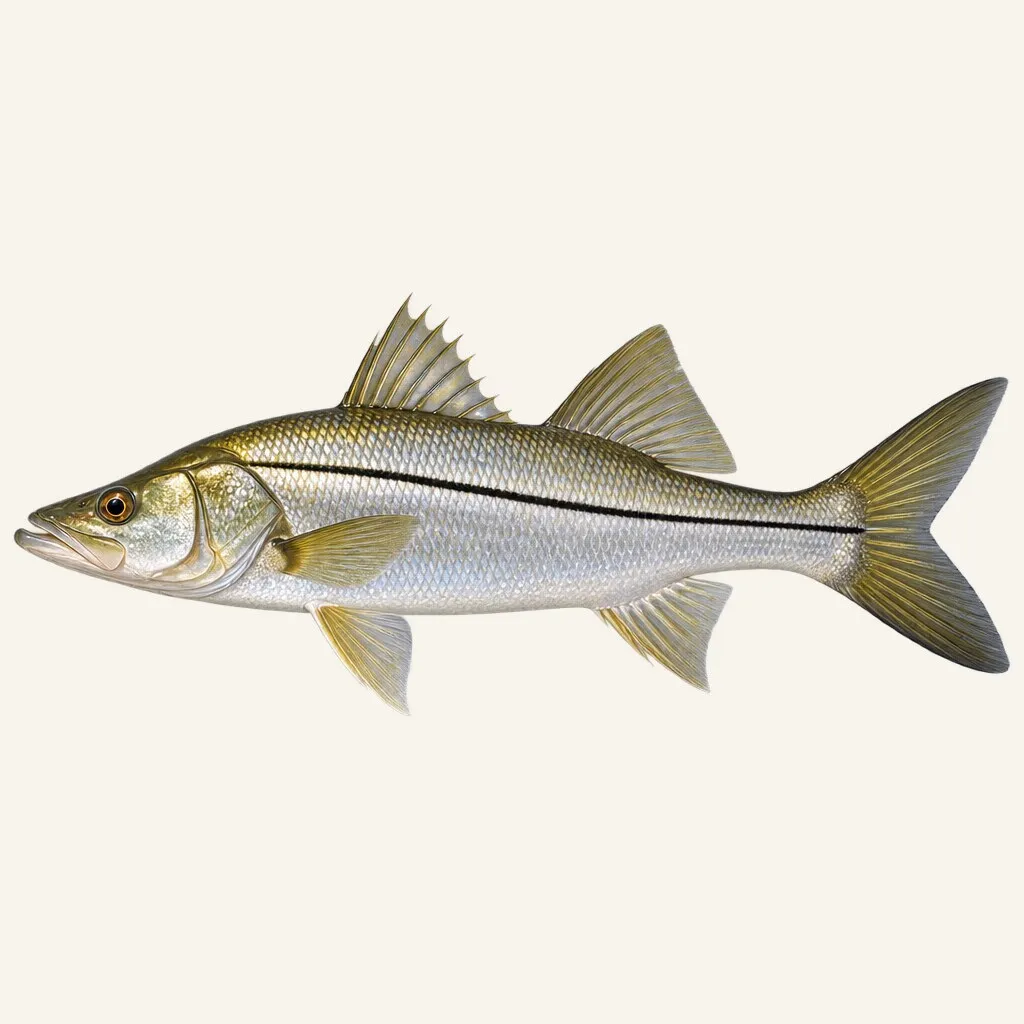
Powerful inshore fish with an elongated body and a distinctive black lateral line, prized for its explosive fights and fine flesh.
Calendar
Recorded in 17 countries
Belize · Brazil · Colombia · Costa Rica · Cuba · French Guiana · Guadeloupe · Guatemala · Guyana · Honduras · Mexico · Panama · Puerto Rico · Suriname · Trinidad & Tobago · United States · Venezuela
GBIF occurrence records — native and introduced populations combined.
Its range
The recorded thermal band is 25 to 31 degrees, which is narrow, and the shape of the range follows from it. The continuous part runs from southern Florida and the south-eastern Gulf of Mexico through most of the Antilles and along the Caribbean coast of Central and South America to Rio de Janeiro.
North Carolina and Texas then appear as separate entries rather than as extensions of that line. Read them as the cold edge of a tropical fish: places it reaches and holds in some years, at latitudes where a single cold spell undoes the occupation.
Identifying it
A black line is drawn along the flank. The lateral line of a snook is pigmented, sharp-edged and unmistakable against silver. What the count does is place the fish inside its genus: 67 to 72 pored scales along that line, from the head to the base of the tail.
The rest of the fin formula is short. Eight or nine dorsal spines, 10 soft rays, three anal spines and six soft rays. That last number is the one to keep: six is a low count, and it is the sort of figure a key is built on. The body is fusiform.
Breeding
Mature fish gather at the mouths of passes and rivers through the spawning season, from May to September.
Five months of concentration at narrow points of passage is the whole vulnerability of the species. Fish that are spread through miles of mangrove and estuary for the rest of the year all pass through the same few hundred metres of water, at a season anyone can look up.
Seasonal movements into fresh water also occur, and the source says plainly that they are poorly understood. That is an admitted gap on a heavily fished animal, and it has a practical edge: nobody can price what an estuarine barrier costs a population whose freshwater phase has not been mapped.
Maturity is reached from 42 cm. The maximum reported age is seven years.
The water it needs
Adults use coastal water, estuaries and lagoons, push into fresh water, and are usually inside 20 m. Mangrove is named specifically, and it is the term that ties the rest together.
Almost everything about the animal is a mangrove-and-estuary specification: shallow, warm, sheltered, structured by roots and channels rather than by rock or reef. A snook is a fish of edges — the line where a channel meets a root system, where a flat drops into a creek, where moving water meets still.
Areas
- Florida and Gulf of Mexico
- Caribbean
- Central American coasts
- Brazilian estuaries
- Inlets and river mouths
Techniques
- Lure casting
- Sight fishing in mangroves
- Live baiting
- Fly fishing
- Night fishing under dock lights
Baits
- Mullet and live baitfish
- Live shrimp
- Soft plastics (swimbaits)
- Hard jerkbaits/plugs
- Fly streamers
What it eats
The prey list is specific enough to be useful. Fishes of three families — gobies, mojarras and anchovies — plus crustaceans, shrimps and crabs.
Not one item on it is a reef fish or an open-water fish. Those three families are the small silvery inhabitants of estuaries, mangrove creeks and beach edges, which confirms where the predator makes its living better than any habitat list could.
It also settles the bait. A live shrimp and a small estuarine baitfish are not a compromise here; they are what the animal has been eating all its life.
How to catch it
Structure and edge first, everything else second. The marks are river mouths, passes, mangrove channels and the lower reaches of rivers, in less than 20 m of water, and the fish will be against the cover rather than out from it.
The May-to-September aggregation at the passes is the most productive window of the year and the most delicate. Fish are concentrated, findable and busy with something other than watching the water — a combination that produces catches and, applied hard, produces nothing the following year.
Then the salinity. This is an amphidromous fish that penetrates fresh water, so a search that stops at the tidal limit stops early. What the record cannot say is when it goes up and why, so the freshwater fishing is a matter of local observation rather than of a published season.
Common length is 50 cm, and seven years is the whole of the life available to reach it. Growth is quick and the fish is not long-lived, which is worth knowing before assuming a big one is an old one.
Conservation
Seven years of life and maturity at 42 cm give a fast turnover, and that counts in the species' favour. A population knocked back can rebuild inside a few years, which is not true of the long-lived coastal fish it is often grouped with.
The break point is the aggregation. Five months during which the entire breeding stock of a district files through a handful of narrow openings is an arrangement that concentrates risk to a degree that no amount of fast growth compensates.
Mangrove supplies the second pressure, and it is independent of fishing altogether: clearance, embankment and channel works remove the ground itself. The third is the admitted ignorance about the freshwater movements — a population can be losing access to part of its range without anyone being able to say what the loss amounts to.
Regulations
Strictly regulated in Florida (slot limit, bag limit, permit and seasonal closures); check local regulations.
For guidance only. Legal sizes, quotas and open seasons vary by location and season: always check the local regulations in force before fishing.
Other names
Common snook in English, and snook has nothing to do with any pike: the resemblance in outline is convergence, and the family is the Centropomidae. Common distinguishes it from the other snooks of the same genus, which are separated from it on counts of exactly the kind given above.
Spanish and Portuguese use róbalo and robalo, and there the trouble starts. In this catalogue alone, robalo is the Portuguese name of this fish, of the European sea bass, of the Japanese seabass and of the Waigieu seaperch — four families, one word. A market name in that language locates a fish in a shape, not in a genus.
Sources: fishbase.se · api.gbif.org