Red porgy
Pagrus pagrus · Sparidae
- Saltwater
- Coastal
- Medium
- Size
35–91 cm
- Weight
0.6–7.7 kg
- Lifespan
26 years
- Depth
0–250 m
Where to fish
- Estuary
- Beach
- Rocky shore
Habitat icons: Flaticon
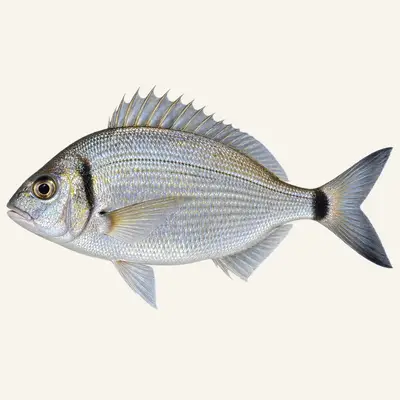
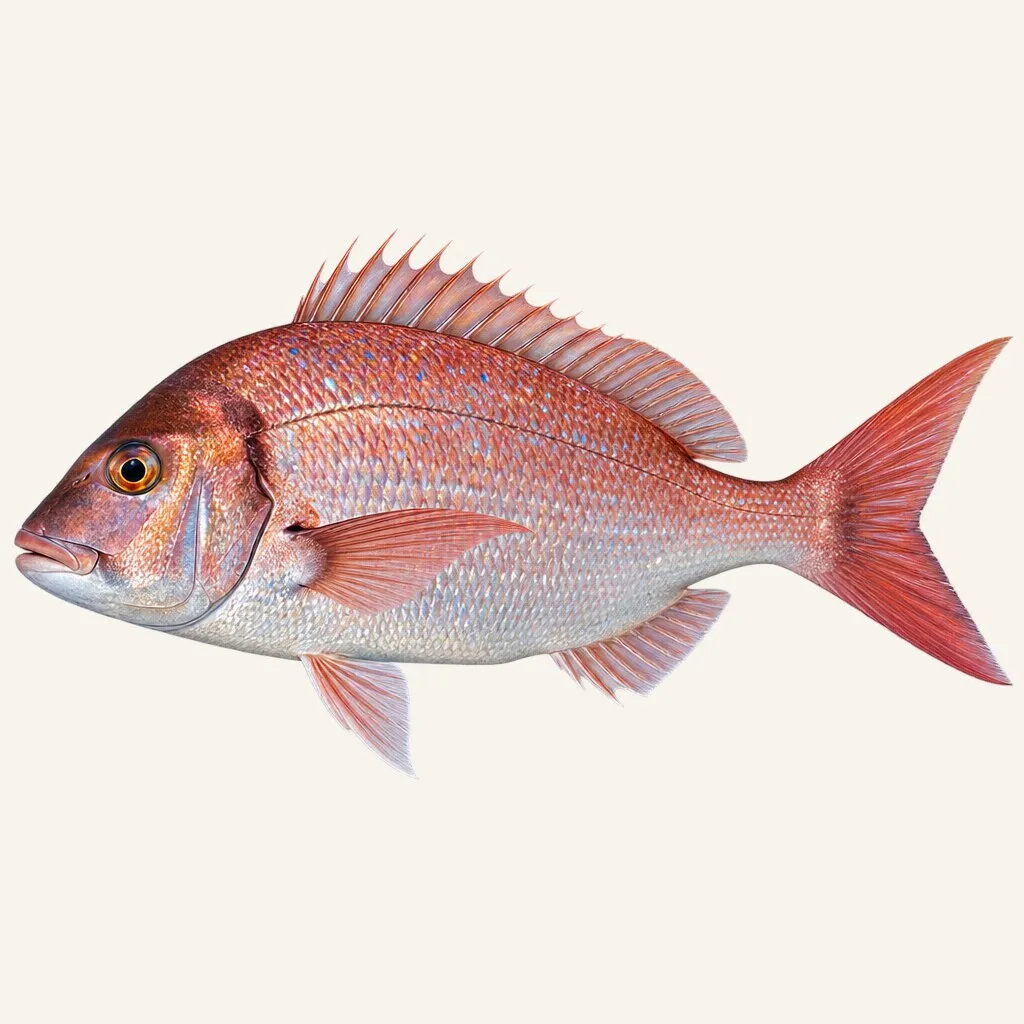
The common seabream is a sturdy sparid with a compressed oval body, silvery pinkish-red in colour with brighter highlights on the flanks. Its powerful mouth bears anterior canines and rounded molars adapted for crushing shells and crustaceans on rocky coastal bottoms.
Calendar
Recorded in 23 countries
Argentina · Brazil · Cameroon · Congo - Brazzaville · Côte d’Ivoire · Equatorial Guinea · France · Gabon · Ghana · Greece · Guadeloupe · Guinea · Guinea-Bissau · Israel · Italy · Liberia · Nigeria · Portugal · Puerto Rico · Senegal · Sierra Leone · Spain · United States
GBIF occurrence records — native and introduced populations combined.
Its range
This species holds both sides of the Atlantic, and that is the fact everything else on the page has to be read against.
In the east: from the Strait of Gibraltar down to 15°N, rarely as far as 20, with Madeira and the Canaries, the whole Mediterranean, and a northward extension as far as the British Isles. In the west: from New York State and the northern Gulf of Mexico down to Argentina, along the continental margin of the Caribbean. Fifty-one degrees north to forty-three south.
Two populations, one ocean basin, and no adult movement between them. What that produces is two of everything else. Two commercial fisheries, two management systems, two scientific literatures, two sets of vernacular names. A number established for this species off Greece was established for the eastern stock, and there is no mechanism by which it applies to a fish caught off Georgia.
Identifying it
Open the mouth and read it front to back. Four large canine-like teeth in the upper jaw, six in the lower, standing at the very front. Behind them the teeth get shorter and blunter, and by the back third of each jaw they are molars. Flanking those two outer rows, in the front part of the mouth only, are several rows of very small teeth.
That is a gradient rather than a set of tools, and it is unusual enough to be diagnostic on its own. The seizing equipment and the crushing equipment are not in two separate places; one becomes the other along the length of the jaw.
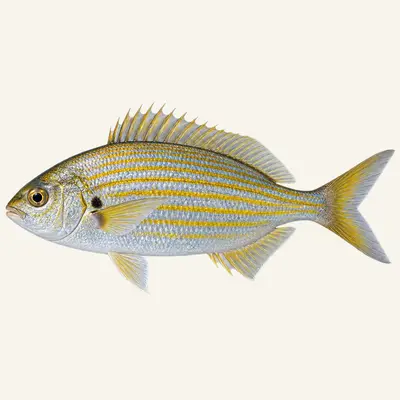
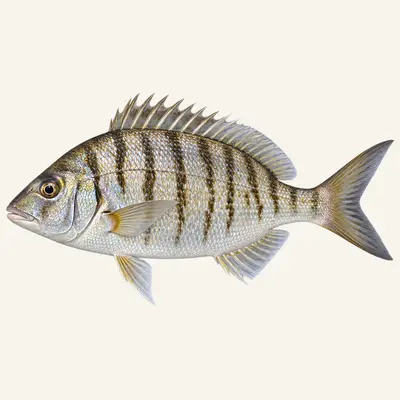
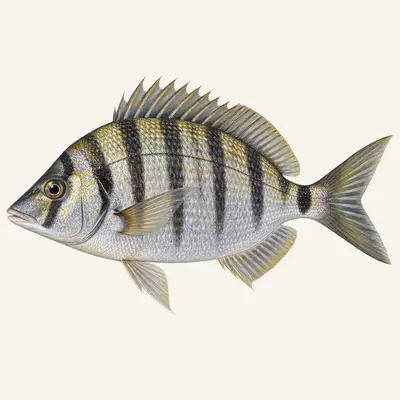
Colour is the field character, and the caudal fin is where it concentrates. The fin is dark pink and both tips are white — a two-point contrast that holds up in poor light and on a wet deck. The body is pink with silver over it, paler on the belly. The head is dark from the nape down to the corner of the mouth. There is often a darker patch in the armpit of the pectoral fin. Fine blue dots may be scattered over the upper flank; they are obvious on young fish and go later.
For the counts: 12 dorsal spines and 9 to 12 soft rays, three anal spines and eight or nine. Fifty-two to sixty scales along the lateral line, six or seven rows on the cheek, and a preopercle with no scales at all. The first gill arch carries eight to ten rakers on its lower limb and six to eight on the upper.
Breeding
Female first, male afterwards. First maturity comes at three years and around 24 cm, and the fish spawns as a female before it becomes anything else. Length at first maturity is elsewhere given as 26.6 cm with a range starting at 19.
Spawning is governed by a temperature window of 15 to 19 °C. Four degrees is a narrow tolerance, and it means the calendar is set by the water rather than by the month. Across most of the range spawning falls in spring. In the Canary Islands, where the water reaches that band earlier, it can begin in January.
Now put that against a range that spans both hemispheres. Fifteen to nineteen degrees arrives in April off Iberia, in January in the Canaries, and in the southern-hemisphere spring off Argentina — which is autumn in the north. A spawning season for this species is a local statement. Copying one from the other side of the Atlantic inverts it.
The water it needs
Rock, rubble and sand, from the surface to about 250 metres. The usual band is 10 to 80, and the species is rarely above 150 in the sense of being deeper than that. One record from south-west Brazil puts it at 160.
Ten to eighty metres is a narrow slice of that envelope, and it is where the fishery is.
The young are somewhere else. They turn up regularly over seagrass and on the open shelf, ground the adults do not use in the same way. A sector that produces nothing but small fish is not a poor sector; it is a nursery, and it will keep producing small fish.
Areas
- Coastal rocky bottoms
- Posidonia meadows
- Estuaries and harbours
- Deep drop-offs
Techniques
- Bottom fishing
- Coastal dropshot
- Light trolling
- Vertical jigging
Baits
- Fresh shrimp
- Squid
- Green crab
- Opened shellfish
- Sardine
What it eats
Crustaceans, fish and molluscs.
The middle item is the one that separates this animal from most of the family. A sparid that takes other fish is hunting something that moves, evades and has to be held once caught, and the front canines are exactly the equipment for it. The molars at the back deal with the first and third items on the list.
Because the jaw does both jobs without compromising either, the diet is not a constraint. Hard prey on rough bottom, mobile prey in the water above it, and no need to specialise in either — which is a fair description of a fish that occupies rock, rubble and sand indifferently.
How to catch it
Ten to eighty metres over rock, rubble or sand is the ground. Seagrass produces juveniles.
The dentition opens the bait list at both ends. Crustacean and opened shellfish work on the bottom, as they do for the shell-crushers of the family; strips of fish and small live baits work as well, and squid and octopus with them, because this fish genuinely hunts. The published diets of several sparids taken on the same marks list no fish at all, so the second category cannot be assumed to travel from one species to the next.
Two things to expect on a fish in the hand. Monogenean flatworms of the genus Anoplodiscus parasitise the skin and fins, so a mark that looks like an injury on a fresh fish is often not one. And reports of ciguatera poisoning exist for this species while its toxic nature is recorded as uncertain — which, on an animal fished on two continental shelves, is a question with a different answer in different places and is asked locally rather than settled from a page.
There is also a bibliographic point worth understanding. Weights of 9 to 17 kg have been reported for fish taken off Greece, 9 to 10 of them from the west coast, and those numbers sit above the maximum weight the species carries in the published record. Neither figure is wrong. A published maximum records what has been weighed and written up, not what swims.
Conservation
Start with the lifespan, because it is the figure that changes the scale of everything else. This fish reaches 26 years and first breeds at three. That is more than two decades of reproductive life per individual, and it means the age structure of a healthy population is decades deep. It also means recovery runs on the same clock: a stock stripped of its older ages does not rebuild in a season, because the fish that would do the rebuilding have to be grown.
Those twenty-odd years are spent in 10 to 80 metres of water. There is no deep refuge below that band and no shallow one above it, and on both of the shelves this species occupies that is the depth worked hardest by line, net and trawl. The animal is available for its entire adult life.
Sex adds a wrinkle rather than the main story. Because the change runs female to male, the large fish here are the males — the opposite of what holds for the gilt-head bream over the same bottom, and a reason why no single rule about releasing large fish serves both.
Aquaculture is the one thing pulling the other way. The species is farmed commercially on both sides of the Atlantic, which decouples what appears on a market slab from what is happening offshore. Availability at the fishmonger stopped being evidence about the wild stock some time ago.
Regulations
Check the local regulations in force (legal size limits, closed seasons, bag limits).
For guidance only. Legal sizes, quotas and open seasons vary by location and season: always check the local regulations in force before fishing.
Other names
Red porgy in North America, Couch's sea bream in Britain, and the two names have almost nothing in common — which is what happens to a species with two separate fisheries and no contact between them.
The binomial is a tautonym: Pagrus pagrus, genus and epithet identical, the mark of a fish named early and never needing revision.
The word to be careful with is pargo. English took porgy from it, so an English speaker reasonably reads a Spanish or Portuguese menu offering pargo as offering this family. In most of Latin America it does not: pargo there is normally a snapper, family Lutjanidae, an unrelated fish with a different body, a different price and a different fishery. Brazilian Portuguese resolves the collision by calling this species pargo-legítimo, the legitimate one — an adjective nobody adds to an undisputed name.
Spanish pargo, Italian pagro, German Sackbrasse.
Sources: fishbase.se · api.gbif.org