Humpback red snapper
Lutjanus gibbus · Lutjanidae
- Saltwater
- Coastal
- Medium
- Size
45–57 cm
- Weight
1.3–2.8 kg
- Lifespan
24 years
- Depth
1–150 m
Where to fish
- Reef
Habitat icons: Flaticon
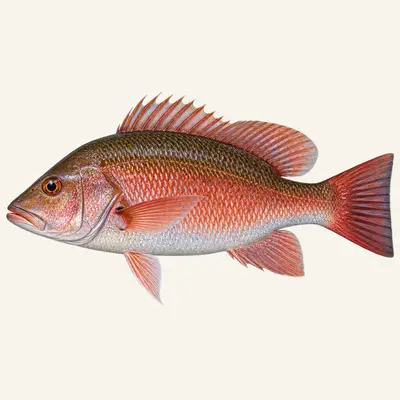
The humpback red snapper owes its name to the distinctive nuchal hump that develops on adults, a unique trait among lutjanids. Its stocky pinkish-orange body and slightly forked tail are characteristic of tropical reef species across Asia, Africa, and Oceania.
Calendar
Recorded in 31 countries
American Samoa · Australia · Fiji · French Polynesia · French Southern Territories · Guam · India · Indonesia · Japan · Kenya · Kiribati · Maldives · Marshall Islands · Mayotte · Micronesia · Mozambique · New Caledonia · Northern Mariana Islands · Palau · Papua New Guinea · Philippines · Samoa · Seychelles · Solomon Islands · South Africa · Taiwan · Tonga · Tuvalu · United States · Vanuatu · Wallis & Futuna
GBIF occurrence records — native and introduced populations combined.
Identifying it
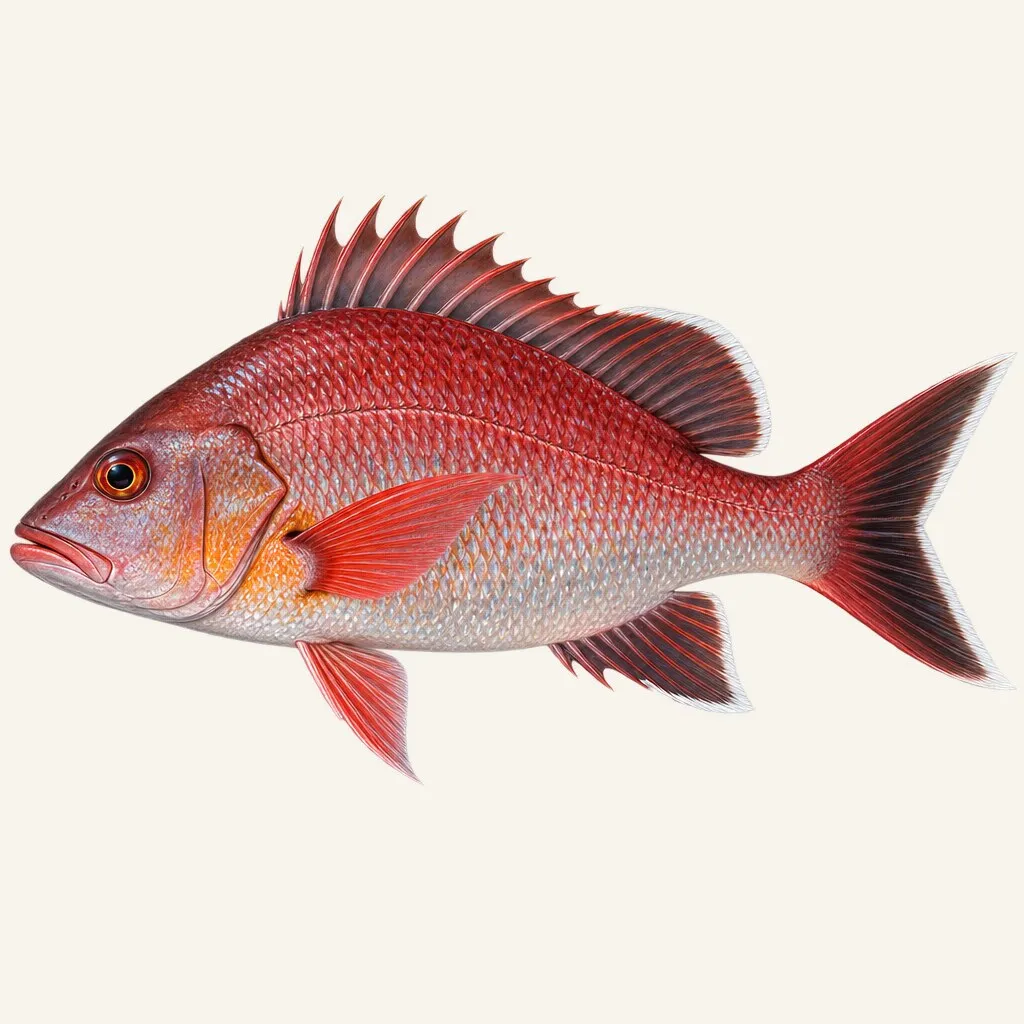
The tail settles it. The caudal fin is clearly forked and both lobes are rounded at the tip, a combination rare enough to identify the fish underwater, where colour misleads.
The fins come next. Body colour shifts from red to greyish with mood and light, but the fins stay dark brown to blackish, edged with a narrow white margin on the soft dorsal, the anal and the caudal. An orange tint marks the lower gill cover and the pectoral axil, while the pectoral fins themselves are red.
Juveniles carry a large round black spot at the base of the tail. It fades as they grow.
The hump the name promises can be measured: body depth goes 2.2 to 2.5 times into standard length. That is the deepest profile among the snappers of this range, by a small margin. The preopercular notch and knob are well developed, and the vomerine tooth patch forms a crescent with no median extension.
One figure stands apart because it predicts the diet — 25 to 30 gill rakers on the first arch, rudiments included. For a lutjanid that is a great many, and it describes a fish that retains prey smaller than a pure piscivore would bother with.
Breeding
Off East Africa, spawning concentrates in spring and summer.
The remarkable part is the individual timetable. First maturity comes at about 21.5 cm — a little over a third of the achievable size, the earliest ratio in the genus — after which the fish may live 24 years without ever becoming a heavy one.
The water it needs
Sub-adults form very large schools that stay put through the day, or drift slowly along a slope. Adults aggregate too, sometimes in numbers, and those groups are equally stationary in daylight.
This is the trait that organises everything else about the species. A school here is not a moving mass to be intercepted: it is a fixed point on the reef, in the same place from one day to the next, dispersing only after dark.
Juveniles live apart, in seagrass and over the mixed sand and coral of sheltered shallow reef. Large individuals work coastal slopes at moderate depth instead. The fish is benthopelagic, holding above the bottom without settling on it.
Areas
- Coral lagoons
- Reef passes
- Outer reef slopes
- Branching coral zones
Techniques
- Light handline fishing
- Fine soft lure fishing
- Natural bait fishing
- Reef drift fishing
Baits
- Live shrimp
- Small live fish
- Marine worms
- Squid strips
- Crabs
What it eats
The diet is the widest in the genus: fishes first, then shrimps, crabs, lobsters, mantis shrimps, cephalopods, and — unusually — echinoderms, with sea urchins and brittle stars among them.
Those last two entries are the ones worth pausing on. Brittle stars are prey most reef predators decline, and their regular appearance on the list explains the high gill raker count. A fish eating urchins and ophiuroids is working a resource its direct competitors do not touch, which is one way of supporting very large aggregations on a reef that has no shortage of predators already.
How to catch it
The school does not flee, it holds. A quiet drift over a located group beats a powered approach, and a mark that produced once will produce again, because the aggregation reforms in the same place rather than moving on.
That daytime immobility explains the gear in use as well: handlines, traps and gill nets. A trap in particular works on a group that stays where it is.
The fish remains small — 45 cm for a common one — so light tackle is not merely permissible but better. Heavy gear on a fish this size misses bites rather than converting them.
Ciguatera turns up in this species from time to time, particularly around the Pacific islands. Whether it is a concern on any given reef is a local matter with a local answer.
Conservation
Nothing about the vulnerability of this species is seasonal. What concentrates it is not a breeding appointment on a known date but its ordinary way of living: dense groups, motionless, in one place, all year round. An aggregation that can be worked twelve months out of twelve offers the population forming it no window of relief at all.
The biology runs the other way, and that deserves saying too. Maturity at 21.5 cm against a common capture length of 45 means the overwhelming majority of fish taken have already spawned — the reverse of the usual situation among large lutjanids, where the fishery works on animals too young to have bred.
The weak point is therefore the predictability of the place, not the age of the catch. Management by size would change nothing here. Management by area would.
Regulations
Check the local regulations in force (legal size limits, closed seasons, bag limits).
For guidance only. Legal sizes, quotas and open seasons vary by location and season: always check the local regulations in force before fishing.
Other names
English gives this snapper two names that point at two different fins. The books call it the humpback red snapper, after a body depth exceeding its neighbours' by a fraction of a ratio and not remotely obvious in the water. Australian usage calls it the paddletail, after the rounded-lobed tail, which is the character an identification actually turns on.
The hump name has travelled into most other languages. The paddle name has stayed where the fish is caught, which is the usual fate of the more useful of two names.
Sources: fishbase.se · api.gbif.org