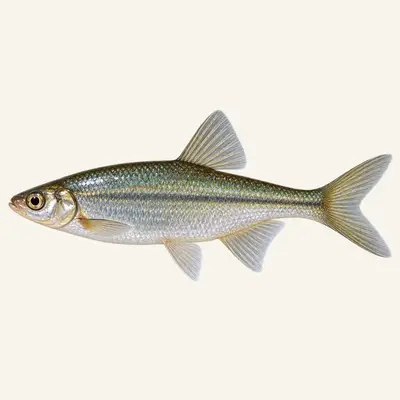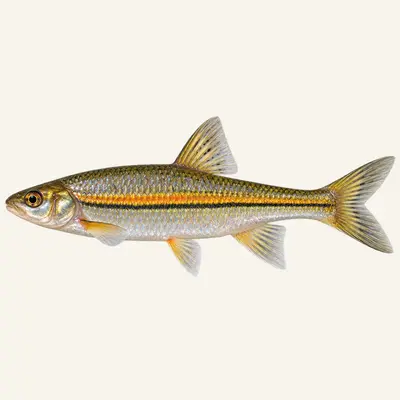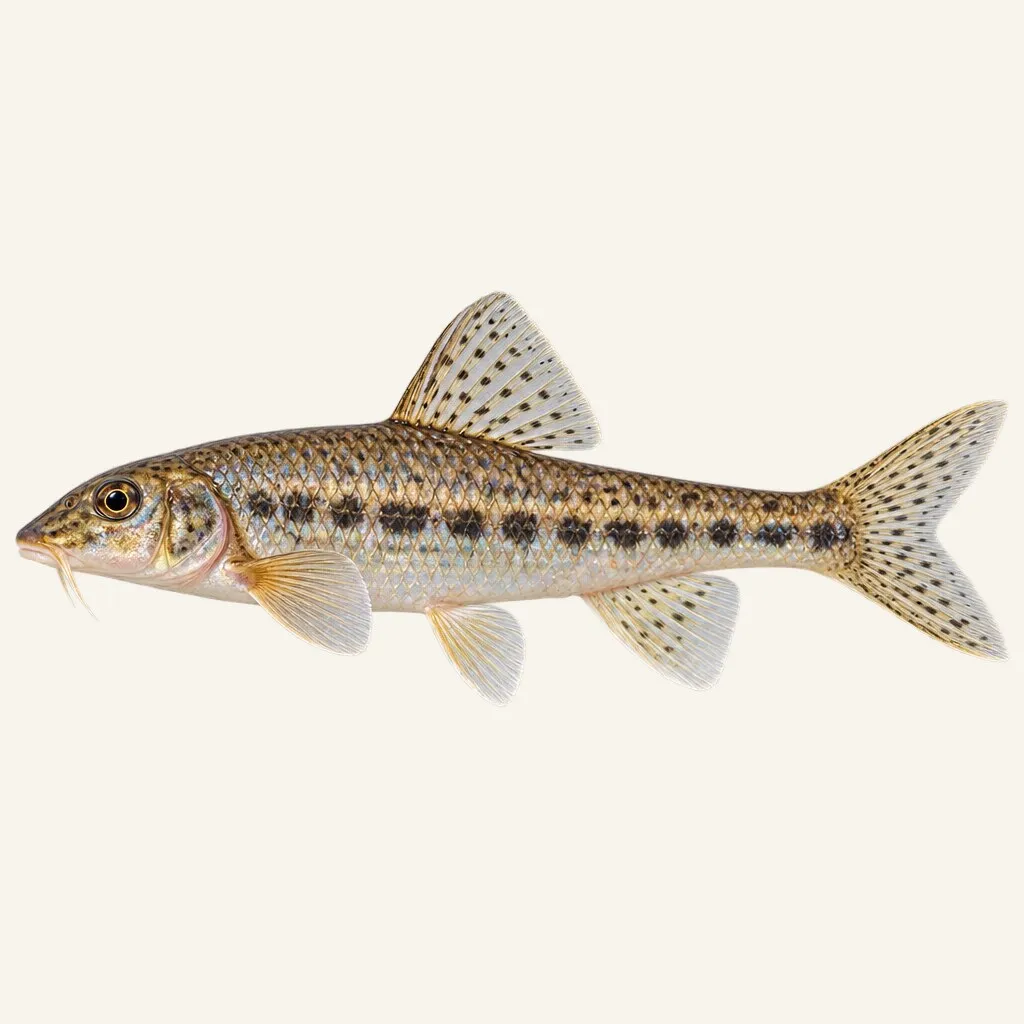
Gudgeon
Gobio gobio · Cyprinidae
- Freshwater
- Carp & coarse
- Easy
- Size
12–20 cm
- Weight
0.0–0.1 kg
- Lifespan
8 years
- Water temp.
2–18 °C
Where to fish
- River
Habitat icons: Flaticon
Two barbels - Cylindrical mottled body - Gregarious bottom-dwelling fish
Calendar
Recorded in 19 countries
Austria · Belgium · Czechia · Denmark · Estonia · France · Germany · Italy · Luxembourg · Netherlands · Norway · Poland · Russia · Spain · Sweden · Switzerland · Ukraine · United Kingdom · Uzbekistan
GBIF occurrence records — native and introduced populations combined.
Its range
From the Loire eastward: the Atlantic, North Sea and Baltic drainages, eastern Britain, the Rhône and the Volga, the upper Danube, and the middle and upper Dniester and Dnieper, reaching about 61 degrees north in Finland. Eastward the limit is unclear, with records as far as Korea.
That vagueness is not a gap in survey effort. It is the taxonomic division described above working its way east, and the eastern boundary of this species will keep moving until it is finished.
Identifying it
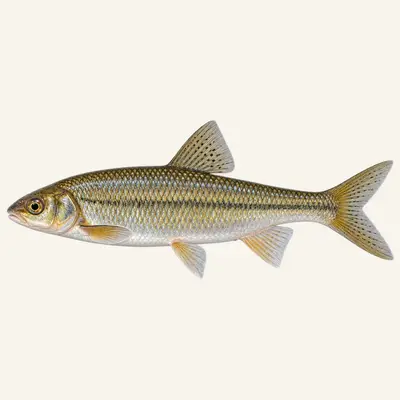
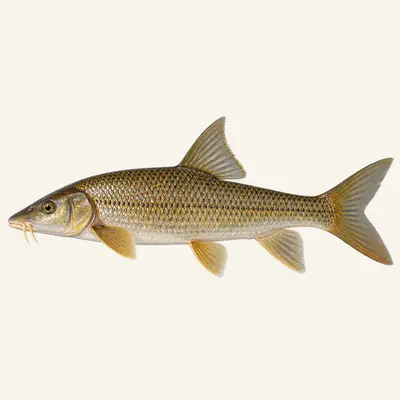
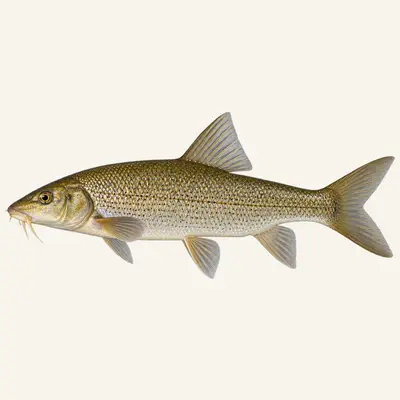
There are two barbels, one at each corner of the mouth, and their length is the measurement that matters. Laid back against the head, a barbel passes the front edge of the eye and usually reaches the middle of it. Across the European members of this genus that reach is what separates one species from the next, so the barbel is not merely a family badge here — it is the ruler.
A second character is taken with a fingertip rather than an eye. The breast, between the pectoral fins, is naked: no scales adhere there and the skin is smooth where the rest of the fish is not. It costs a second to check and it needs no light.
The snout is long, longer than the distance from the back of the eye to the edge of the gill cover, and the head takes 26 to 30 per cent of standard length. The eye is small at five to seven per cent of standard length. The body is round in section, 19 to 23 per cent deep, and built to hold position on a bed with water moving over it.
The remaining numbers are proportional: 39 to 42 scales along the lateral line with two more onto the tail, 12 to 14 rows around the wrist, four or five scales between the vent and the start of the anal fin, 19 rays in the tail, and 39 to 41 vertebrae.
What the description does not use is the mottling. Every illustration shows a row of dark blotches along the flank; nothing in the diagnosis of the species rests on them, and any determination that does is resting on a variable.
Breeding
The eggs are not placed, they are let go. A female releases them above the bed in shallow water, over stones, sand or plants, and they drift on the current, sinking slowly, sticking wherever they finally touch. Spawning site and incubation site are therefore two different places, and the distance between them is set by the flow.
The larvae continue in the same direction. They live on the bottom and want detritus-rich sand in slack water, which is downstream of the fast shallow water in which they were spawned. A reach must supply both, in that order, for a single fish to be produced. A canalised channel with uniform flow from bank to bank accepts the eggs and returns nothing.
The rhythm adjusts to the productivity of the water. In poor streams a female spawns once a year and does so over several successive years; in rich ones she divides her output across a single season. Two populations of the same species may therefore run different reproductive strategies, and comparing them without accounting for productivity compares nothing.
First maturity comes at about 9.3 cm, against a common length of 12 and a recorded lifespan of eight years.
The water it needs
Sand decides. Mountain streams, big lowland rivers, large lakes, brisk current or still water — nearly all of it is acceptable provided the bed is sandy, with gravel as the secondary option.
The other requirements are tighter than a fish with that reputation suggests. Temperature between two and 18 degrees, pH between 7.0 and 7.5, hardness from 10 to 20 German degrees. That is a narrow envelope beside the one a pond cyprinid will accept, and it is the origin of the species' standing as an indicator: it does not live in just any water, so its disappearance from a reach where it was numerous is information before it is an anecdote.
It lives in loose schools, held on the bottom. Activity is normally by day, but it shifts towards low light when the fish are disturbed, and predators are named as the disturbance. A pressured stretch therefore changes its hours without changing its population, which is a thing worth knowing before concluding that a swim has emptied.
One trait is rare enough among European cyprinids to be worth recording: this fish makes sounds, a kind of squeak. The emissions vary with how active the fish is and with the temperature, and they are independent of the spawning season, so they are not courtship. They are communication inside the group.
Areas
- Gravelly bottoms
- sandy
- moderate currents
Techniques
- Float fishing
- Light feeder
Baits
- Worms
- Maggots
- Small baits
What it eats
Insect larvae, molluscs and crustaceans — the fauna the sand holds, and nothing that passes overhead in open water.
That dependence on interstitial life explains why substrate quality matters more to this fish than current speed does. A clean, stable, well-sorted sand bed is a larder. The same bed compacted or sealed under fines is not, whatever the water above it is doing.
How to catch it
On the bottom, in fine line, with a small hook and a small bait — worm, a single maggot, anything scaled to a fish of 12 cm. They school, so a bite means a group is there, and a swim that gives one will give twenty if it is not frightened first.
The traditional method is to disturb the sand just upstream of the tackle, with a boot or a rake. It has a real basis: the fish eats what the substrate holds and the young seek out sand loaded with detritus, so a cloud of suspended sediment puts exactly what they want back into the water. It also has a cost, and the cost is in the biology above — disturbance is what shifts this species onto low-light hours. A stretch worked all morning may give nothing more until evening.
The other fact about fishing for gudgeon is that most of it is not fishing for gudgeon. This is the standard livebait of the region, and the databases record bait as its usual use, ahead of the table. That is a fact about the practice rather than about the animal, and it has one consequence worth carrying to the bank: what is in the bucket at the end of a session generally does not go back where it came from.
Conservation
Start with the buckets, because the taxonomy has changed what they mean. The populations of the Iberian Peninsula and the Adour belong to Gobio lozanoi, and those of the Caspian basin may represent a third species; the genus is being divided, and the range attributed to this name shrinks as the work proceeds. The documented introductions to Ireland, Wales, Scotland and northern and eastern Italy follow the routes a small fish takes when it is carried alive. Moving one of these between catchments used to mean moving individuals. It now means moving lineages, and the rules on transporting live fish are a matter for the competent authority in each country.
The second pressure is the ecological window. A species that requires sand, water no warmer than 18 degrees and a narrow chemistry reacts before the tolerant cyprinids around it do. A reach that has lost its gudgeon has changed in some respect, and that is worth recording even when the change has not yet been identified.
The third is structural and follows from the drifting eggs. Recruitment needs fast shallow spawning water with slack, silty sand below it, in the same reach, connected. Straighten the channel and the sequence breaks in the middle while the adults remain perfectly visible.
Regulations
Check the local regulations in force (legal size limits, closed seasons, bag limits).
For guidance only. Legal sizes, quotas and open seasons vary by location and season: always check the local regulations in force before fishing.
Other names
Gudgeon in English, through Old French goujon from Latin gobio, which was then taken unaltered as the genus name and repeated as the species name — the mark of the fish the genus was built on.
The word has left the river twice. In engineering a gudgeon is a pivot or bearing pin, and in older English a gudgeon is a person who will swallow anything — both from the same fish and the same reputation for taking a bait without hesitation. To swallow the gudgeon was to be taken in.
The name has also travelled to fishes that are no relation. In Australia and New Zealand, gudgeons are small freshwater fishes of an entirely different family, so a reference without a binomial cannot be assumed to be about this animal.
Sources: fishbase.se · api.gbif.org