Mutton snapper
Lutjanus analis · Lutjanidae
- Saltwater
- Coastal
- Medium
- Size
50–94 cm
- Weight
1.5–16 kg
- Lifespan
29 years
- Water temp.
20–28 °C
- Depth
25–95 m
Where to fish
- Reef
- Rocky shore
Habitat icons: Flaticon
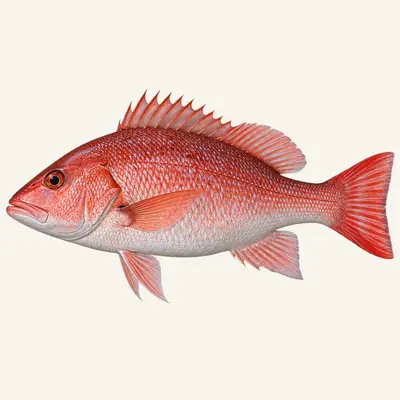
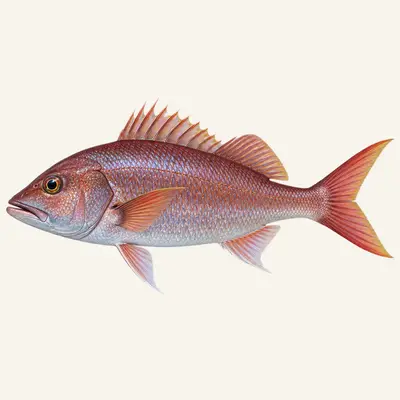
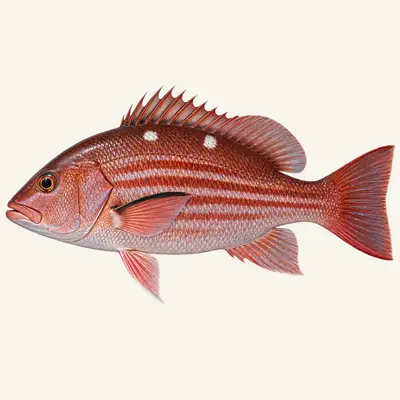
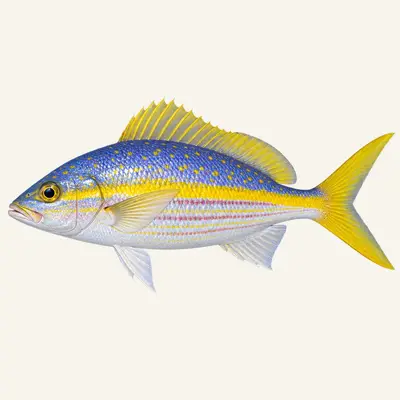
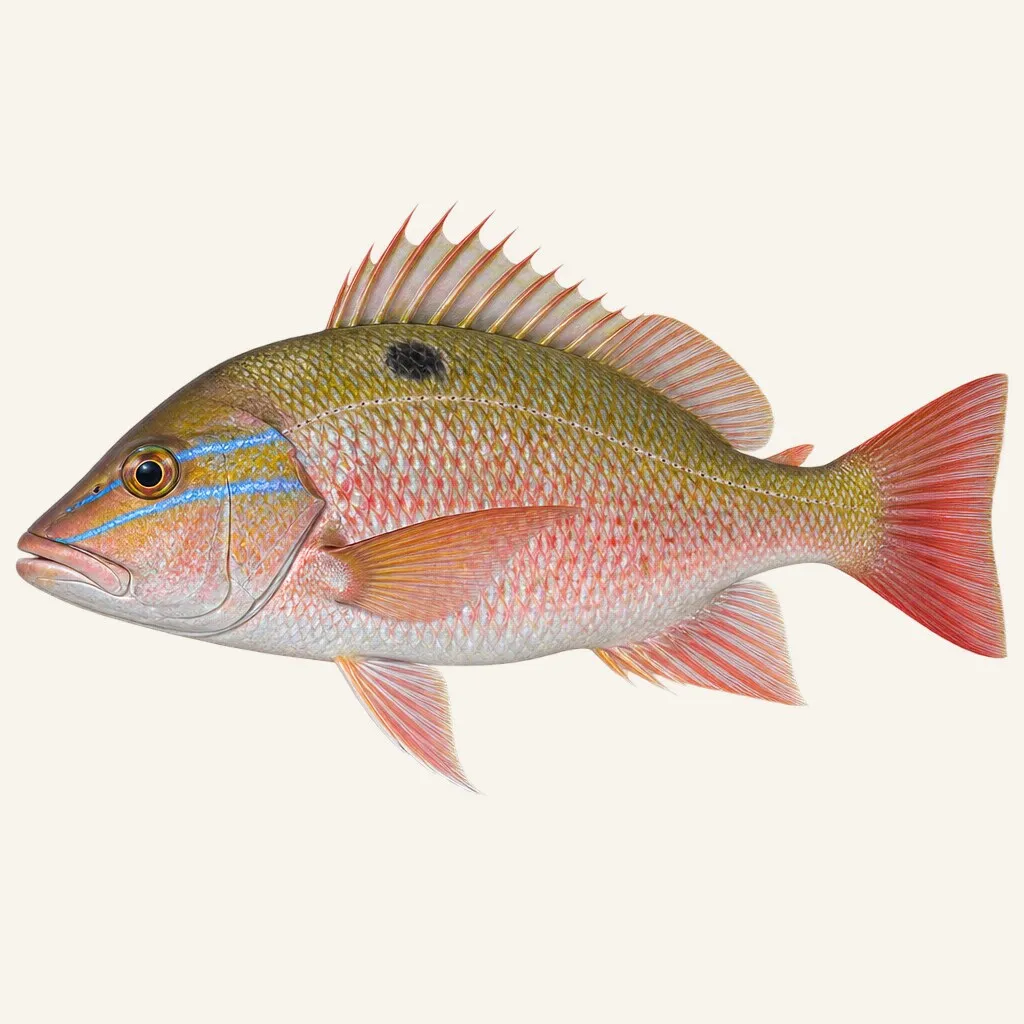
The mutton snapper is a robust snapper with an oval, greyish-pink body adorned with yellow longitudinal stripes and a persistent dark spot on the flanks. It lives around coral reefs, mangroves, and seagrass beds in the tropical western Atlantic.
Calendar
Recorded in 17 countries
Bahamas · Belize · Brazil · Cayman Islands · Colombia · Cuba · Curaçao · Guadeloupe · Honduras · Jamaica · Martinique · Mexico · Panama · Puerto Rico · U.S. Virgin Islands · United States · Venezuela
GBIF occurrence records — native and introduced populations combined.
Identifying it
Two blue lines cross the snout and cheek, one above the other. The upper one does not stop at the eye: it passes behind it and carries on to the top edge of the gill cover. That pair is the best mark the species has, and it holds on a live fish and on a dead one.
The body combines two colours that rarely meet in this genus — olive green over the back and upper flank, whitish washed with red below. A black spot sits on the upper back above the lateral line, under the first soft dorsal rays, as it does on several neighbours.
The pectoral fin gives a second check that costs nothing. Folded back, it is long and reaches the level of the vent, where several western Atlantic snappers of similar size fall short. That one gesture is worth more than comparing spots, which all look alike. The counts: ten or 11 dorsal spines, 13 or 14 soft rays, three anal spines, seven or eight soft rays.
The water it needs
The depth band is narrow. The full range runs from 25 to 95 m, the ordinary one from 40 to 70, and a temperature window of 20 to 28 °C closes off the rest.
The upper bound has an immediate practical effect: adults do not come up into shallow coastal water, and no shore fishery reaches them. Getting to this species means going out and going down.
Adults hold continental shelf ground and the clear water around islands, the largest of them among rock and coral. The young are elsewhere, over vegetated sand — usually Thalassia beds — and the move between the two goes downward rather than along the coast.
Areas
- Reef drop-offs
- Rocky shoals
- Coastal seagrass beds
- Submerged wrecks
Techniques
- Bottom fishing with handline
- Soft lure fishing
- Light trolling
- Live bait fishing
Baits
- Live shrimp
- Small live fish
- Cut squid
- Crabs
- Marine worms
What it eats
Fishes, shrimps, crabs, cephalopods and gastropods: nothing in the list separates this snapper from its relatives.
The timing does. It feeds by day and by night, with no marked resting period, while most of the snappers sharing its range hunt after dark and sit still the rest of the time. Round-the-clock feeding is a competitive advantage in water crowded with twilight specialists, and it means the species has no dead hour to plan around.
How to catch it
The social rhythm of this fish runs opposite to that of its relatives, and a trip is best built on that.
It forms small aggregations that break up at night. By day the search is for a group; after dark it is for scattered individuals, which are nonetheless still feeding, since the appetite does not switch off. Both produce fish, but they are not the same search, and staying on a daytime mark through the night means working a place the group has already left.
The 40 to 70 m band dictates the method — bottom or vertical fishing on a drop-off, a rocky rise, a wreck. Inshore grass beds produce juveniles and nothing else.
A common fish runs 50 cm, and the oldest recorded individual was 29. The flesh is rated highly, which is the reason commercial pressure on the species is heavy from one end of the range to the other.
Conservation · Near Threatened (IUCN) — This species is in decline. Release your catch quickly and handle it with care — wet hands, as little time out of the water as possible.
Conservation
The length at first spawning is not known accurately, and that is the problem in itself. Published values spread from 28 to 44 cm. A spread that wide means no single length describes maturity across the whole range: what protects one population need not protect another, and a measure calibrated in one region transfers badly to the next.
Set against a common capture length of 50 cm, that interval leaves open the possibility that part of the landings in some areas have never spawned, without indicating which areas.
Pressure then arrives through two circuits that are never counted together. The species supports an intense commercial fishery for the table across its range, and juveniles additionally feed the aquarium trade, recorded in Brazil. The first takes adults, the second takes recruits, and the stock beneath them is one.
The daytime aggregations finish the picture. They are not seasonal and they are not vast, but they are regular, and a modest group found in the same place every morning wears down without any spectacular collapse to mark the moment.
Regulations
Check the local regulations in force (legal size limits, closed seasons, bag limits).
For guidance only. Legal sizes, quotas and open seasons vary by location and season: always check the local regulations in force before fishing.
Other names
Mutton snapper, from a language that also produced the older form muttonfish — and that is where the trouble lies, because muttonfish has been attached to unrelated animals elsewhere in the English-speaking world, the abalone of Australian coasts among them. Nothing about this snapper suggests a sheep to begin with.
Caribbean Spanish says pargo criollo, Brazilian Portuguese cioba, a local word that describes no feature of the animal.
On a counter in the United States the fish is frequently sold as mutton alone, with the family name dropped, which removes the only part of the label carrying information. On a whole fish, the two blue lines across the cheek still carry it.
Sources: fishbase.se · api.gbif.org