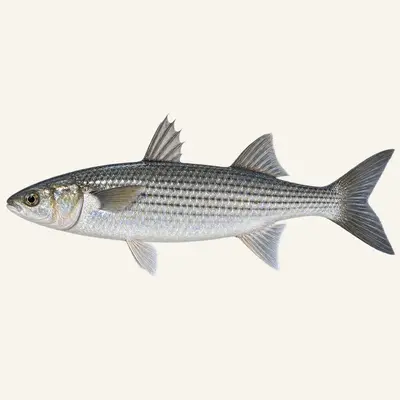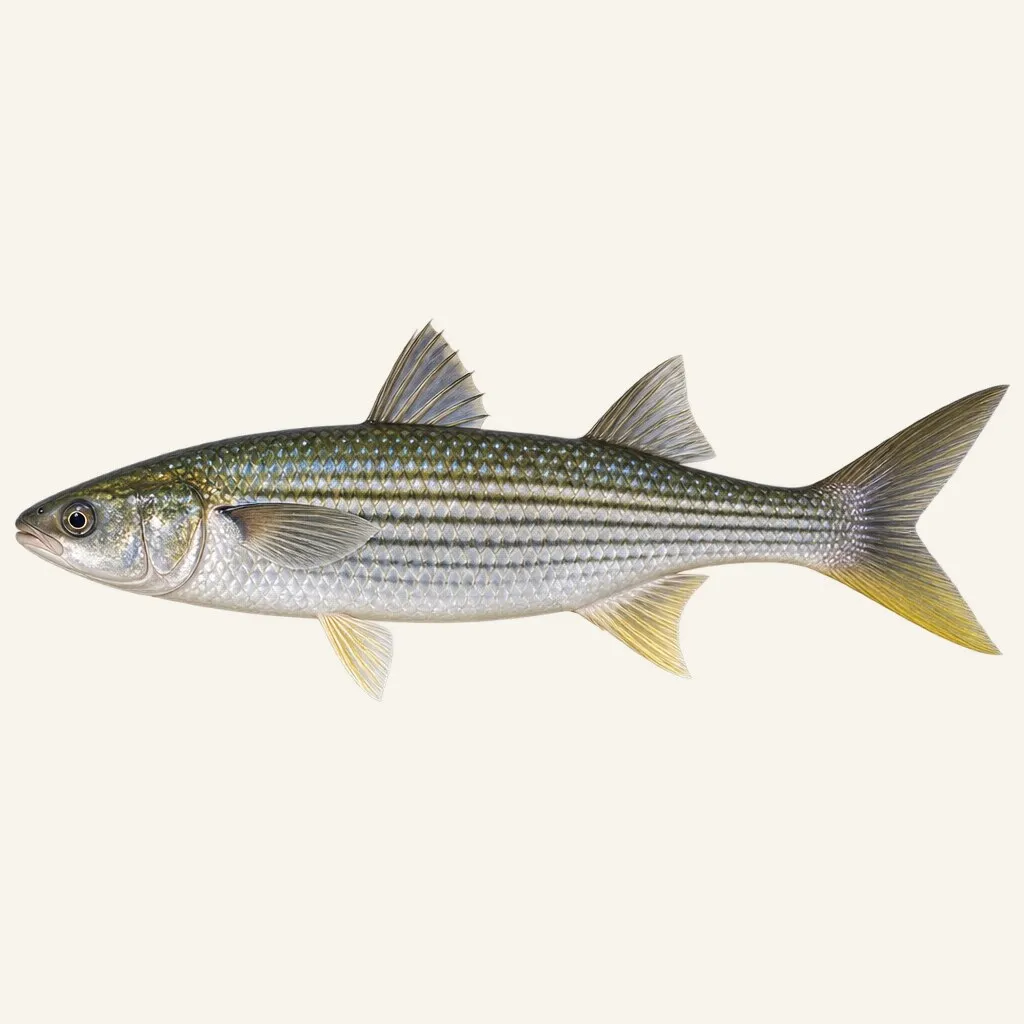
Flathead grey mullet
Mugil cephalus · Mugilidae
- Saltwater
- Coastal
- Medium
- Size
50–100 cm
- Weight
1.2 kg
- Lifespan
16 years
- Water temp.
8–24 °C
- Depth
0–120 m
Where to fish
- Estuary
- Rocky shore
Habitat icons: Flaticon
Flathead grey mullet - coastal marine species, Worldwide
Calendar
Recorded in 30 countries
Australia · Chile · China · Colombia · Ecuador · France · French Guiana · French Polynesia · Greece · Hong Kong SAR China · India · Israel · Italy · Japan · Mexico · Mozambique · New Zealand · Norfolk Island · Peru · Portugal · Puerto Rico · Russia · Senegal · Singapore · South Africa · South Korea · Spain · Taiwan · Ukraine · United States
GBIF occurrence records — native and introduced populations combined.
Its range
Coastal water in the tropical, subtropical and temperate zones of every sea, from 62 degrees north to 57 degrees south. Very few marine fish hold a band that wide as one species instead of splitting into several.
The interesting part of the map is a hole in it. Along the American seaboard the fish is recorded from Nova Scotia to Brazil, and it is missing from the Bahamas and from most of the West Indies and the Caribbean — a gap in the middle of a coast it otherwise occupies end to end. The sources do not account for it, but the animal makes its living on bottom deposits, and clear carbonate banks are poor in the fine sediment and organic matter it works. A grazer of mud has little to graze there.
The thermal band, 8 to 24 degrees, sets the other edges. It is wide enough to admit both the Sea of Okhotsk at the top and equatorial lagoons at the bottom.
Identifying it
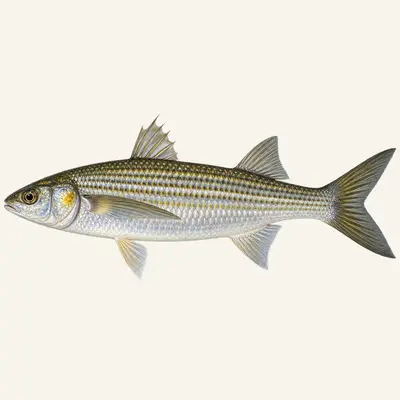
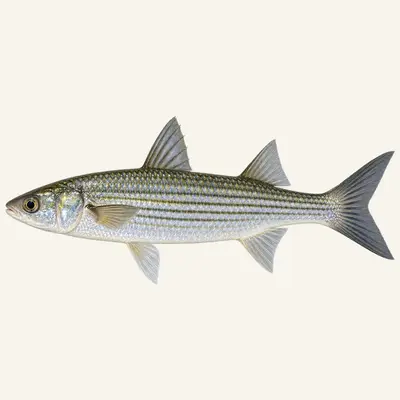
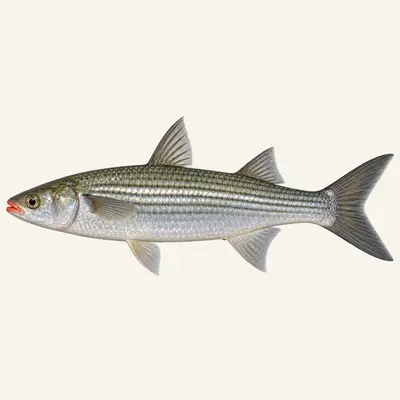
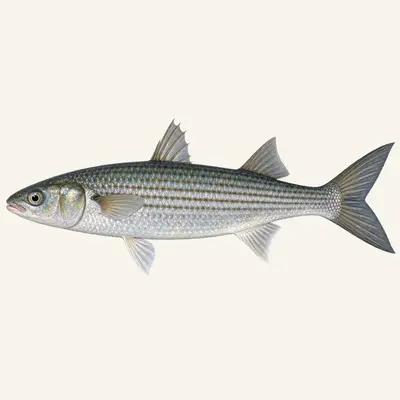
A pad of fatty tissue covers most of the pupil. That adipose eyelid is the first thing to check, and it puts the animal among the mullets before anything else has been looked at.
The head is broad and flat across the top, the body stout and circular in section. The upper lip is thin and free of papillae, carrying one or two outer rows of small single-pointed teeth and as many as six inner rows of smaller two-pointed ones. The lower lip has an equivalent outer row and sometimes an inner one behind it. None of that is equipment for seizing anything; it is equipment for scraping.
Three proportions separate this species from the white mullet, which shares both the fatty eyelid and the outline. The rear end of the upper jaw reaches the vertical drawn through the front margin of the eye. The origin of the first dorsal sits closer to the snout tip than to the base of the tail. And there are 13 to 15 rows of scales between the dorsal origin and the pelvic one.
Two more checks confirm it. The maxillary pad does not show below the corner of the mouth when the mouth is shut, and the second dorsal and anal fins are scaled over their forward parts and bases only, not throughout. An elongate axillary scale sits above the pectoral fin.
Counts: five dorsal spines, seven to nine soft rays behind them, three anal spines with eight or nine rays.
On the tropical Atlantic coast of Africa the pelvics, the anal and the lower lobe of the tail turn yellowish. That is regional variation rather than a character of the species.
Breeding
Breeding takes place at sea and only at sea. Adults leave the coast in schools, run offshore, spawn there, and it is the larvae that make the inbound journey.
A single spawning group has been watched closely, and the account is worth having in detail: five fish, one female with four males, the males pressing against her while the whole group moved slowly forward into a firm tidal flow. Four attendants is a spare arrangement for the output involved. One female releases between 800,000 and 2.6 million eggs, and they develop in open water offshore.
Maturity comes at three or four years, from about 35 cm. Recorded longevity runs to 16 years.
The cycle is catadromous, and the qualification attached to it is the important part: there is no obligatory freshwater phase. A fish of this species can complete its entire life without once entering a river. Fresh water is available to it rather than required of it, which is not how the word catadromous usually reads.
The water it needs
Ordinary life happens in the first 10 m, over sand or mud, in schools, while the species is on record down to 120 m. Depth is not what limits it. Substrate is.
The range of salinities on the record for it is exceptionally wide. It occurs in the open sea, in estuaries, a long way up rivers, in lagoons, in mangrove creeks, and in hypersaline water saltier than the ocean itself. Those are not separate populations specialised to each: the same individual crosses the gradients without any transition stage.
The practical consequence is that this fish turns up in water that holds very little else of its size — a brackish pond cut off from the sea for months of the year, the head of a tidal creek, a salt lagoon in high summer.
Areas
- Estuaries and river mouths
- Coastal lagoons and ponds
- Harbour walls
- Shallow bathing areas
Techniques
- Fine float fishing
- Light feeder fishing
- Floating bread fishing
- Ledger fishing in estuaries
Baits
- White bread
- Bloodworm
- Cooked corn
- Sticky rice
- Bread paste ball
What it eats
Detritus, micro-algae and bottom organisms, taken by day. The fish lifts surface sediment and sorts it internally rather than selecting before it swallows.
The sorting is done in a pyloric stomach with thick muscular walls — a working gizzard, which grinds sand and debris — and continues along a very long intestine. An animal that swallows sand to extract a film of diatoms from it needs a mill, not teeth, and the absence of any real dentition and the presence of the gizzard are two halves of the same solution.
The change of diet is dated to a size. Below roughly 3 cm the fry live on zooplankton; above it they go to the bottom and do not come back up. Those are two ways of feeding in one body, taken up in succession.
How to catch it
The tidal flow is where to start. The only spawning aggregation ever described in detail held its position facing into a strong tidal current, and current is what orients the schools generally: harbour mouths, lagoon channels, tidal passes, river outfalls and the edges of mangrove all work for the same reason, which is that they concentrate suspended material and the fish sits in the delivery.
Activity is chiefly diurnal, which is unusual in coastal fishing and makes a session easy to plan. The fish live in schools, so one found on a mark means more on the same mark.
The mouth then settles the tackle. An animal with no dentition worth the name, which takes food by scraping a surface, will not come to anything built to imitate prey — the baits are bread, paste and weed, presented fine on a small hook, and the signal it gives on taking one is very slight.
One thing about a capture is worth knowing before deciding what to do with it. A female late in maturation carries gonads worth more than the rest of the fish. The roe is sold fresh or smoked, and pressed and dried it becomes bottarga.
Conservation
This species is fished hard across its whole range, and it is also farmed in fresh and brackish ponds on a scale and with a history that few marine fish can match. Part of the demand is met away from the wild stock, which separates its position from that of coastal fish whose market rests on capture alone.
An imbalance remains, and it is created by the roe. The value of bottarga points the effort at gravid females — that is, at fish taken in the weeks before they spawn. A fishery aimed at gonads does not merely remove breeders, it removes the spawning itself, and every intercepted female takes up to 2.6 million eggs out with her.
One caution about the figures. The largest measurements circulating for the species are flagged as unconfirmed by the authors who report them, and the confirmed values are appreciably lower. Arguments about record fish here rest on numbers their own sources decline to stand behind.
Regulations
Check the local regulations in force (legal size limits, closed seasons, bag limits).
For guidance only. Legal sizes, quotas and open seasons vary by location and season: always check the local regulations in force before fishing.
Other names
Flathead grey mullet is the standard English name, and flathead mullet is the same fish. In the United States the species is called striped mullet, and along the Gulf coast black mullet — three English names for one animal, and none of them is the bare term grey mullet.
That bare term is the real trap, because it identifies nothing below the level of the group. Half a dozen species share the same harbours, they are separated in the hand by the lip, the eye and the fin position, and a market label records none of those checks.
Spanish lisa, Italian cefalo, German Meeräsche, French mulet cabot. The dried roe carries its own name in several languages, from the Arabic batarikh, and the word now refers to the product rather than to the fish that supplies it. The roe is also used in Chinese medicine. The epithet cephalus means head, which is the one part of this mullet everybody agrees about.
Sources: fishbase.se · api.gbif.org