European whitefish
Coregonus lavaretus · Salmonidae
- Freshwater
- Salmonids
- Medium
- Size
30–73 cm
- Weight
0.2–10 kg
- Water temp.
4–16 °C
Where to fish
- Lake
Habitat icons: Flaticon
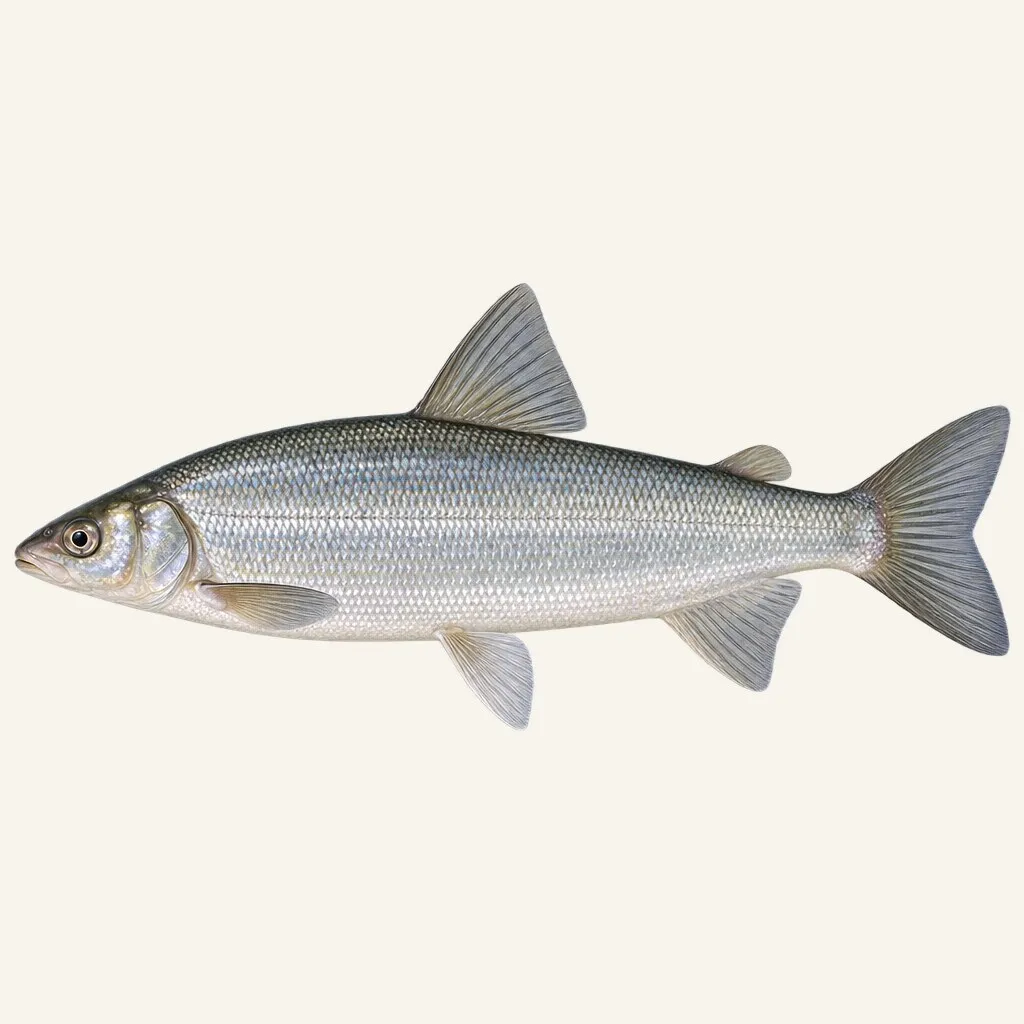
Silvery white fish - Small mouth - Specialised winter fishing
Calendar
Recorded in 7 countries
Denmark · Finland · France · Italy · Norway · Sweden · United Kingdom
GBIF occurrence records — native and introduced populations combined.
Its range
The native water is small: Lake Bourget in France and Lake Geneva. The population of Lake Aiguebelette is apparently introduced, though a lavaret was already being recorded there in the seventeenth century, which shows how far back the confusion goes.
Other authors treat the name as covering a superspecies present in Great Britain and across the Alpine parts of central Europe. The species has additionally been stocked into a great many European lakes outside any of those ranges, and introduced to Iran.
The result is a map that records a restocking history at least as much as a natural distribution, and pulling the two apart is now largely impossible. The lakes are real; which fish belong in which is the open question.
Identifying it
Start with the warning rather than the fish. Coregonus is among the most tangled genera in European ichthyology, and this species carries a long list of parallel and simply incorrect scientific names in current use. A whitefish identified in one Alpine lake under a given name may appear under three others in the literature, and none of the four is obviously wrong. Nothing written below resolves that; it only describes what is in front of you.
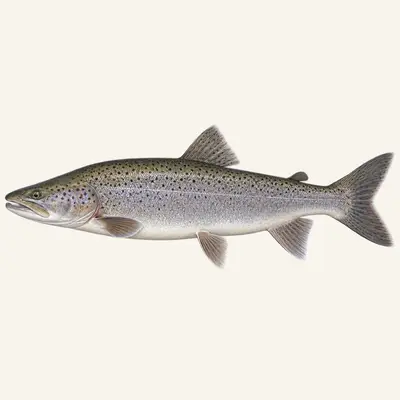
The mouth is small, with the upper jaw projecting over the lower. That is the generic character and it points the snout downwards — this is an animal that takes food in front of and below itself, not above.
The body is silver and fusiform, the tail carries 19 soft rays, the dorsal fin three to five spines and nine to 12 soft rays, the anal three to five spines and 10 to 13 rays. An adipose fin behind the dorsal places the fish among the salmonids, which surprises people who have only met it on a plate.
Maturity comes at around 27 cm, and growth carries on well past it.
Breeding
Spawning happens in December, at night, on gravel close to the shore in shallow water.
December is the arresting part. Where most European freshwater fish spawn into rising spring temperatures, this one lays in the coldest weeks of the year. The eggs sit on the gravel through the winter with almost nothing active enough to eat them, and they hatch as the plankton year begins — which is the only food the fry can use.
The timing also fixes the species to a narrow window of conditions. Eggs incubating for months on shallow gravel need that gravel to stay clean and the lake bed to stay where it is, for a long stretch of the calendar when nothing else is happening in the water.
The water it needs
The species exists in two forms: gregarious and lacustrine, or anadromous and estuarine, the latter rarely entering full salt water. Its thermal range is narrow, 4 to 16 degrees, and it wants alkaline hard water, around pH 7.0 to 7.5.
Depth is not a fixed property of this fish. It moves through the water column following the distribution of zooplankton, which shifts by hour and by season, so asking what depth a whitefish holds is asking the wrong question. The right one is where the food layer currently sits.
Areas
- Large cold deep European lakes
- Lake littoral zones in autumn
- Mid-water open lake areas
- Shallow lake areas in winter
Techniques
- Worms
- Larvae
- Light lures
- Flies
Baits
- Light spoon
- Nymph flies
- Worms
What it eats
Adults live on planktonic crustaceans. In brackish water they take larger bottom-dwelling crustaceans instead, which is the only substantial change in diet the species makes.
A plankton feeder is not a hunter in any useful sense. It works through a cloud, selecting, rather than pursuing individual prey, and that single fact accounts for the small mouth, for the shoaling, and for why nothing resembling a baitfish imitation interests it.
How to catch it
Find the layer before looking for the fish. The productive depth changes through the day as the plankton moves, and it is the first decision of the session rather than a refinement at the end of it. Sounder work comes before tackle work.
The small mouth then dictates everything downstream: fine hooks, small imitations, larvae and nymphs and scaled-down suggestions of planktonic crustaceans. Anything sized for a trout in the same lake is fishing for a different animal.
Because the fish moves in shoals, one take locates a group rather than an individual, and holding the same depth matters more than covering water.
The species supports old professional fisheries on the large Alpine lakes and is farmed commercially as well. Angling for it is regulated there, and the current rules must be checked with the competent authority.
Conservation · Vulnerable (IUCN) — This species is threatened with extinction. Always release it (no-kill), handle it with the utmost care and check local rules — fishing for it may be prohibited.
Conservation
The December spawning on clean shallow gravel is the exposed point. That is the littoral zone of a lake, which is exactly the band affected first by bank development, by siltation and by managed water levels, and the eggs are lying in it for months rather than weeks.
The taxonomic confusion makes the problem worse in an unusual way. When nobody can say how many species or lineages sit behind a single name, nobody can say what decades of stocking between lakes have mixed together. Local populations may have been erased before they were ever described, and the record of what was there beforehand does not exist.
French environmental legislation from the late 1980s is expected to work in the species' favour, which indicates where the leverage lies: this is a fish whose future depends on what happens to lake shores rather than on how many are caught.
Regulations
Check the local regulations in force (legal size limits, closed seasons, bag limits).
For guidance only. Legal sizes, quotas and open seasons vary by location and season: always check the local regulations in force before fishing.
Other names
English usage is where this species becomes genuinely difficult. In Britain, the fish assigned to this superspecies carry a different name in almost every lake that holds them — powan in Scotland, schelly in the Lake District, gwyniad in Wales — and those names were coined by communities who had no reason to know the fish existed anywhere else. Common whitefish is the general English label, and it is nobody's local name.
Whitefish itself is more of a market word than a biological one. It is applied to this genus, to several unrelated marine species, and in the fish trade to almost any pale, mild fillet, which is why it appears on menus that could not name the animal if asked.
French has lavaret in the Alpine lakes and féra in Lake Geneva, two names for populations long treated as separate species. German has Felchen and Renke, each covering several lake forms of their own. Every one of these names is older than the taxonomy and none of them will be tidied up by it.
Sources: fishbase.se · api.gbif.org