Green humphead parrotfish
Bolbometopon muricatum · Scaridae
- Saltwater
- Coastal
- Medium
- Size
70–130 cm
- Weight
5.0–46 kg
- Depth
0–40 m
Where to fish
- Reef
Habitat icons: Flaticon
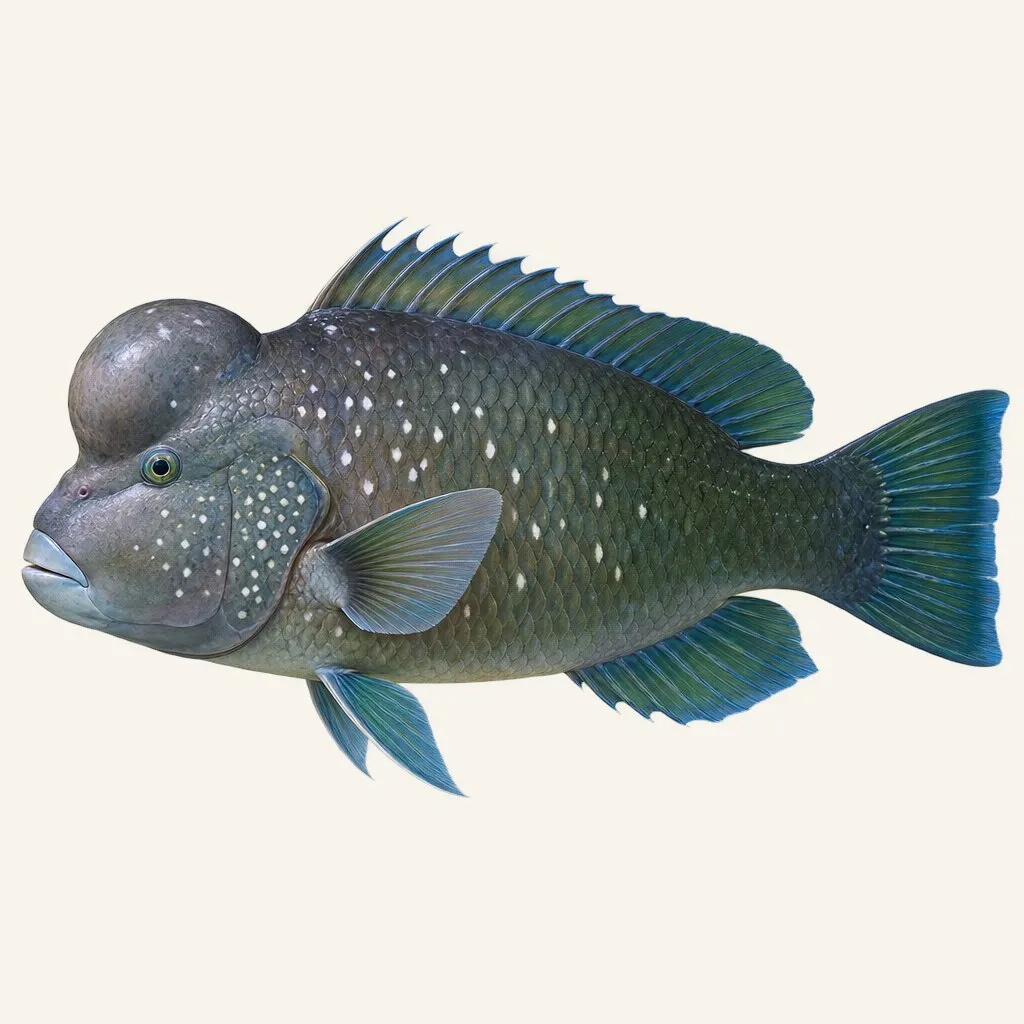
The bumphead parrotfish (Bolbometopon muricatum) is the largest parrotfish in the world, instantly recognizable by its distinctive bulging forehead and grey-green body with bluish hues. It roams coral reefs of the Indo-Pacific in dense schools, using its calcified beak to bite off chunks of live coral.
Calendar
Recorded in 10 countries
Australia · Indonesia · Malaysia · Micronesia · New Caledonia · Palau · Papua New Guinea · Philippines · Seychelles · Solomon Islands
GBIF occurrence records — native and introduced populations combined.
Identifying it
A rough age can be read off the outline. The bump on the forehead is evident from about 25 cm, so a fish without one is a young fish. Body depth goes two to two and a half times into standard length and increases with growth, so the older the animal the deeper it is. Shape here is a function of age rather than a fixed character.
The colours move with it. Juveniles are brownish to green with five vertical rows of whitish spots along the side. Primary-phase fish are a dull grey with scattered white spots. Then the spots go and the fish becomes uniformly dark green.
Two characters do not change. The head profile is steep, and the description calls it distinctive. And the teeth carry nodules that the same description calls unique to the species — the rare case where the source makes the exclusivity claim itself, so it can be repeated as written.
The rest is bookkeeping: two to four median predorsal scales, which the hump may hide, three rows of scales on the cheek, 16 or 17 pectoral rays, and the family's nine dorsal spines with 10 soft rays, three anal spines and nine.
The water it needs
Two water bodies at two ages. Juveniles are in lagoons; adults are on clear outer lagoon and seaward reefs, down to at least 30 m, with the recorded range running from the surface to 40.
The entry that matters is what they do at night. They sleep in caves, and often in shipwrecks.
A wreck is a fixed, charted, well-known object, and a large fish asleep inside one is at a published address with no watch kept. That single line explains more about the state of this species than its depth range does.
Areas
- Massive coral reefs
- Shallow Indo-Pacific zones
- Lagoons
- Reef flats
Techniques
- Bottom fishing
- Float fishing
- Light bottom rig fishing
- Coastal natural bait fishing
Baits
- Shrimp
- Algae and marine plants
- Crabs
- Marine worms
What it eats
It feeds by demolition. Benthic algae, live coral and shellfish, and to reach them it sometimes rams its head against the coral to break the structure open.
The scale is the point. A parrotfish beak scrapes a surface; a forehead driven into a coral head moves structure. On the largest parrotfish there is, feeding is a physical rearrangement of the habitat, and a reef that holds them carries the marks.
It is usually in company rather than alone.
How to catch it
The record calls it the largest and the wariest of the parrotfishes, and the two halves of that phrase pull in opposite directions.
By day the wariness is real and it works. Getting within range of a fish this size on open reef, in clear water, is the difficulty the description implies, and it is the reason the species has a reputation for being unapproachable.
By night none of it applies. A sleeping animal in a cave or a hull can be taken by hand-held gear with no approach at all, and the assessments in the file report exactly the outcome that predicts: vulnerability to overfishing. There is a commercial fishery, and a live trade for aquariums alongside it.
Conservation · Vulnerable (IUCN) — This species is threatened with extinction. Always release it (no-kill), handle it with the utmost care and check local rules — fishing for it may be prohibited.
Conservation
The species has one defence and it is off duty for half of every day. Nothing about daytime wariness carries over to a fish asleep at a fixed location, and night spearfishing turns the hardest target on the reef into the easiest.
The breeding arrangement offers no cushion. Oviparous, with distinct pairing — two adults at a time, rather than a mass spawning that can absorb losses by sheer numbers.
Then there is the reef itself. An animal that grazes algae, bites live coral and breaks structure with its head is doing engineering work, and when it thins out what changes is the shape and surface of the reef rather than a species list. That is not recoverable the way a fish stock is, because the reef has to be rebuilt by the animals that build reefs.
The current assessment is from July 2024. Nothing here is a historical account.
Regulations
Check the local regulations in force (legal size limits, closed seasons, bag limits).
For guidance only. Legal sizes, quotas and open seasons vary by location and season: always check the local regulations in force before fishing.
Other names
Green humphead parrotfish is the full English name and bumphead parrotfish is what most people say. Neither word is safe on its own: humphead in English also attaches to a large Indo-Pacific wrasse, so the word alone does not name a fish.
The other languages name the same lump. Büffelkopf-Papageifisch in German, buffalo-head; pez loro cototo verde in Spanish; pesce pappagallo testa a bernoccolo in Italian; budião-cabeçudo-verde in Portuguese. Topa is used across parts of the Pacific.
Bolbometopon is built from bolbos, a bulb, and metopon, the forehead. The genus holds this species alone.
Sources: fishbase.se · api.gbif.org