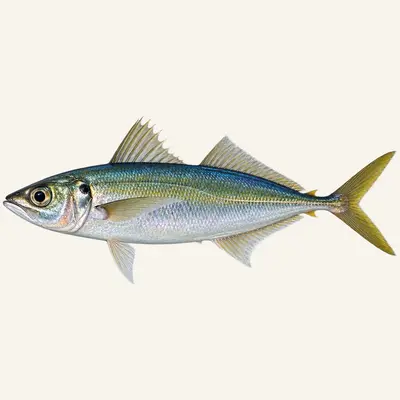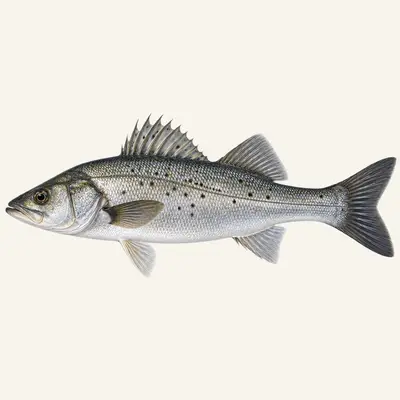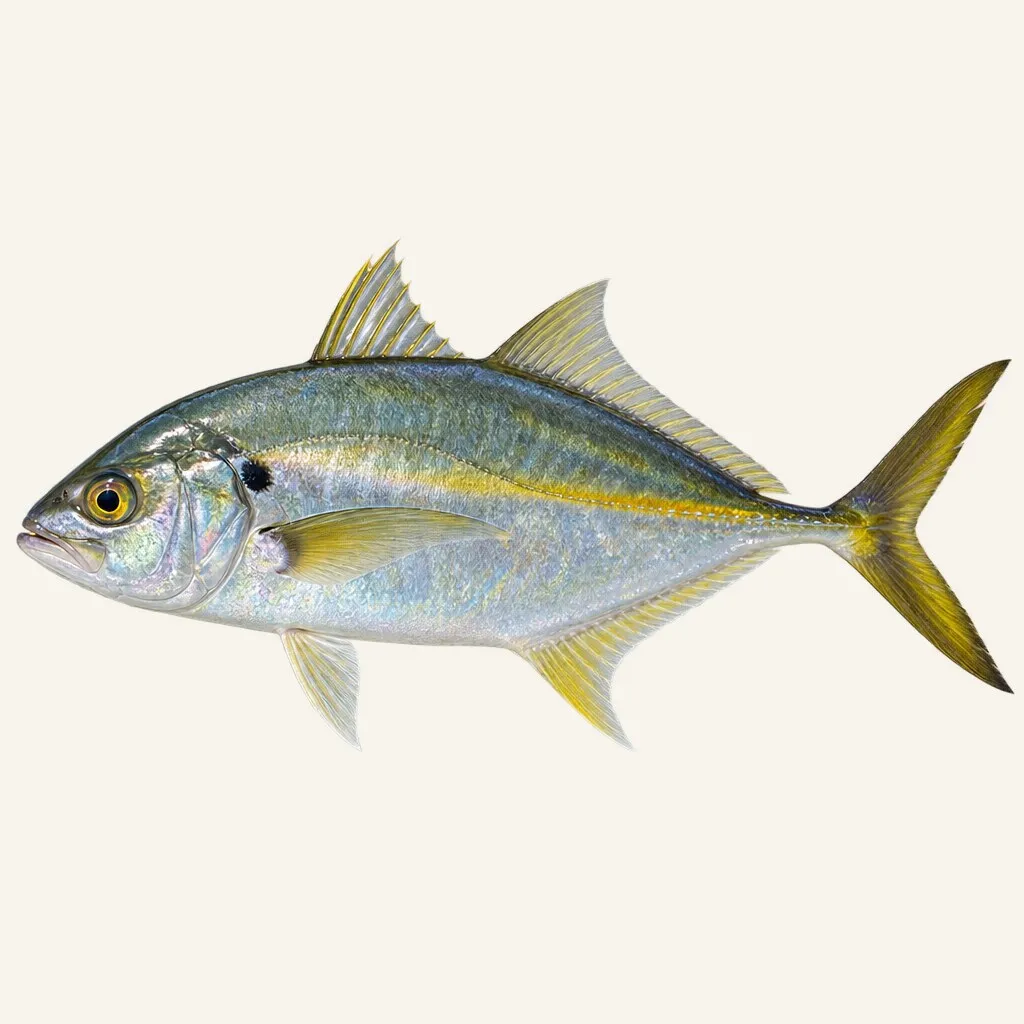
Island trevally
Carangoides orthogrammus · Carangidae
- Saltwater
- Coastal
- Medium
- Size
40–75 cm
- Weight
0.7–6.6 kg
- Depth
0–168 m
Where to fish
- Reef
- Rocky shore
- Offshore
Habitat icons: Flaticon
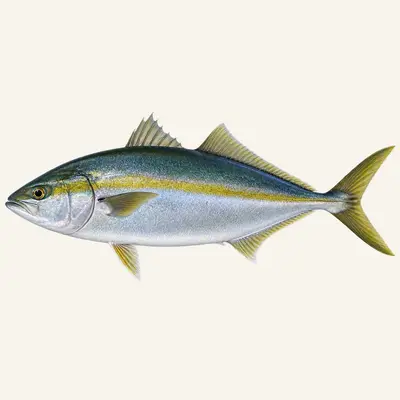
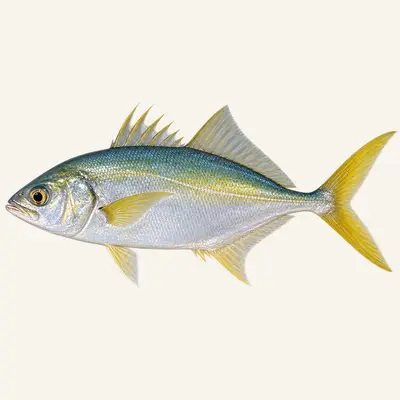
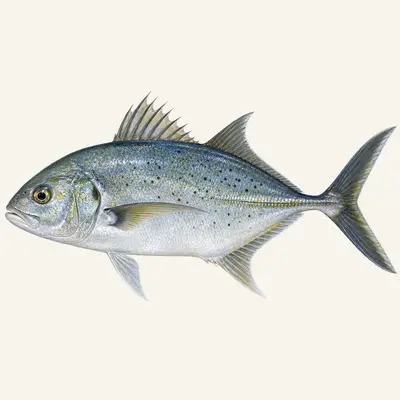
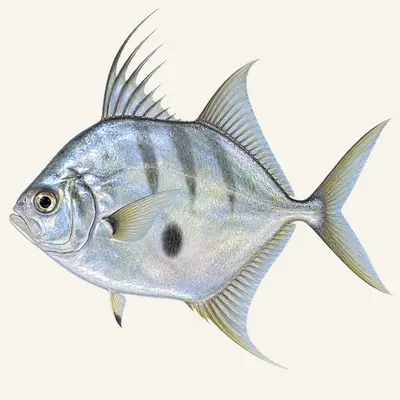
The island trevally is a medium-sized Carangidae with a silvery oval body adorned with small golden-yellow spots scattered across the flanks in adults. It inhabits tropical coastal and lagoon waters of the Indo-Pacific, often near reefs and sandy shallows.
Calendar
Recorded in 9 countries
American Samoa · Australia · French Polynesia · Japan · Marshall Islands · Mexico · Niue · Northern Mariana Islands · United States
GBIF occurrence records — native and introduced populations combined.
Its range
Two blocks, with the widest empty stretch of ocean on the planet between them. In the west, the Indo-Pacific at full extension: from the western Indian Ocean to the Austral Islands, north to southern Japan and Hawaii, south to Sydney. In the east, Mexico and the Revillagigedo Islands. Nothing in between.
That shape follows from the ecology without any further explanation. A species that will not colonise continental shelves can only advance island by island, and the eastern Pacific offers it nothing else — an isolated volcanic archipelago and a Mexican seaboard fringed with islands. Hawaii, the Australs, the Revillagigedos: footholds, never stages along a coast.
Identifying it
The soft-rayed fins are long-based. Nine dorsal spines are followed by 28 to 31 soft rays, three anal spines by 24 to 26. Those are high figures for a jack — the published account of the giant trevally gives 18 to 21 in the same fin — and the difference is read off the length of the fin base before anyone starts counting rays. The body is fusiform, the section compressed.
The entry above gives adults a silvery oval body scattered with small golden-yellow spots. Those spots are worth a warning rather than a diagnosis. The published description of the yellowspotted trevally, the other Carangoides in this catalogue, records numerous small gold or brassy spots of its own, mainly on the upper half of the body. Two species, two accounts, the same gold spotting: colour will not separate them.
Habitat will. One is confined to oceanic islands and explicitly absent from neritic water; the other is on rocky and coral reef and on offshore banks. That is a difference a fish cannot cross in the course of a session.
The water it needs
This fish ignores the continental shelf. Adults are abundant around oceanic islands and are not found in neritic waters — the account states it flatly, in those terms, and that one sentence draws the whole search area on its own.
Where it does occur, the ground is narrow and specific. Schools work sandy basins, the sand channels of lagoons, and seaward reefs. The water column runs from the surface to 168 m, but the reading that matters is taken off the bottom.
The grouping is loose and unpredictable: a single fish, a pair, or a small school, with no state given as the usual one.
Areas
- Outer reef drop-offs
- Current-swept reef tips
- Coastal pelagic waters
- Shallow rocky bottoms
Techniques
- Vertical jigging
- Fast cast and retrieve
- Coastal trolling
- Live-bait fishing
Baits
- Metal jigs
- Small live fish
- Squid
- Soft lures
What it eats
It eats small crustaceans in the sand. Not over it — in it.
The whole ecology of the species closes around that preposition. A carangid that takes its food out of the sediment has no business above living coral, and it needs sand in quantity, which is what puts it in the channels, on the soft floors of lagoons and on the pale aprons at the foot of outer reefs. An oceanic island does not attract it for its rock. It attracts it for what accumulates around the rock.
The habit is also what makes the fish oceanodromous in a family full of coastal residents: sand aprons around islands are separated by open water, and moving between them is a crossing rather than a stroll along a coast.
How to catch it
The mark is sand, not the coral head. That runs against the instinct for a jack, and it changes the route a session takes: channels, the soft tongues between coral masses, the sand shelves at the base of outer drop-offs.
Retrieve follows diet. A lure that reaches the bottom and scrapes it resembles what the fish is looking for. A lure held in mid-water imitates prey that is not on its list.
Common length is 40 cm, against an established commercial fishery that ships the fish fresh, dried or salted. That is a moderate animal, to be met with tackle scaled to it rather than the gear kept for the giants of the family — and a hooked fish over sand has nothing to cut a line on, which is the one advantage the ground gives back.
Regulations
Check the local regulations in force (legal size limits, closed seasons, bag limits).
For guidance only. Legal sizes, quotas and open seasons vary by location and season: always check the local regulations in force before fishing.
Other names
The epithet is built on Greek orthos, straight, and gramma, a line. It records the geometry of the lateral line, not the colour of the fish.
The common names went the other way and named a place instead. Island trevally in English, carangue des îles in French, jurel de islas in Spanish, Insel-Stachelmakrele in German, carangide delle isole in Italian, xaréu-das-ilhas in Brazilian Portuguese. Six languages, one word, and for once it is not a description of the animal at all — it is a description of where to look for it, and the biology rubric endorses it phrase for phrase.
Sources: fishbase.se · api.gbif.org