Rainbow parrotfish
Scarus guacamaia · Scaridae
- Saltwater
- Coastal
- Medium
- Size
70–120 cm
- Weight
5.1–20 kg
- Depth
3–25 m
Where to fish
- Reef
Habitat icons: Flaticon
Coral reefs. Juveniles are commonly found in mangrove areas.
Calendar
Recorded in 11 countries
Aruba · Bahamas · Bermuda · Caribbean Netherlands · Cayman Islands · Colombia · Guadeloupe · Honduras · Mexico · Puerto Rico · United States
GBIF occurrence records — native and introduced populations combined.
Its range
Bermuda, Florida and the Bahamas down to Argentina — with a hole in the middle. The species is absent from the northern Gulf of Mexico, and that is written into the range as an exclusion rather than left as a gap in the sampling.
The two-habitat requirement accounts for it. The northern Gulf is the outfall of a very large river, and its inshore ground is river-fed mud rather than clear reef backed by mangrove. An animal that needs coral for its adults and mangrove for its young has nothing to use there. Its range stops where one of the two runs out, not where the water gets too cold.
Identifying it
Colour settles nothing about sex here. The published description records no obvious difference in colour between males and females, which is worth stating in a family where the two liveries of a single species have more than once been described as two species. A fish in the hand cannot be sexed by looking at it.
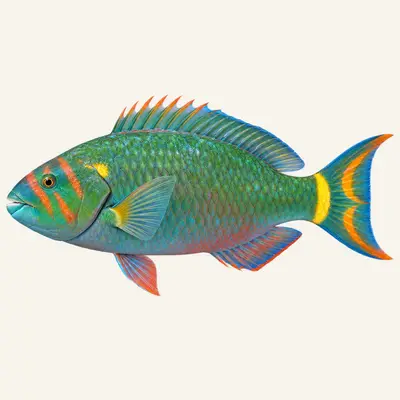
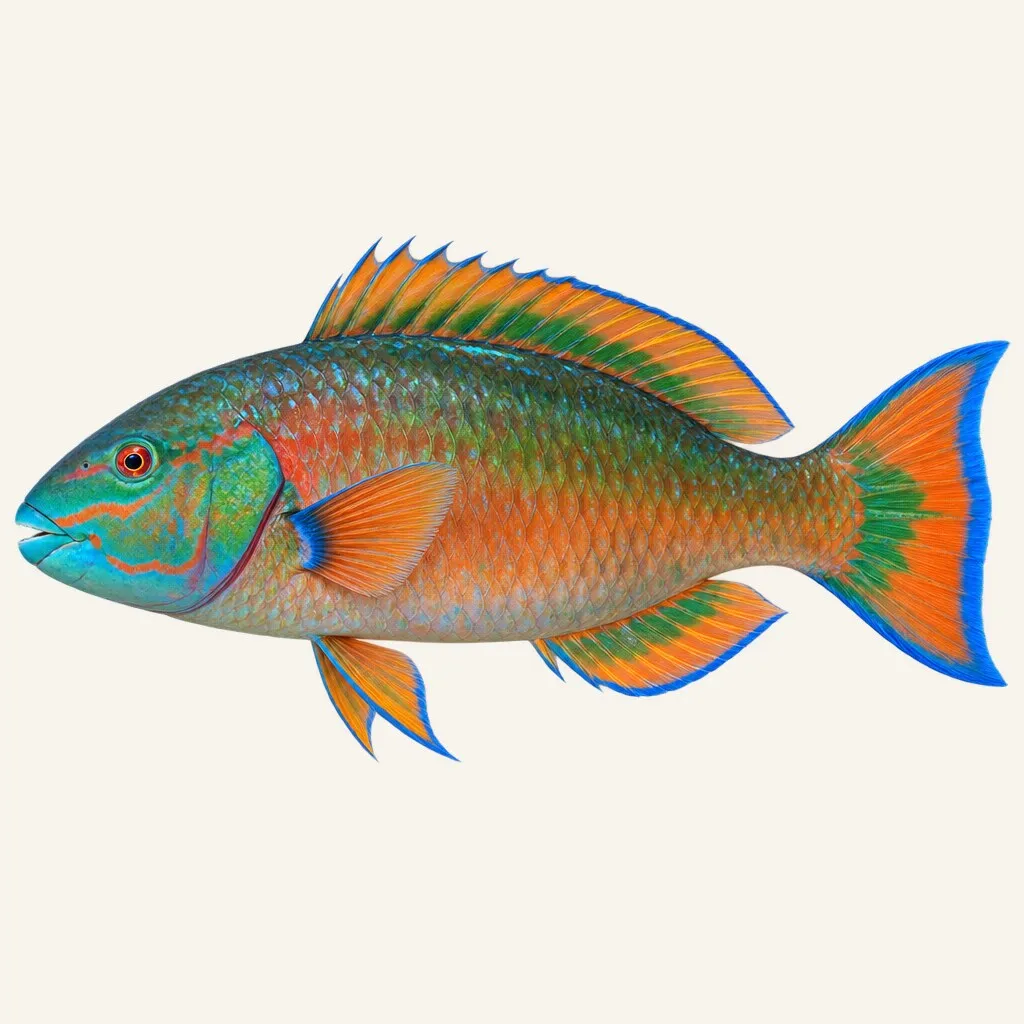
What the colour does do is name the species. The fins are dull orange, and tongues of green run into the dorsal and the anal from their bases. The margins of the median fins are blue. The dental plates — the fused beak the whole family grazes with — are blue-green.
The counts are short and belong to the family rather than to the fish: nine dorsal spines and 10 soft rays, three anal spines and nine soft rays. They confirm what it is and decide nothing about which one.
Breeding
Oviparous, with distinct pairing at breeding.
Read that beside the colour. The description records no visible difference between the sexes and it records the formation of pairs, so whatever the partners signal to each other it is not the livery, and the file does not say what it is. Compare the stoplight parrotfish, whose own entry in this catalogue carries protogyny and a breeding system that depends on which colour phase of male is involved. Two relatives, two accounts, and this one has neither a sex change nor a costume in it.
The water it needs
The reef between three and 25 m is where this animal works. It is not where it lives.
It lives in a cave, and the record is specific about it: a home cave, the same one, that it retires into at night and whenever danger appears. Then it adds the part that makes the entry remarkable — the fish makes use of the sun as an aid to locating the cave. An animal navigating back to a fixed shelter on the position of the sun is running a daily commute, out in the morning and home in the evening, over ground it knows.
That changes what a reef means here. This is not a grazer drifting with the algae but a resident with a centre, and the useful question about it is where the centre is rather than where the food is.
The young are somewhere else altogether. They are commonly found in mangrove, which is why the record lists the species as brackish as well as marine. Two habitats, two ages, and the distance between them.
Areas
- Coral reefs
- Tropical seagrass beds
- Shallow coastal zones
- Lagoons
Techniques
- Bottom fishing
- Float fishing
- Light bottom rig fishing
- Coastal natural bait fishing
Baits
- Shrimp
- Algae and marine plants
- Crabs
- Marine worms
What it eats
Benthic algae, mainly, taken off fixed substrate.
Grazing is daytime work, and that follows from the cave: an animal that shuts itself away at night feeds in the light. It also means the same fish can be expected on the same patch at the same hour, which is unusual enough on a reef to be worth planning around.
How to catch it
Look for a hole rather than for a slope. A species that keeps one cave and returns to it is found by finding the cave, and a fish pushed off the algae does not run for open water — it goes home, to the place it went yesterday.
Common length is 70 cm, which for a reef grazer is a substantial animal, and three separate demands are made on it: a minor commercial fishery, a game fishery, and collection for the aquarium trade.
One warning belongs to the plate rather than the tackle. Reports of ciguatera poisoning are on file for this species. Whether it applies on the reef being fished is a question for the people who fish it, asked before anything is kept.
Conservation · Near Threatened (IUCN) — This species is in decline. Release your catch quickly and handle it with care — wet hands, as little time out of the water as possible.
Conservation
The pressure falls on the nurseries, not on the reef.
Mangrove fringe is the easiest part of this animal's life to remove, because it occupies exactly the strip a coastline gets built on: filled, walled, cut into marinas and ponds. Nothing has to happen to the coral at all.
The effect then arrives late, which is what makes it hard to see. Adults keep their caves for years after the mangrove behind the reef has gone; the visible stock holds and the replacements stop coming. By the time the decline is measurable on the coral, the cause is a decade in the past and no longer available to be photographed.
The standing assessment dates from 2012, on a coast that has been built hard since.
Regulations
Check the local regulations in force (legal size limits, closed seasons, bag limits).
For guidance only. Legal sizes, quotas and open seasons vary by location and season: always check the local regulations in force before fishing.
Other names
Rainbow parrotfish in English, Regenbogen-Papageifisch in German, perroquet arc-en-ciel in French: three languages promising a spectrum for a fish its own description gives as dull orange with green.
Spanish went the other way. Pez loro guacamayo names the macaw, and that is where the scientific epithet comes from — guacamayo is the Taíno word Spanish kept for the bird, latinised into guacamaia. So the fish is named after a parrot twice over, once by its family and once by its species, and the second time after a particular parrot.
Sources: fishbase.se · api.gbif.org