Stoplight parrotfish
Sparisoma viride · Scaridae
- Saltwater
- Coastal
- Medium
- Size
38–64 cm
- Weight
0.9–1.6 kg
- Depth
3–50 m
Where to fish
- Reef
Habitat icons: Flaticon
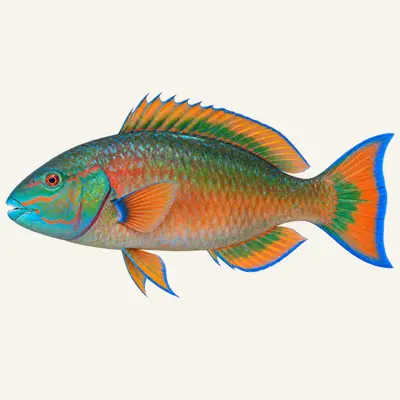
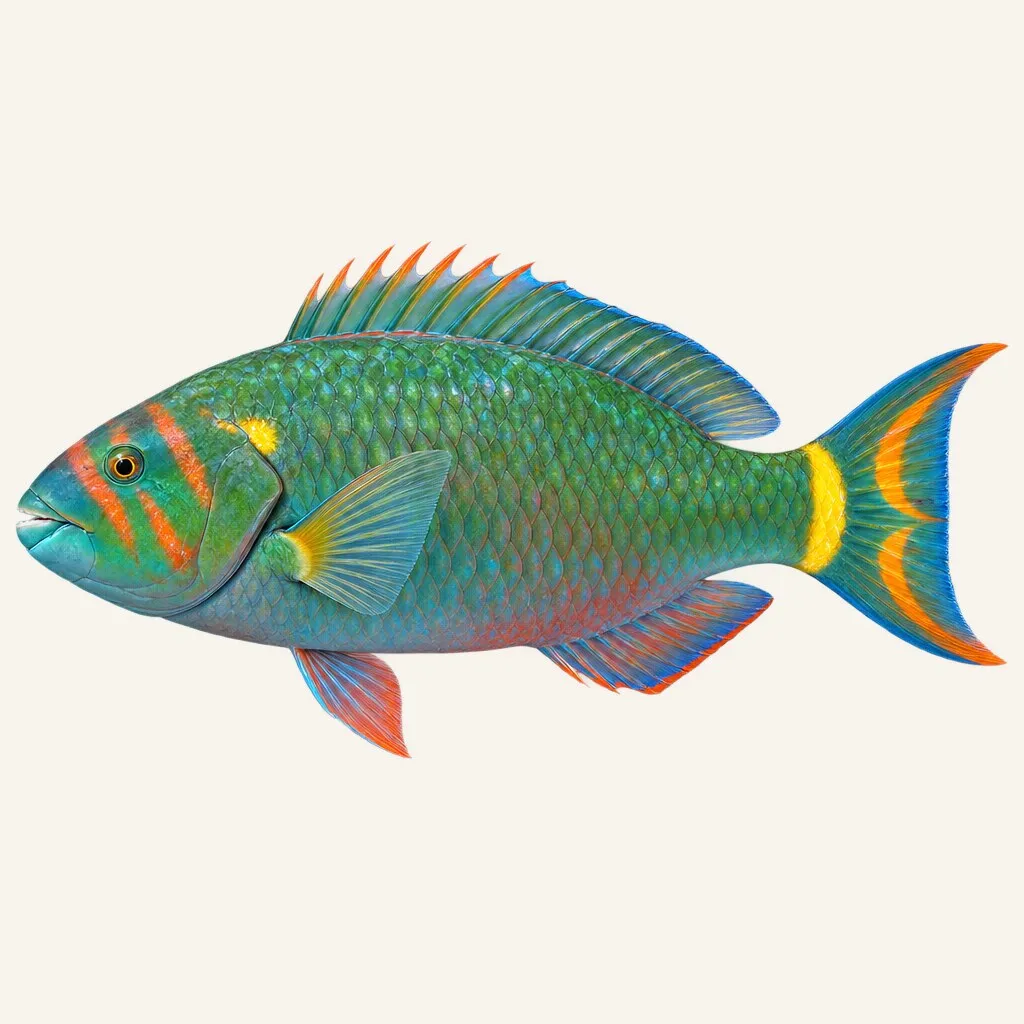
The stoplight parrotfish is a large herbivorous parrotfish of Caribbean and western tropical Atlantic coral reefs, recognisable by its marked sexual dimorphism: terminal-phase males display brilliant blue-green colouration with yellow and red markings, while females and juveniles show a brown-red mottled livery. Its fused dental beak allows it to graze algae directly from coral.
Calendar
Recorded in 32 countries
Antigua & Barbuda · Aruba · Bahamas · Barbados · Belize · Bermuda · Brazil · British Virgin Islands · Caribbean Netherlands · Cayman Islands · Colombia · Cuba · Curaçao · Dominica · Dominican Republic · Guadeloupe · Haiti · Honduras · Jamaica · Martinique · Mexico · Panama · Puerto Rico · Sint Maarten · St. Barthélemy · St. Lucia · St. Martin · Trinidad & Tobago · Turks & Caicos Islands · U.S. Virgin Islands · United States · Venezuela
GBIF occurrence records — native and introduced populations combined.
Identifying it
The mark the fish is named for sits at the upper edge of the gill cover: a bright yellow spot, carried by the largest males, with a yellow bar at the base of the tail and a curved orange-yellow mark across the caudal rays. Those three together are the stoplight.
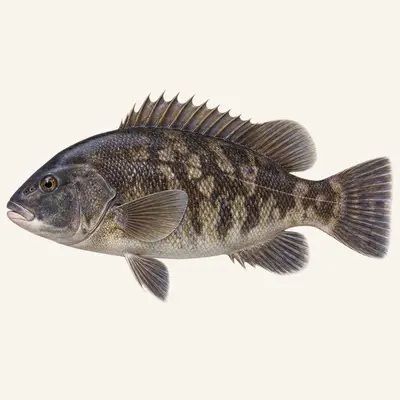
Most of the fish on the reef do not have them. The species runs through named phases that look nothing alike. Initial-phase fish have a brown head, the scales of the upper two-thirds of the body pale-centred with dark brown edges, and the lower third of the body and the fins bright red. Terminal-phase males are green with three diagonal orange bands across the upper half of the head. Young adults and females carry scales outlined in darker grey and are often bright red underneath.
So the English name describes one stage of one sex. That is the identification problem here in a sentence, and it is why the species has a history of being described more than once.
The fin counts are the family's — nine dorsal spines, 10 soft rays, three anal spines, nine soft rays — and they separate nothing.
One entry is unusual enough to quote. The literature gives body depth as a formula rather than as a ratio: maximum depth equals 0.10 plus a third of fork length, fitted on 79 fish between 13.5 and 25.5 cm. The rate at which a parrotfish gets deeper as it gets longer is written down for this species.
Breeding
Females turn into males. The species is protogynous, and the consequence for anyone fishing it is direct: the large fish are the ones that changed.
The second entry is what makes the colour phases matter. The type of breeding behaviour depends on the colour phase of the males involved — so the livery is rank rather than decoration, and rank decides which reproductive strategy is in use. Take the terminal-phase males off a reef and the system running there is not reduced, it is replaced by a different one.
Maturity is given at 16.3 cm, with a range starting at 18. The two figures in the file do not quite agree, and both are small for a fish of this build.
The water it needs
Clear water, coral reef, three to 50 m. The young are elsewhere: seagrass beds and other heavily vegetated bottoms, where a grazer can graze without a reef.
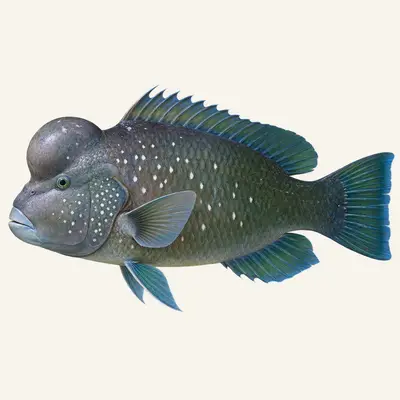
It is strictly diurnal, and the whole day goes on grazing rather than part of it. The night it spends sleeping on the bottom — an entry worth comparing with its relatives one file at a time rather than as a family, since the rainbow parrotfish's own account puts it in a home cave and the humphead's in caves and shipwrecks, while this one is on open bottom.
Singly or in small groups.
Areas
- Shallow coral reefs
- Seagrass beds
- Live coral areas
- Tropical lagoons
Techniques
- Bottom fishing
- Float fishing
- Light bottom rig fishing
- Coastal natural bait fishing
Baits
- Shrimp
- Crabs
- Algae and marine plants
- Marine worms
What it eats
Soft algae mainly, and live coral when it chooses to: Montastraea annularis is named in the record.
The jaws are a beak, they are strong, and the teeth grow back continuously because they are being worn away continuously. What comes out the far end is sediment. This fish produces a significant amount of it by bioerosion, scraping limestone off the reef to reach the algae growing in it and voiding the rock as sand.
That is a geological function and not a dietary detail. A grazer that mills its own substrate is manufacturing the beach behind the reef, and the tonnage has nothing to do with how good it is to eat.
How to catch it
There is no sport fishery here and the record says so plainly: minor commercial, plus a trade in live fish for aquariums. Where it is taken it goes to spear and trap, in daylight, on clear reef — and the fish makes that straightforward by being predictable. Diurnal, resident, feeding in the open.
The question a captor faces is not about tackle. Common length is 38 cm, and the animal on the end of the spear does two things on that reef: it keeps the algae down and it turns coral rock into sand. Remove enough of them and the algae stay where they are.
Reports of ciguatera poisoning are on file for the species, which is a second reason to ask locally before keeping one.
Conservation
Protogyny does the usual thing to a size-selective fishery. The big fish are males, they hold the positions that determine how the reef breeds, and taking them takes the structure rather than a share of the biomass.
The functional loss is the larger issue, and it does not appear in landings. An animal that grazes algae and mills sediment is a piece of reef machinery; when it thins, what changes is the state of the coral, not a catch statistic. That is a slow and almost invisible failure, and it is why the parrotfishes are a management question in the Caribbean out of all proportion to what they are worth on a quay.
The reference assessment dates from 2009.
Regulations
Check the local regulations in force (legal size limits, closed seasons, bag limits).
For guidance only. Legal sizes, quotas and open seasons vary by location and season: always check the local regulations in force before fishing.
Other names
Stoplight parrotfish is the English name and it comes from the yellow spot on the gill cover of the terminal male — the one fish in the population that has it. Loro viejo, old parrot, in Caribbean Spanish; Ampel-Papageifisch, traffic-light parrotfish, in German, which reads the same mark the same way.
The scientific name combines Sparus, the sea bream, with soma, body — a bream-bodied fish. The epithet viride, green, picks the terminal male again. Between them the genus says bream and the species says green, and neither describes the red-bellied animal that most of the population consists of.
Sources: fishbase.se · api.gbif.org