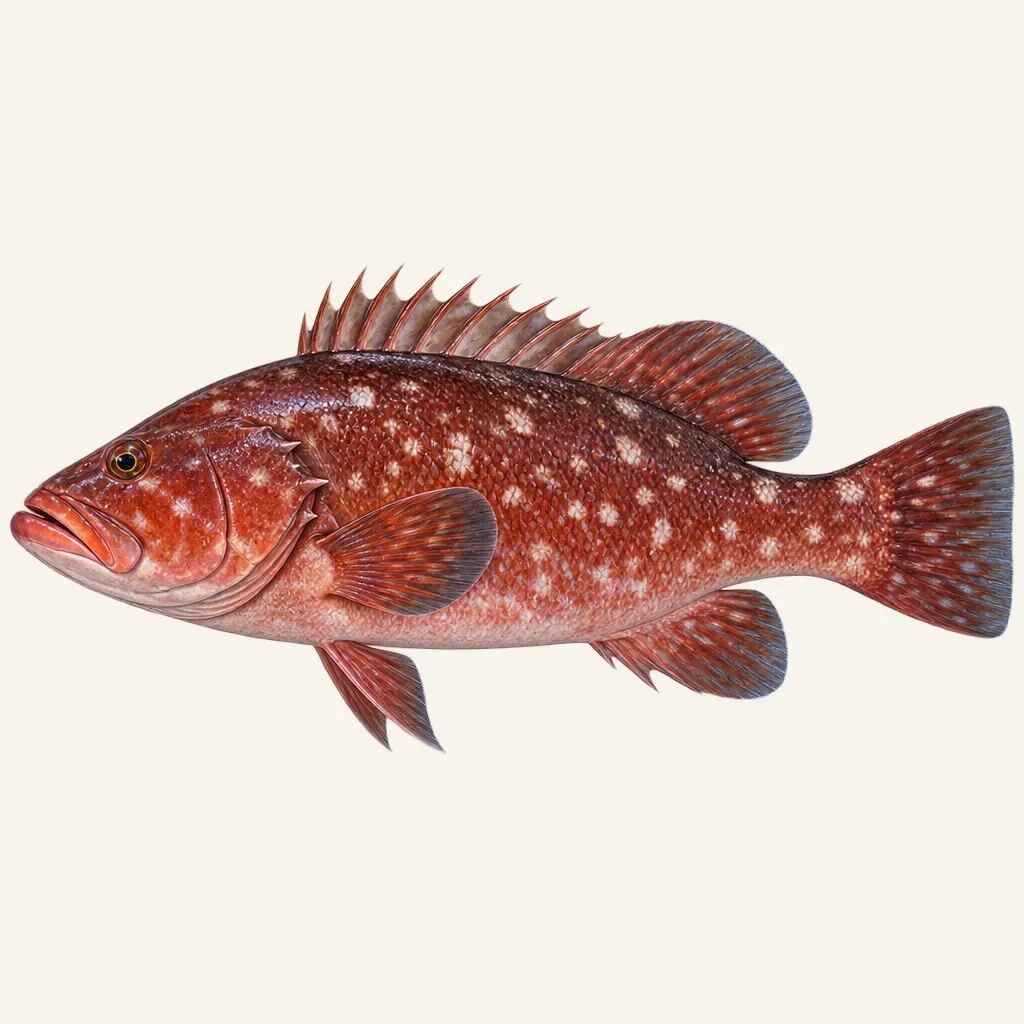
Red grouper
Epinephelus morio · Serranidae
- Saltwater
- Coastal
- Medium
- Size
50–125 cm
- Weight
1.9–23 kg
- Lifespan
25 years
- Depth
5–330 m
Where to fish
- Reef
- Rocky shore
Habitat icons: Flaticon
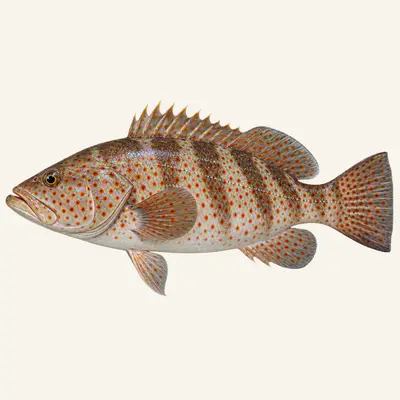
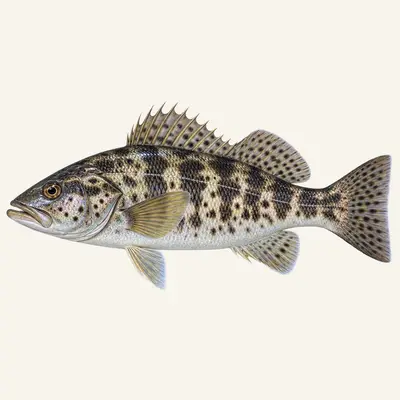
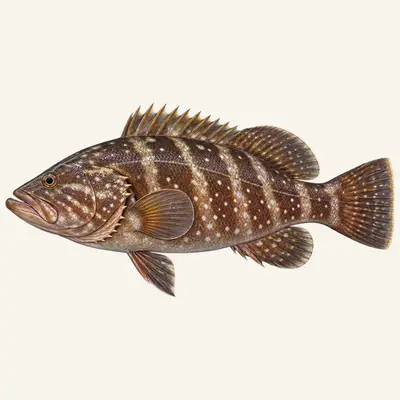
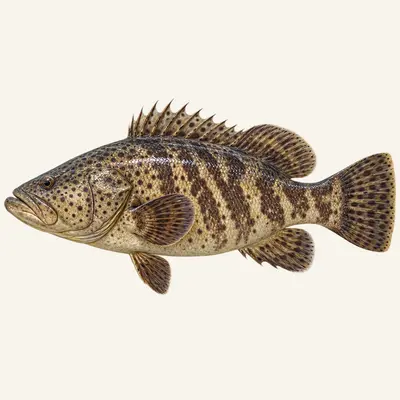
The red grouper is a stocky serranid of American Atlantic coasts, uniformly brownish-orange with pronounced reddish reflections on the flanks. Its fins have a characteristic orange margin. It inhabits rocky and coral bottoms in the Gulf of Mexico and Caribbean down to 150 metres.
Calendar
Recorded in 3 countries
Brazil · Puerto Rico · United States
GBIF occurrence records — native and introduced populations combined.
Its range
North Carolina to southern Brazil, taking in Bermuda, the Gulf of Mexico and the Caribbean.
The species is classed as non-migratory, and that is what gives the northern records their meaning. Individuals recorded as far up as Massachusetts are strays, not the leading edge of a population moving north, because there is no mechanism in this fish for a population to move. The map has a long tail and the fishery does not.
What the range describes is two continental shelves rather than an archipelago, and that separates it from the island groupers whose ranges it overlaps without sharing their ground.
Identifying it
The colour is plain. Dark reddish brown over the head and back, shading to pink or red below, and that is all — no dots, no bars, no marbling, no saddle on the caudal peduncle. In a genus where identification almost always runs through a pattern, having no pattern is itself the character.
The gill cover carries three flat spines, the middle one the tallest, and its upper edge is straight. The preopercle is subangular with its serrations barely enlarged at the corner. The two nostrils are of similar size, the space between the eyes is convex, and head length goes 2.3 to 2.5 times into standard length.
Two details apply to large fish only. The membranes between the dorsal spines are not incised, so the fin keeps an unbroken outline. And the unpaired fins become angular with age where they are rounded in young fish: the silhouette of an old individual is not the silhouette of a small one, which is a useful thing to know before deciding two fish are two species.
The pelvic fins are shorter than the pectorals and set slightly behind their base. The bases of the soft dorsal and the anal disappear under thick, scaled skin. Eleven dorsal spines with 16 or 17 soft rays, three anal spines with eight to 10 rays.
Breeding
This is a protogynous species: females change into males, most of them between seven and 14 years of age. The average transition is placed at 75.5 cm total length and 9.5 years.
The figure worth pausing on is not the average but the spread around first maturity. It is given as 54.4 cm on average, within a range running from 35 cm to 98. That is a 63 cm interval for a single life-history event, which means size is a poor guide to whether an individual of this species has bred. A 40 cm fish may have; a 90 cm fish may not. Longevity reaches 25 years.
The water it needs
This is a grouper that is not a reef fish. It is recorded as uncommon around coral and placed instead over rock and mud, which is close to the opposite of what the genus leads one to expect. It rests on the bottom rather than holding a vertical face.
Depth follows from that. The full range starts at 5 m and reaches 330, but the usual band is 70 to 330. The fish lives at the bottom of the shelf and on the slope, where reef has stopped existing.
And depth sorts the ages. Juveniles are found in shallow water; adults are almost all taken from 70 m down. A young fish and an adult of this species do not occupy the same water, do not meet the same gear and do not belong to the same fishery.
That is the fact this page is built on, and its consequence is a monitoring problem rather than a biological one. Effort in the shallows touches recruitment and nothing else. Effort on the slope touches the spawning stock and nothing else. Both effects are real, they are independent of one another, and no landings table separates them — so a collapse in one can be masked for years by stability in the other.
Areas
- Coastal rocky shallows
- Reefs and hard structures
- Deep seagrass beds
- Gulf of Mexico bottoms
Techniques
- Vertical jigging on rocky bottom
- Bottom fishing with natural bait
- Slow deep trolling
- Heavy Texas-rigged soft lure
Baits
- Whole squid
- Live fish
- Crab
- Shrimp
- Oily fish fillet
What it eats
A wide variety of fishes and invertebrates, with nothing dominant.
The absence of a specialism is the finding. Groupers of this size usually show a bias — towards crustaceans, towards cephalopods, towards reef fish — and that bias normally explains where they live and how they hunt. Here there is no bias to explain anything, which fits an animal sitting on open rock and mud and taking whatever comes within reach of a fish that does not chase.
How to catch it
Depth organises the whole operation. Looking for this grouper on a coral drop-off at 20 m means looking for a fish that is hardly ever there. It is taken on the slope, between 70 and about 300 m, over rock or mud — which calls for deep-water tackle and a reading of the sounder rather than a reading of visible relief.
Because the diet has no dominant item, the bait is not the difficulty and the choice can be made on what is available. The depth is the difficulty.
One number puts the recreational fishery in proportion: the rod-and-line record for the species stands at a little under 18 kg, taken off Cape Canaveral in Florida. The commercial fishery, working the same depths with different gear, handles fish this rod fishery rarely sees.
The species is sold fresh and frozen, and fishing for it is subject to specific measures in a number of countries across its range. Those must be checked with the competent authority before going out.
Conservation · Vulnerable (IUCN) — This species is threatened with extinction. Always release it (no-kill), handle it with the utmost care and check local rules — fishing for it may be prohibited.
Conservation
One source of mortality has nothing to do with fishing. This grouper is susceptible to the red tide toxin produced by the dinoflagellate Ptychodiscus brevis. A bloom on the shelf kills fish of every size within days, in a quantity unrelated to whatever effort was exercised that season, and a thinned population absorbs an episode like that far worse than a full one. No fisheries measure can reduce it.
Renewal is slow in its own way. With average maturity above 50 cm, sex change around nine and a half years and a lifespan of 25, a year class removed is not replaced within the season, or within several.
Then there is the geography of the exploitation. The fish holds the slope of two heavily worked continental shelves, from the Gulf of Mexico through the Caribbean, across exactly the depth band that bottom longlines and commercial gear operate in. It has no shallow refuge, because it does not live in the shallows as an adult, and no pelagic one, because it does not leave the bottom.
Regulations
Check the local regulations in force (legal size limits, closed seasons, bag limits).
For guidance only. Legal sizes, quotas and open seasons vary by location and season: always check the local regulations in force before fishing.
Other names
Red grouper in English, mérou rouge in French, mero americano in Spanish. Italian says cernia rossa atlantica, adding the ocean in order to separate it from another red cernia of the same waters, the red hind — which is genuinely red, but by its spots rather than over its whole body.
Brazilian Portuguese calls it garoupa-de-são-tomé, after a place rather than after the animal, which makes it the odd one out among the names.
The genus holds well over a hundred species, so the word grouper on its own conveys almost nothing about which fish is in question. On a Gulf or Caribbean fish counter the informative question is not the name but the depth the fish came from, because in this species the depth is what identifies the stage of the animal's life.
Sources: fishbase.se · api.gbif.org