Red hind
Epinephelus guttatus · Serranidae
- Saltwater
- Coastal
- Medium
- Size
40–76 cm
- Weight
0.9–25 kg
- Lifespan
22 years
- Depth
1–100 m
Where to fish
- Reef
- Rocky shore
Habitat icons: Flaticon
Shallow reefs and rocky bottoms. Usually solitary and territorial.
Calendar
Recorded in 17 countries
Bahamas · Belize · Bermuda · British Virgin Islands · Caribbean Netherlands · Cayman Islands · Colombia · Cuba · Guadeloupe · Honduras · Martinique · Mexico · Puerto Rico · Sint Maarten · Turks & Caicos Islands · U.S. Virgin Islands · United States
GBIF occurrence records — native and introduced populations combined.
Its range
North Carolina to Paraíba in north-eastern Brazil, and it is not evenly distributed along that stretch. This is the commonest member of its genus in the West Indies, while the two continental ends of the range — the Carolinas in the north, the Brazilian coast in the south — are the thin margins.
The centre of gravity is therefore insular, and that matches the economics: it is in the island arc that the species counts, both in the number of fish taken and in the tonnage landed.
Identifying it
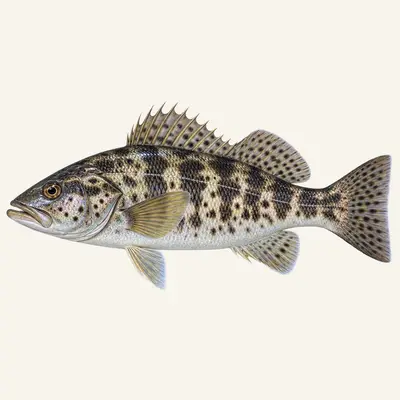
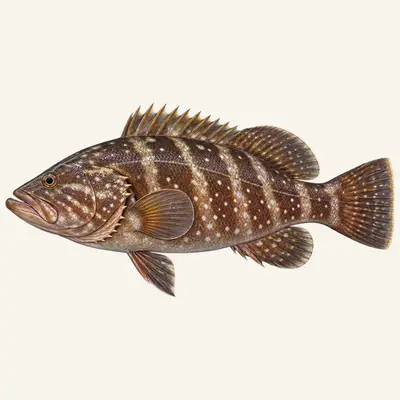
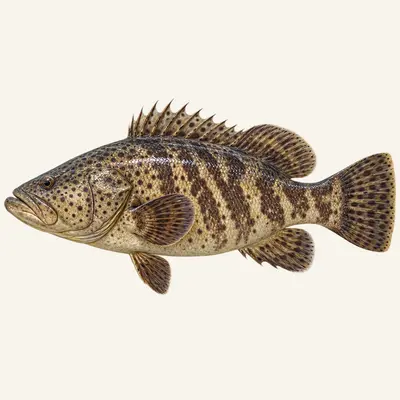
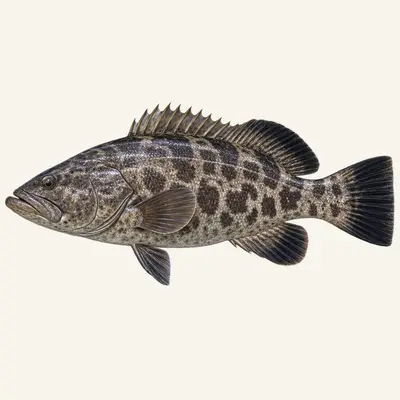
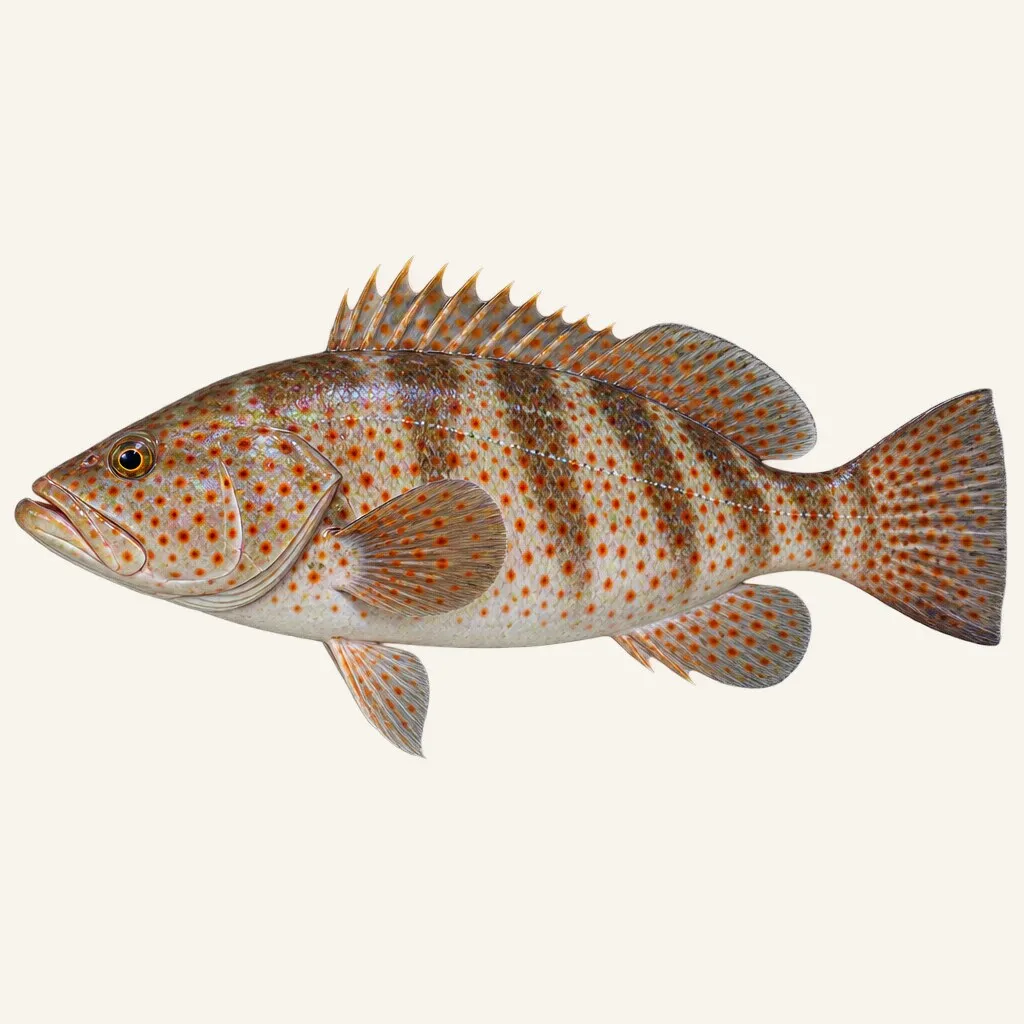
The spotting decides it. Dull orange-red to brown dots, well spaced rather than crowded, cover the head, the body and the fins without leaving any area clear. The ground colour is greenish grey to light brown over the back, paling to white on the belly.
Five faint diagonal bars can be made out along the flank. They are not pigment in their own right: they are the darker spots falling into line, and they dissolve as soon as the fish is looked at closely.
Two absences count as much as the pattern. There is no saddle-shaped blotch on the caudal peduncle and none along the base of the dorsal fin. Both marks occur in other groupers of the same water, so their absence is a character rather than a blank.
The preopercle is evenly serrated with no salient angle sticking out. The rear nostril is the larger of the two. Body depth is contained 2.7 to 3.1 times in standard length and head length 2.3 to 2.4 times. Scales are cycloid all over except for a ctenoid patch of variable extent in the pectoral region. Eleven dorsal spines and 15 or 16 soft rays; three anal spines and eight rays.
One field note saves a mistake. The red grouper, Epinephelus morio, shares the whole range and is often taken over the same ground. It is a uniform reddish brown with no spotting at all, and its two nostrils are of much the same size. The two do not resemble each other once either one has been looked at properly.
Breeding
The social arrangement is a harem, and it is held in place by one fish. Females rest on the bottom or just above it. A male patrols a sector containing one to five of them and drives other males out of it.
That is a spatial structure maintained by a single individual, and it can be watched from the water. It also fixes who is where: the females are stationary and dispersed across the sector, the male is the one moving through it.
The species then aggregates, and reproduction happens almost exclusively inside the aggregation period. Outside that window nothing takes place at all.
Sex change comes early in the life of the fish. Some individuals have switched by 28 cm total length, and most fish above 40 cm are male. Since the common length of the species is about 40 cm, the ordinary capture sits exactly on the threshold. This matters by comparison: the large groupers of the same genus cross the same point at 80 or 90 cm, at an age and a mass in a different category altogether. Here the change belongs to the everyday life of the animal, and it has to, because a harem system needs enough males for each of them to hold a piece of ground.
First maturity arrives at about 25 cm. The maximum recorded age is 22 years.
The water it needs
Shallow reef and rocky bottom, from the first metre down to at least 100. Outside the aggregation the fish lives alone and holds a sector against others of its own sex.
Its reputation among divers comes down to one point: it lets people get close. A territorial animal that does not leave when approached is an animal whose address is known and whose behaviour does not protect it, and that combination governs everything downstream.
Areas
- Coral reefs
- Coastal rocky bottoms
- Underwater drop-offs
- Wrecks
Techniques
- Bottom fishing
- Cast and retrieve with soft lure
- Coastal trolling
- Light jigging
Baits
- Small whole fish
- Squid
- Shrimp
- Soft lures
What it eats
The prey list is the most specific in the genus, and it is worth reading item by item. Crabs come first, with two genera named: Calappa, the box crabs, which fold their claws flat against the face like a shield, and Mithrax, the reef spider crabs. Then alpheid shrimps — the snapping shrimps of dead coral and sediment — and scyllarid lobsters, the flattened slipper lobsters that clamp onto rock. Fish appear as well, wrasses and grunts, and octopus.
Almost everything on that list is armoured, buried or wedged in. This is not a predator that runs down fast prey in open water; it is one that extracts and breaks. Box crab shell is among the harder things a reef fish can be asked to deal with, and the jaws that routinely deal with it are a demolition tool applied to hard ground.
The practical consequence is that the species exploits a food supply that most reef predators cannot touch, which is a large part of why it is the abundant grouper of the islands rather than a scarce one.
How to catch it
The diet writes the bait list. Crab, slipper lobster, a piece of octopus, presented in contact with the bottom and immediately beside a ledge or a drop-off. The fish does not travel to find food; it waits within a short distance of cover, and a bait more than a few metres from structure is a bait in the wrong place.
The literature records that the species comes to a hook without difficulty and is straightforward to spear. Those two statements describe a vulnerability, not a quality, and there is nothing to add to them except what the social structure implies.
Which is this: the fish that is moving, that shows itself, that comes to look, is the male of the harem. He is the one who gets caught first, because patrolling is his job. His territory loses its organisation at the same moment he does, and the females left on the bottom are not a group any more.
Ciguatera has been reported from this species. The toxin comes from the reef the fish has been feeding on rather than from the fish itself, it cannot be seen, and neither cooking nor freezing removes it. Whether a given area is affected is a local question with a local answer, and an answer from one island does not transfer to the next.
Conservation
The calendar is the weak point. All reproduction passes through the aggregation period, so a species that breeds at no other time has no fallback if a season is missed.
Three traits then reinforce each other: fidelity to a fixed sector, an absence of wariness, and a fishery that weighs heavily in Caribbean landings in numbers of fish and in total weight both. An abundant, approachable and commercially important animal gets no protection from being inconspicuous, because it is not inconspicuous.
The harem makes the removal asymmetrical, and that is the part no landings record captures. Taking the patrolling male leaves a set of females with no structure around them. Taking several males from one stretch of reef removes the spatial organisation of that stretch entirely. The tonnage is identical whichever sex comes over the side.
Regulations
Check the local regulations in force (legal size limits, closed seasons, bag limits).
For guidance only. Legal sizes, quotas and open seasons vary by location and season: always check the local regulations in force before fishing.
Other names
Red hind in English, and the word hind deserves a note. In the English-speaking Caribbean it is applied to the smaller Epinephelus, with grouper reserved for the large ones. That distinction is real and useful — it separates fish that differ in size, in longevity and in how much pressure they can absorb — and most other languages flatten it by using one word for the whole family.
Caribbean Spanish gives mero cabrilla, Brazilian Portuguese garoupa-pintada, the spotted grouper. French says mérou couronné.
Italian files it as cernia rossa pellegrina while calling the red grouper cernia rossa atlantica: two red cernie in the same water, of which only one is actually spotted and neither is reliably identifiable from the name alone.
Sources: fishbase.se · api.gbif.org