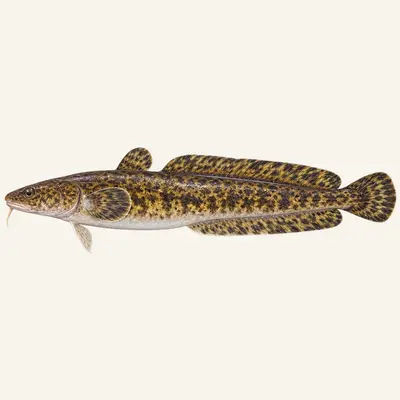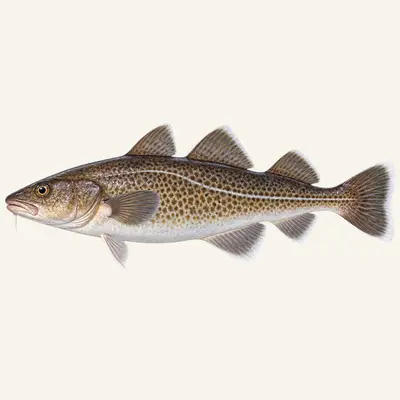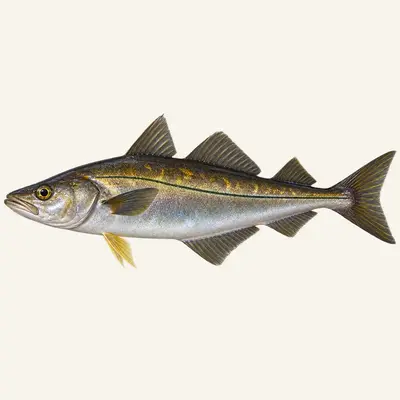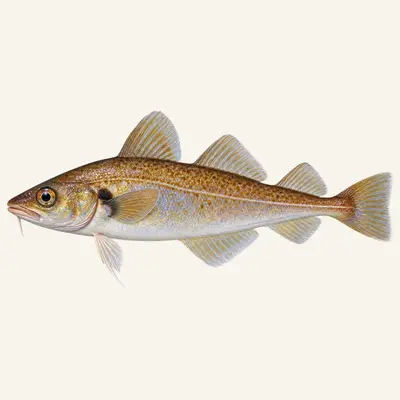
Ling
Molva molva · Lotidae
- Saltwater
- Bottom fish
- Medium
- Size
106–200 cm
- Weight
6.6–45 kg
- Lifespan
25 years
- Depth
100–1,000 m
Where to fish
- Rocky shore
Habitat icons: Flaticon
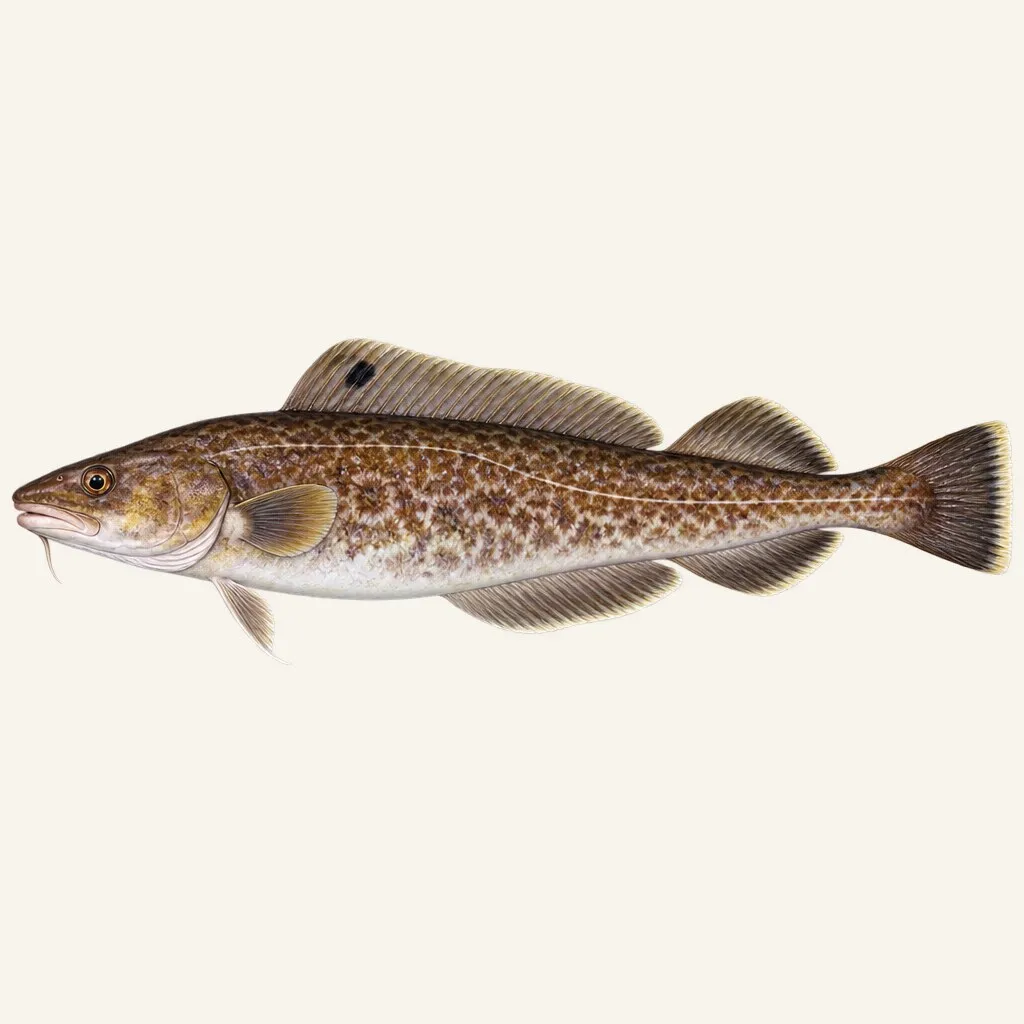
The ling is a large Lotidae with a very elongated, eel-like body that can exceed 1.5 m. Its back is brownish-green, the belly whitish, with white edges on the dorsal and anal fins. It actively hunts cod, herring, flatfish, lobsters, cephalopods and starfish over deep rocky grounds of the North-East Atlantic.
Calendar
Recorded in 6 countries
Denmark · Ireland · Isle of Man · Norway · Sweden · United Kingdom
GBIF occurrence records — native and introduced populations combined.
Its range
The north-west Atlantic off southern Greenland and Canada, the north-east Atlantic from the Barents Sea and Iceland to Morocco, and the Mediterranean in the north-western basin only.
That last restriction is the informative one. A cold, deep, hard-ground fish finds what it needs in the north-western basin and nowhere else in that sea, and the Mediterranean spawning band recorded from 50 m down suggests the population there is doing something different from its Atlantic conspecifics rather than simply being a thin edge of them.
Identifying it
The barbel comes with a measurement, which is what makes it usable: the one on the chin is longer than the diameter of the eye. Length against a feature on the same head beats any judgement of absolute size on a fish that has just come up 300 m.
Two more marks finish it. There is a black spot at the rear end of the first dorsal fin, and the upper jaw projects beyond the lower. Colour supports rather than decides: reddish brown above grading to white below, the flanks distinctly marbled, the back edges of the vertical fins dark with pale margins.
The counts describe an animal shaped like a rope. Seventy-five to 83 soft rays in the dorsal, 58 to 64 in the anal, 63 to 65 vertebrae, no spines. And the source makes one comparison of its own, which is the one to borrow: the caudal peduncle is stout compared with that of the blue ling. Where a diagnosis contrasts two species itself, the contrast is data.
One point of kinship, since the fish is sold beside cod all winter. The catalogue places the ling with the burbot in the Lotidae, not with the cods.
Breeding
Fecundity reaches 20 to 60 million eggs per female, which is among the highest figures in this catalogue. It goes with mass release into deep open water and no parental investment of any kind afterwards.
The spawning grounds, by contrast, are few and precisely located: Biscay, the slopes west of the British Isles, and off the Faroes and southern Iceland. Depths are given as 200 m from the Bay of Biscay to the Gulf of Norway, 100 to 300 m off southern Iceland, and 50 to 300 m in the Mediterranean — the shallowest band anywhere in the range, in the one sea where the species barely occurs.
Maturity arrives very late. Length at first maturity is 92.5 cm, in a range of 90 to 100, against a common length of 106.
The water it needs
Rocky bottoms in fairly deep water, most commonly between 100 and 400 m, with records down to 1,000.
Hard ground is the requirement and depth is the consequence. On this coast the rock that suits the species happens to lie deep, which is why the fishery is a deep one; the fish is not seeking pressure, it is seeking structure that comes with pressure attached.
Areas
- Deep rocky bottoms
- Wrecks and submerged structures
- Continental shelf edge
- Atlantic slope
Techniques
- Deep bottom fishing from a boat
- Wreck fishing
- Heavy jigging
- Heavy sinker rig
Baits
- Mackerel fillet
- Whole squid
- Fresh herring
- Lobster or crab pieces
- Sand eel
What it eats
Cod, herring and flatfish, then lobsters, cephalopods and starfish.
Cod and lobster in the same list describe the gape and the grip at once — nothing on that menu is swallowed by accident. The starfish describes the temperament. A predator of hard ground that will take an echinoderm is not sorting its food very carefully, and that is the behaviour a large bait exploits.
How to catch it
Deep rock between 100 and 400 m: longline and heavy vertical work, wrecks and shelf-edge ground. The catalogue's baits are all large — mackerel fillet, whole squid, fresh herring, pieces of lobster or crab, sandeel — and the diet is why. Finesse buys nothing from a fish that eats cod.
The arithmetic of maturity is what a ling angler should carry ashore. First spawning happens above 90 cm, which is longer than the entire adult length of most species on this site. A ling of a metre is a fish that has only just begun to breed, and one of 70 cm, which is a substantial animal by any ordinary standard, has never bred at all. Nothing in its appearance says so.
Maximum reported age is 25 years, so the individuals doing the spawning are also the oldest fish present.
Conservation
Late maturity is the mechanism, and it is arithmetic rather than ecology. A fishery working on fish of 60 to 80 cm is working entirely on individuals that have never spawned, whatever the weight on the scale says. There is no interpretation of that figure which makes it comfortable.
The concentration of spawning compounds it. A handful of identified sectors, at known depths, carries the reproduction of very large regions, so effort placed on one of them is not diluted the way effort spread over a range would be.
And the 20 to 60 million eggs offset none of this if the females are removed before reaching the length at which they produce them. High fecundity is a strategy that only pays out at the far end of a long life.
Regulations
Check the local regulations in force (legal size limits, closed seasons, bag limits).
For guidance only. Legal sizes, quotas and open seasons vary by location and season: always check the local regulations in force before fishing.
Other names
Ling in English, and outside the north-east Atlantic the word is a trap. Australia and New Zealand apply it to an unrelated cusk-eel; the Pacific coast of North America calls a greenling relative the lingcod, which is neither a ling nor a cod; and parts of North America use ling for the freshwater burbot, a fish this catalogue also carries. Common ling and European ling are the unambiguous forms.
Lingue or julienne in French, the second being the name on most French slabs. Leng in German, maruca in Spanish and Portuguese, molva in Italian, which simply keeps the genus.
Sources: fishbase.se · api.gbif.org