Pouting
Trisopterus luscus · Gadidae
- Saltwater
- Bottom fish
- Medium
- Size
30–46 cm
- Weight
0.3 kg
- Lifespan
4 years
- Depth
30–100 m
Where to fish
- Estuary
- Rocky shore
Habitat icons: Flaticon
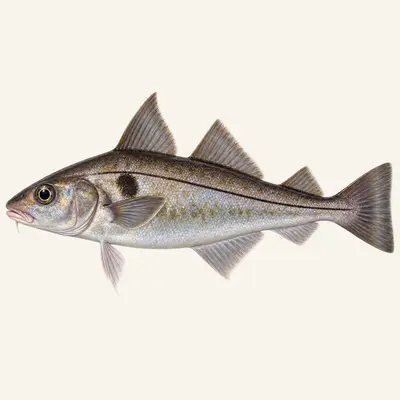
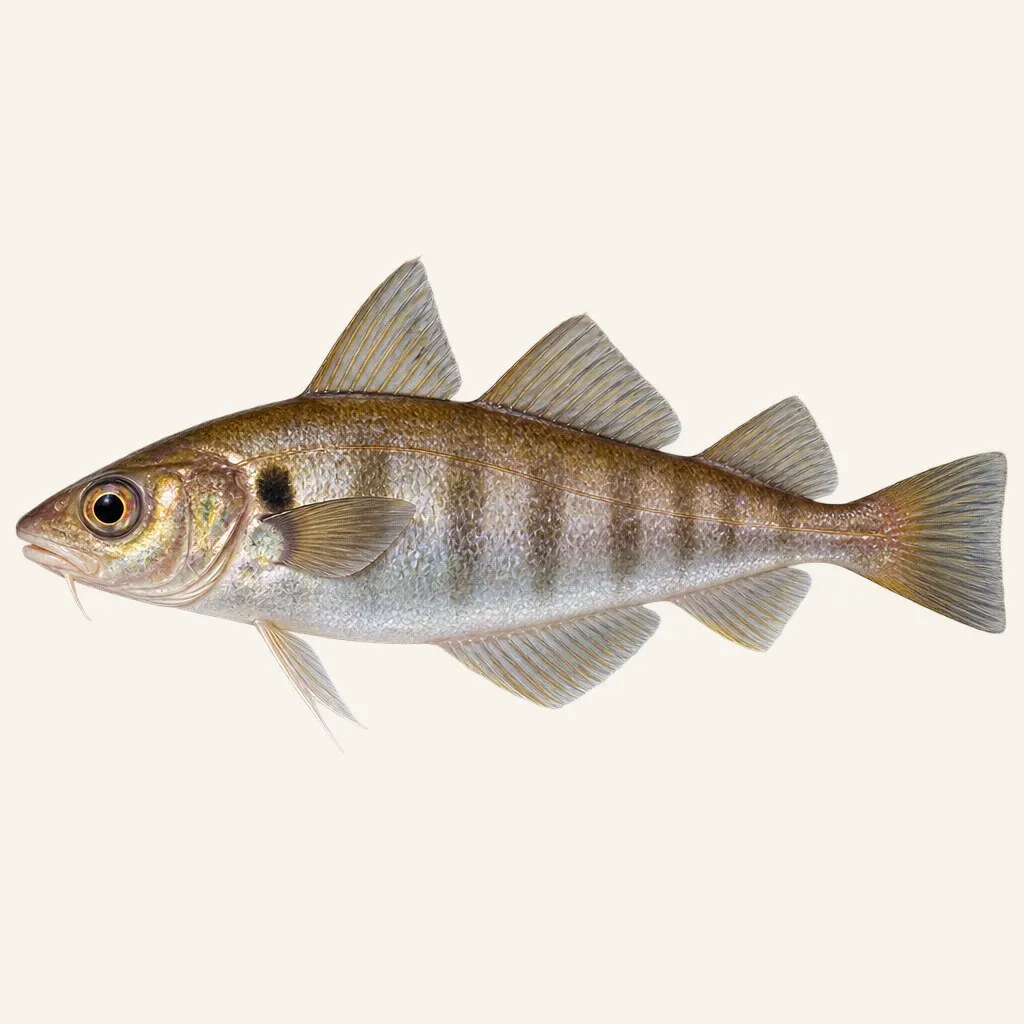
The pouting is a stocky inshore gadid recognisable by its brownish-yellow coloration, three dorsal fins and a single chin barbel. It inhabits shallow rocky and sandy bottoms along European Atlantic and Channel coasts.
Calendar
Identifying it
The dark blotch at the upper edge of the pectoral base is carried by this fish and by the poor cod alike. It marks the genus and separates nothing, and it is the character anglers most often use to do the opposite.
What does separate them begins with depth of body. This is a relatively tall fish, deep through the shoulder, where its congener is slighter. The flanks carry four or five broad transverse bars, ill-defined but present; the poor cod has none. The back is light brown, the sides grey turning silvery below.
Two proportions confirm it on a fish in hand. The eye diameter equals the snout length. And the anus lies below the middle of the first dorsal fin — a character that sounds like something for a museum drawer, and is in fact the one that still holds after the colours have gone.
The chin barbel is well developed, and the leading rays of the pelvic fins are slightly drawn out.
Breeding
The entire reproductive life is compressed into about two years. First maturity falls at 22 cm within a range of 21 to 25, and the maximum reported age is four. A fish spawns in its second or third year and is gone by its fourth.
Spawning is oviparous, the sexes separate, and it follows the inshore movement described above, in 50 m of water or less.
That compression creates an exposure a longer-lived species does not have. A single poor year class is a large fraction of the entire breeding stock, because only two or three of them are ever present at once. There is no reserve of old fish to carry the population through a bad spawning.
The water it needs
Two addresses, and one reason for moving between them. The species lives mostly on the outer shelf, between 30 and 100 m, and comes inshore to 50 m or less in order to spawn. Otherwise it is benthopelagic — off the bottom, but working it.
It is gregarious, and immature fish gather in large schools. Those two facts together describe the inshore fishery: what collects close in, in numbers, is largely fish that have not bred.
The species tolerates brackish water, which puts it inside estuaries at the shallow end of its range.
Areas
- Coastal rocky bottoms
- Shallow sandy areas
- Estuaries
- Wrecks and submerged structures
Techniques
- Bottom fishing from a boat
- Coastal rock fishing
- Weighted sliding rig
- Handline
Baits
- Ragworm
- Shrimp
- Small squid
- Mussel
- Fish strip
What it eats
Benthic crustaceans first, then small fish, molluscs and polychaetes. The chin barbel goes with the first item on that list: this is a fish that finds food by touch and taste on the seabed and does not need to see it.
The order matters for bait. Crustaceans are the staple rather than the exception, and the fish takes them off the ground rather than in the water above it.
How to catch it
This is the fish that reaches the bait first, in numbers, over almost any inshore ground, and it is caught mostly while something else was intended. Commercially it is bycatch too.
The size of what comes in is the useful part. Common length is 30 cm and first maturity 22, but the inshore schools are dominated by immature fish, so a session close in produces many small ones and a few worth keeping. The larger fish are out on the shelf in 30 to 100 m, and they are not in those schools.
Crustacean baits fished hard on the bottom match the diet exactly. Nothing about the animal calls for fine tackle; a short life and quick growth make it an obliging catch, and an unselective one.
The seasonal move inshore concentrates it within shore range at spawning time, which is when the least useful fish and the most vulnerable ones happen to be the same fish.
Conservation
No global assessment of this species exists, and the absence is the finding rather than a gap in the paperwork. A fish taken as bycatch is landed by fisheries directed at something else, so its removals sit inside nobody's target quota and its abundance is nobody's indicator.
Two traits make that matter more than the tonnage suggests. The breeding stock spans two or three year classes, so a fall arrives quickly and cannot be absorbed. And the spawning migration brings the fish inshore into 50 m or less, where inshore gear works — a concentration at the least resilient moment of its year.
Nothing in the record would register either effect while it was happening.
Regulations
Check the local regulations in force (legal size limits, closed seasons, bag limits).
For guidance only. Legal sizes, quotas and open seasons vary by location and season: always check the local regulations in force before fishing.
Other names
Pouting is the standard English name, pout the everyday one, and bib is heard on the same coasts. Whiting pout turns up in older accounts.
The confusion worth flagging is local rather than international. British anglers say pout for this fish and poor cod for its congener, but the two names get swapped freely on small specimens — which are exactly the fish the characters were needed for. Whiting proper is Merlangius merlangus, another genus altogether, so whiting pout names something that is not a whiting.
French says tacaud. The epithet luscus means one-eyed or squinting, an odd choice for a fish whose eye supplies one of its determining proportions.
Sources: fishbase.se · api.gbif.org