Poor cod
Trisopterus minutus · Gadidae
- Saltwater
- Bottom fish
- Medium
- Size
20–40 cm
- Weight
0.1 kg
- Lifespan
5 years
- Depth
1–440 m
Where to fish
- Rocky shore
Habitat icons: Flaticon
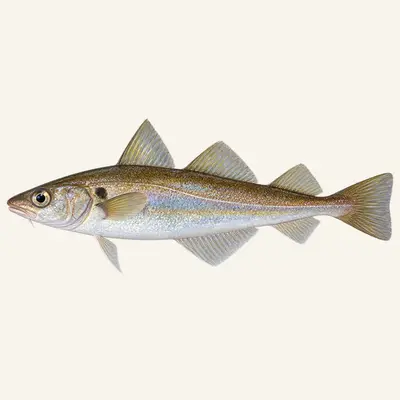
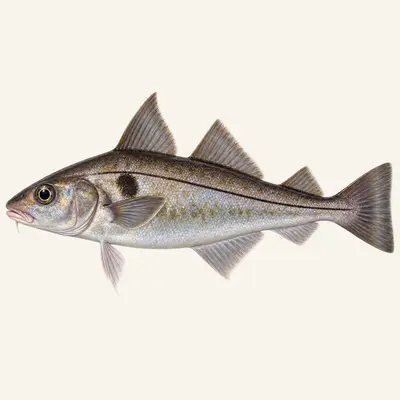
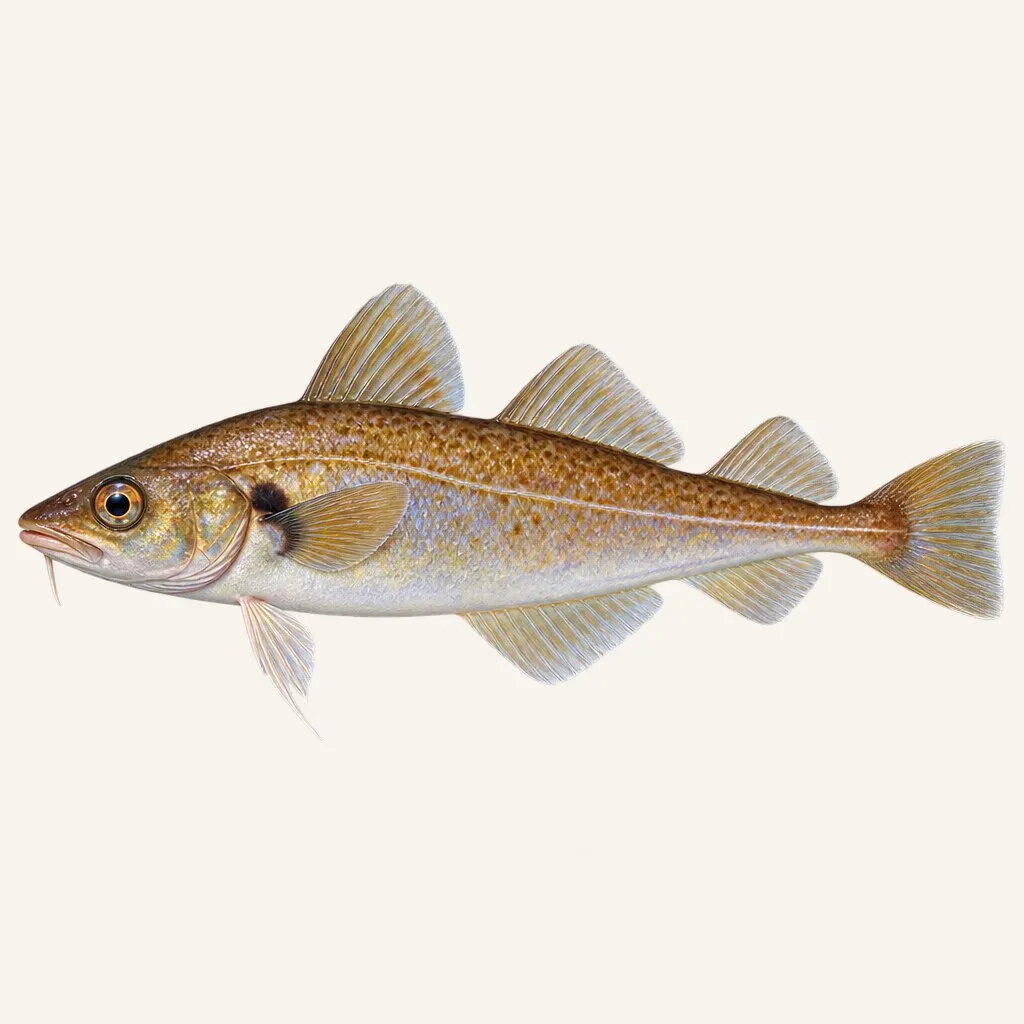
The poor cod is a slender inshore gadid, smaller than the pouting, with a silvery-greenish body and a short chin barbel. It lives in shoals over sandy and muddy bottoms between 20 and 200 metres along European coasts.
Calendar
Its range
The two congeners swap edges. This one runs from Trondheim Fjord and the Faroes south to Portugal and the Atlantic coast of Morocco, and it is absent from the Mediterranean, where the pouting occurs. Going the other way, the Faroes are named in this species' range and not in its relative's.
So the two overlap along the whole Atlantic seaboard and separate at both ends, one reaching further north and the other further into the enclosed sea. The recorded band is 66°N to 28°N.
Identifying it
This is the plain one. Brownish yellow on the back, paling underneath, with no bars, no saddles and no pattern of any kind beyond a dark blotch at the base of the pectoral fin — and that blotch is on the pouting as well. Determination therefore works by absence: a small member of the genus with nothing written on its flanks is this species.
The chin barbel is well developed, as it is throughout the genus. Nothing else in the published description is diagnostic, and that is the honest state of the question. The two species are told apart by the barring and by body depth, and both characters are least reliable on the small fish where the doubt actually arises.
Breeding
Oviparous, sexes separate, and the striking figure is the spread of maturity. Length at first maturity averages 13.3 cm across a reported range of 10 to 26 centimetres. A fish may be breeding at ten centimetres or still immature at twenty-five.
For an animal whose maximum reported age is five years, that spread means mature and immature fish sit side by side at almost every size. Length is not a guide to whether a given individual has spawned, which is unusual, and worth knowing before any conclusion is drawn from the size of a catch.
The water it needs
It stays where it is. The species is recorded as non-migratory, against a congener that runs inshore to spawn, and that single difference changes how a mark behaves: ground holding poor cod holds them through the year.
Depth is the other difference. The recorded range is 1 to 440 m, ordinarily 15 to 200, over mud or sand. That is both shallower at one end and far deeper at the other than the pouting manages, which means the species turns up from the first metre of an estuary out to the edge of the shelf.
Benthopelagic, on soft ground. Brackish water is not among its recorded environments, where it is among its congener's.
Areas
- Coastal sandy-muddy bottoms
- Intermediate coastal bottoms
- Edges of submarine gullies
- Sheltered rocky coasts
Techniques
- Bottom fishing from a boat
- Light feather rig
- Handline
- Coastal casting rod
Baits
- Ragworm
- Shrimp
- Squid strip
- Sand eel
- Mussel
What it eats
Crustaceans, small fish and polychaetes, worked off mud and sand. The barbel does the finding.
The diet overlaps its congener's almost completely, which is the expected result for two species sharing the same ground at the same depths. It also means that bait choice will not separate them either.
How to catch it
Nothing about this fish is targeted by anglers, and its commercial use says why: much of the catch goes into fishmeal, with human consumption confined to southern Europe.
Two things make it worth recognising anyway. It is non-migratory, so a mark that produces them produces them in any month — the opposite of the pouting's seasonal inshore run. And its depth range starts at a single metre, so it appears in water shallow enough to fish from the shore as well as at 200 m offshore.
Common length is 20 cm. A bait sized for anything larger will be stripped by these before it reaches whatever it was meant for, and on soft ground at moderate depth that is the usual outcome.
Conservation
There is no global assessment, and the reason lies in the use. A fish reduced to meal is landed by weight in bulk rather than counted individually, and a species handled that way leaves no species-level record of what was removed.
The exposure sits in the arithmetic of a small gadid: five years of life at the outside, and a maturity range so wide that the proportion of breeders in any landing is simply unknown. Neither figure can be checked against a catch series that does not exist.
Nothing about the animal is under obvious pressure. What is missing is the means of noticing if it were.
Regulations
Check the local regulations in force (legal size limits, closed seasons, bag limits).
For guidance only. Legal sizes, quotas and open seasons vary by location and season: always check the local regulations in force before fishing.
Other names
Poor cod in English, and the name is a judgement rather than a description — a cod-shaped fish too small to be worth the trouble. Norway pout is a different species again, Trisopterus esmarkii, so pout on its own is not safe in this genus either.
The Mediterranean fish long passed under this name and is now generally treated separately as Trisopterus capelanus, which is one reason the reference source records the species as absent from that sea. Older Mediterranean records under minutus have to be read with that in mind.
French says capelan and Spanish capellán, both of which are also handed out to unrelated small fish on other coasts — the capelin of the North Atlantic answers to the first of them. Minutus simply means small, and for once nothing in the naming is trying to be clever.
Sources: fishbase.se · api.gbif.org