Pacific cod
Gadus macrocephalus · Gadidae
- Saltwater
- Bottom fish
- Medium
- Size
60–119 cm
- Weight
2.4–23 kg
- Lifespan
25 years
- Water temp.
6–9 °C
- Depth
10–1,280 m
Where to fish
- Rocky shore
Habitat icons: Flaticon
A large-headed, chin-barbeled North Pacific groundfish of the cod family, prized for its white flesh.
Calendar
Recorded in 7 countries
Canada · Denmark · Greenland · Japan · Russia · Sweden · United States
GBIF occurrence records — native and introduced populations combined.
Its range
A Pacific cod that is not confined to the Pacific. It works the Chukchi and Beaufort Seas, crosses Arctic Canada as far as western Greenland, and comes back down the Atlantic to the Gulf of St Lawrence. On the Pacific side it runs from southern California, at the latitude of Santa Monica, to the Yellow Sea.
Two cod species therefore meet on the same North American seaboard, which makes the identification characters described above rather less theoretical than they look.
The constraint that draws this range is a narrow one. The species is boreal and holds between 6 and 9 degrees, where its Atlantic relative tolerates fifteen. A thermal window three degrees wide leaves little margin: it accounts both for the southern limit, pinned at California, and for the sensitivity of the stocks to a warm anomaly lasting a single season.
Identifying it
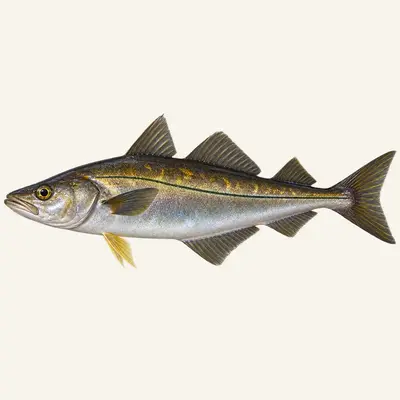
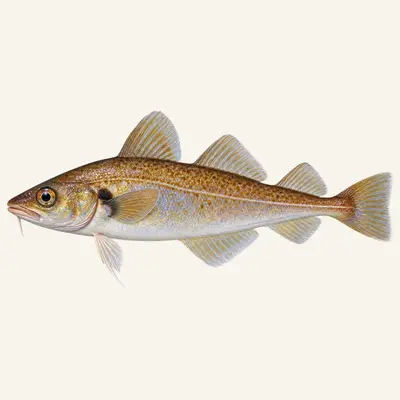
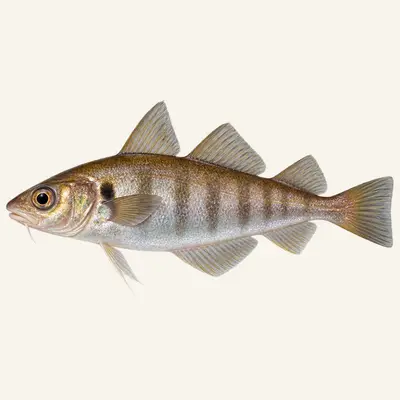
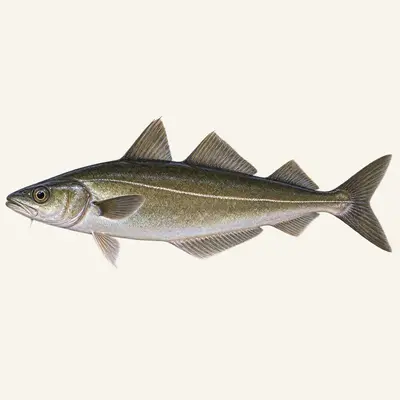
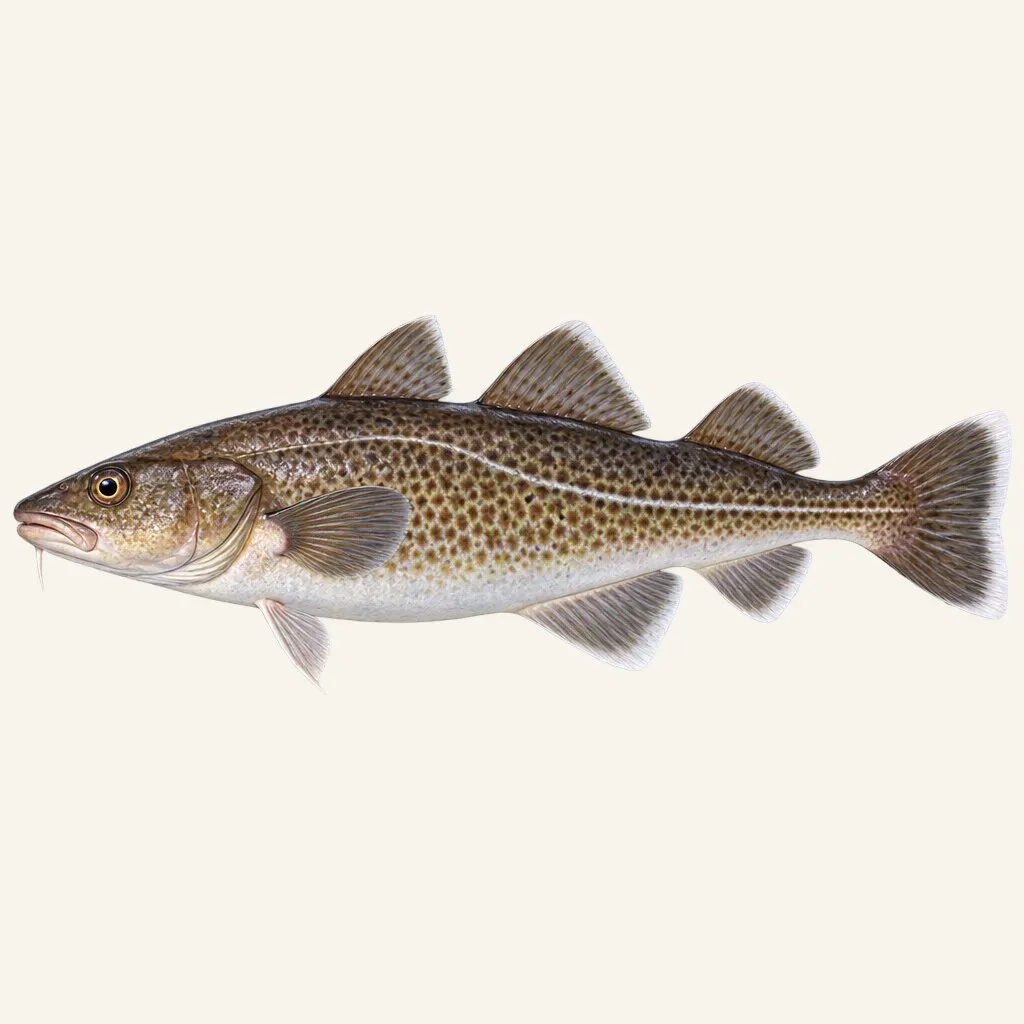
The barbel grows faster than the head. In a young fish it measures about three quarters of the eye diameter; in an adult it exceeds it. That is the character to take first, because it can be read without an instrument and because it separates this cod from its Atlantic cousin as reliably as any ray count.
The second character is measured between the fins. The gap separating the second dorsal from the third is shorter than the eye diameter, and the comparison is made by eye. The lateral line arches sharply beneath the first two dorsals, then runs straight back until it stops under the third.
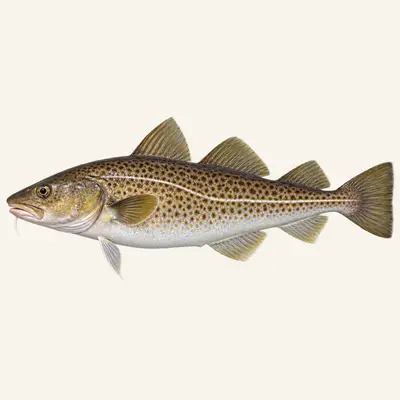
The markings settle the matter. The back is brown or grey, the flanks carry dark spots or vermiculating patterns, and frankly yellow forms exist. The fins are dusky and edged with white, that pale border being distinctly wider on the anal and the caudal than on the dorsals. It has no equivalent on the Atlantic fish, and it shows from one end of the deck to the other.
For the rest, the three dorsals and two anals of the genus carry 37 to 57 soft rays above, 31 to 42 below, without spines. Forty-nine to fifty-five vertebrae.
Breeding
The movement runs downwards to spawn and upwards afterwards, which is the reverse of what a shelf fish is expected to do. From late summer to midwinter the adults move into spawning areas between 100 and 250 m. Once the business is done they come back inshore and settle between 30 and 60 m.
One spawning a year, with no spreading of the effort. Maturity is acquired at around 66 cm, with a very wide spread between populations — from 23 to 85 — and the animal may live 25 years. Ground that yields spawning fish in December will yield nothing of the kind in June: the season decides which depth to sound, not the other way round.
The water it needs
Continental shelf and upper slope, from 10 m to 1,280, the bulk between 100 and 400. That is deeper than the Atlantic cod occupies, and it is enough to keep the two fisheries apart where the ranges overlap.
The fish is demersal in the strict sense: it holds the bottom instead of suspending above it. It lives in schools, with the usual consequence — an isolated bite is rare, and productive ground is productive for a whole drift.
Areas
- Bering Sea
- Gulf of Alaska
- Coasts of British Columbia and Oregon
- Sea of Japan and Sea of Okhotsk
- North Pacific continental shelf
Techniques
- Jigging
- Longline fishing
- Bottom rig with sinker
- Drift fishing over wrecks and drop-offs
Baits
- Squid or herring strips
- Metal jigs
- Marine worms
- Cut bait fish
- Soft baits on jig heads
What it eats
Opportunistic to the point of indifference. The authors describe a predator that takes whichever organism happens to dominate: what it eats depends on the ground, not on any preference of its own.
The detail of the menu follows age. The young take copepods and organisms of comparable size. Adults go after fishes, octopus, large benthic and benthopelagic crustaceans, and worms.
How to catch it
The diet dictates the approach: since the fish eats whatever is abundant where it stands, the bait is chosen from the bottom rather than from a box. Whatever comes up on the first drift — shrimps, octopus, small fish — indicates what needs imitating.
The rest follows from its place in the water column. This is a bottom fish in the full sense, sought in contact rather than in midwater, between 100 and 400 m depending on the season, and the schooling habit makes prospecting pay from the first capture onwards.
One precaution belongs to the kitchen rather than to technique. The flesh frequently hosts a nematode, the anisakid commonly called sealworm; the gills sometimes carry a parasitic copepod and the intestine a cestode. These are ordinary parasites of the species and not a sign of a spoiled fish. Cooking through and prolonged freezing settle the question, as does candling the fillets while trimming.
Conservation
No global assessment has been issued for this species, which is not a certificate of good health. For a fish of this commercial weight the monitoring happens elsewhere and by other means: fishery by fishery, stock by stock, every year, through the scientific advice that sets catch opportunities. The absence of a worldwide verdict signals a method, not an absence of subject matter.
The subject, precisely, is thermal. A window of 6 to 9 degrees is narrow for a shelf animal, and a shelf warms quickly through its whole water column when an anomaly settles in. A stock does not disappear because it is warm for a week; it disappears because one or two years of recruitment fail, and that consequence is read three years later.
The remaining pressures are those of any industrial demersal fishery: the species is landed in very large quantity and sold fresh, frozen, dried, salted or smoked, and it also enters Chinese medicine.
Regulations
Species subject to strict catch quotas and fishing seasons across the North Pacific; subject to local regulations.
For guidance only. Legal sizes, quotas and open seasons vary by location and season: always check the local regulations in force before fishing.
Other names
Pacific cod in English, with gray cod and true cod in use on the American west coast. French says morue du Pacifique, and the trade cabillaud du Pacifique — the same fresh-versus-cured distinction that language applies to the Atlantic fish. Japanese calls it madara, literally the true tara, tara being the general word for cod in the archipelago.
On a European counter the two species often circulate under neighbouring trade names once filleted and frozen. The country of origin of the lot then says more than the commercial name does.
Sources: fishbase.se · api.gbif.org