Saithe
Pollachius virens · Gadidae
- Saltwater
- Bottom fish
- Medium
- Size
60–130 cm
- Weight
1.9–32 kg
- Lifespan
25 years
- Depth
37–364 m
Where to fish
- Rocky shore
Habitat icons: Flaticon
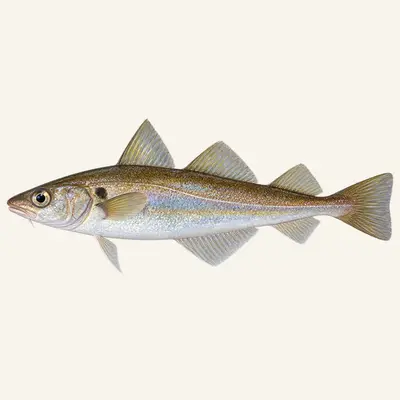
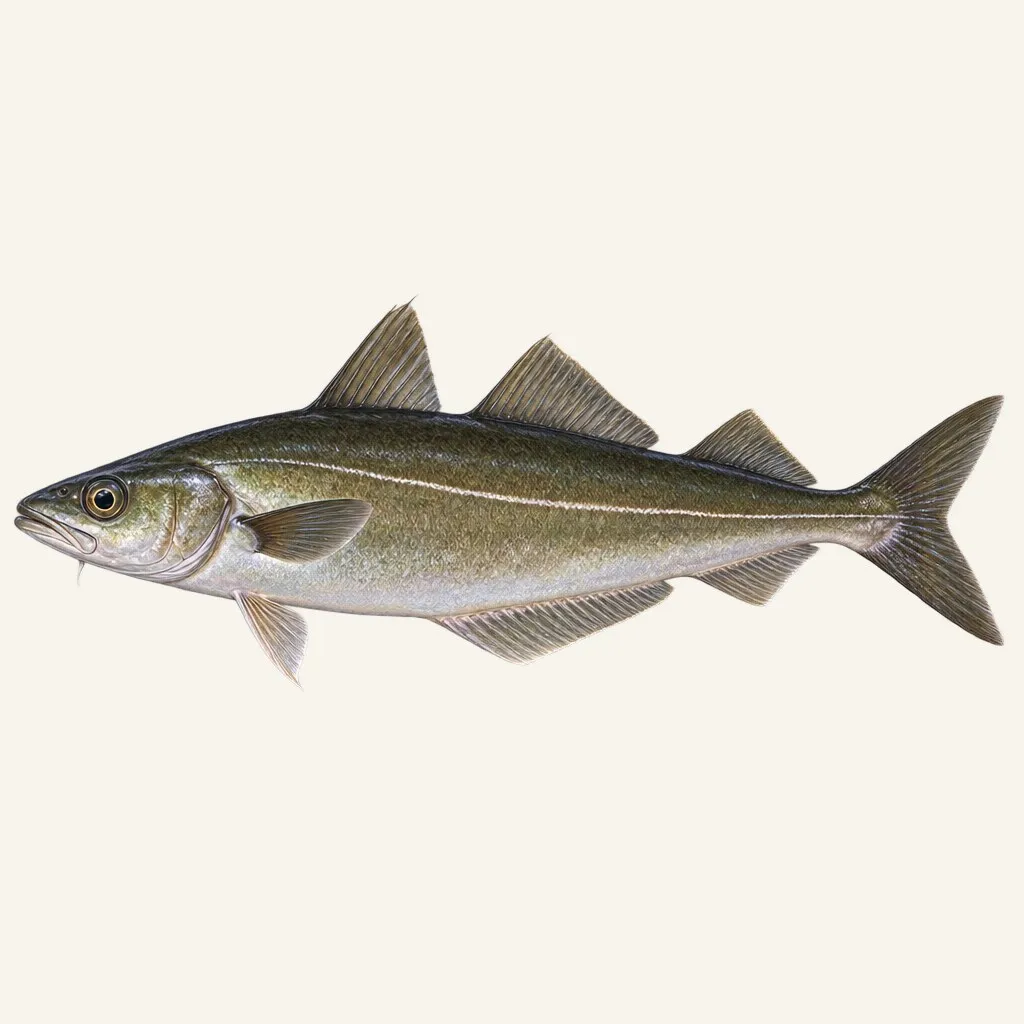
Fast, shoaling gadid with a dark greenish back and a straight whitish lateral line, forming large schools in the cold north-east Atlantic.
Calendar
Recorded in 15 countries
Canada · Denmark · Faroe Islands · France · Iceland · Ireland · Isle of Man · Netherlands · Norway · Russia · St. Pierre & Miquelon · Svalbard & Jan Mayen · Sweden · United Kingdom · United States
GBIF occurrence records — native and introduced populations combined.
Its range
The species holds the North Atlantic from south-west Greenland and Hudson Strait down to North Carolina, and eastward to the Bay of Biscay, the Barents Sea and Spitsbergen. It is rare at the extremes of that span.
That last clause is the one to keep. The map shows presence, not abundance, and at both ends of this range presence means the occasional fish rather than a fishery.
Identifying it
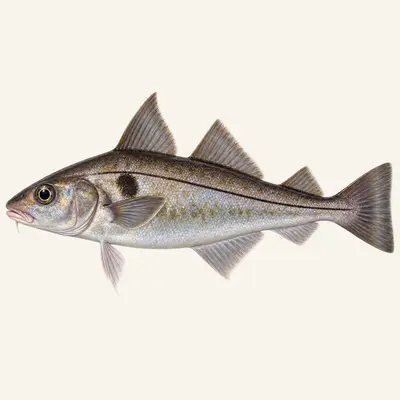
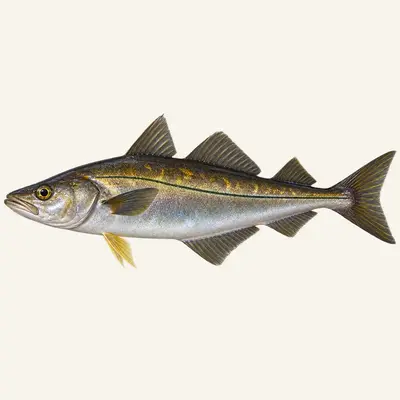
The lateral line is smooth for its whole length, and pale. That is the character to read first, because the fish it has to be separated from is its own congener: the description of the pollack gives a dark lateral line that curves sharply over the pectoral fin. One line runs straight, the other takes a step. Nothing else about the two animals is as quick to see.
The chin barbel is small, but it is there — the pollack's description records none. Colour completes the pair. This fish is brownish-green on the back and only slightly paler underneath, so the flank has no boundary on it; the pollack's own text describes a dark back set sharply against silver-grey sides. Uniform against contrasted, at any distance, in any light.
Body fusiform, circular in section, no spines anywhere on the animal.
Those three readings all come from the two species' own published descriptions, which matters because they are landed together and sold under names that overlap.
Breeding
Oviparous, with separate sexes, and a batch spawner: the season's eggs go in successive instalments rather than in one release. Length at first maturity is 39.1 cm.
Batch spawning spreads the risk across weeks of weather and water. It also spreads the period during which a mature fish is engaged in spawning, which is longer than the single event the term suggests.
The water it needs
An active, gregarious fish, at home inshore and offshore alike, recorded between 37 and 364 m.
The year has a shape. It normally comes into coastal water in spring and withdraws into deeper water in winter, and that alone would be worth knowing. On top of it sit spawning migrations and, in both European and American waters, long-distance movements north and south.
The practical consequence is that a fish taken off a given mark is rarely a resident of it. It is a member of something that is passing, and the mark is a place where the school happened to be.
Areas
- Offshore wrecks
- Rocky shoals
- Strong current zones
- Deep coastal waters
Techniques
- Jigging
- Trolling
- Soft lure fishing
- Paternoster rig fishing
Baits
- Metal pirks
- Shad soft lures
- Deadbait fish
- Artificial sandeel
- Colored feathers
What it eats
Diet splits at a size, and the split is clean. Small fish in coastal water live on small crustaceans — copepods, amphipods, euphausiids — with small fish alongside. Large individuals prey predominantly on fishes.
There is nothing gradual in how that reads for the angler. A grown saithe is a fish-eater, and the invertebrate half of the diet belongs to an earlier stage of its life, in shallower water, usually somewhere else.
How to catch it
Gregariousness is the whole strategy. This fish travels in active schools, so a take is information about a group rather than about an individual: the next cast matters more here than the last one did.
Metal pirks, shads, artificial sandeel and feathers are what the catalogue lists, and the reason they work on grown fish is in the diet — a strict predator of fishes wants something moving fast in the water column, not a bait resting on the ground. Wrecks, rocky shoals and strong tidal ground between 37 and 364 m are where the schools are looked for.
The calendar follows the migration. Spring brings the fish to the coast and winter takes it back out to depth, which makes the shore and boat fisheries two different seasons for one animal.
Conservation
Two figures set the replacement rate. The maximum reported age is 25 years and maturity comes at 39 cm — against the pollack, whose own record stands at eight years. Two fish of one genus, taken on the same ground, differ threefold in how long a generation lasts, and therefore in how quickly each can refill what has been removed. Anyone who treats them as interchangeable has the arithmetic of one of them wrong.
The migrations raise the other problem. A stock that runs north and south over long distances passes through the waters of several states, and no single one of them can manage it alone. That is a governance question rather than a biological one, but it decides what the biology is subjected to.
Regulations
Check the local regulations in force (legal size limits, closed seasons, bag limits).
For guidance only. Legal sizes, quotas and open seasons vary by location and season: always check the local regulations in force before fishing.
Other names
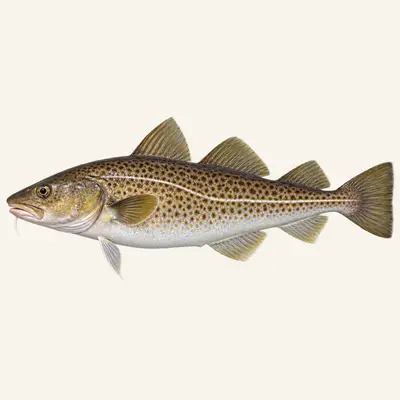
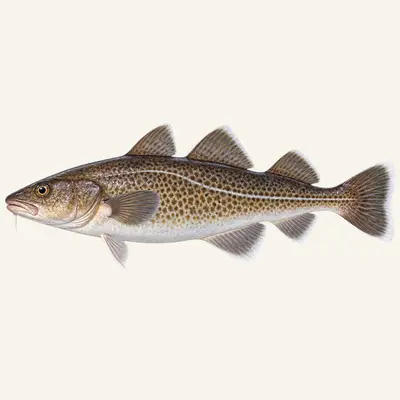
Saithe is the name in the trade and the one the catalogue carries; coley and coalfish are the everyday British alternatives. In the United States and Canada the same fish is sold as pollock — which is the word British usage gives to Pollachius pollachius, the other species on this page. The label therefore points at two different fish depending on which side of the Atlantic printed it, and the scientific name is the only way through.
German Seelachs, sea salmon, is frank about its purpose: it is a market name for an inexpensive fish. French colin is worse than frank, since it covers this species, the pollack and the hake without distinction.
Sources: fishbase.se · api.gbif.org