Burbot
Lota lota · Lotidae
- Freshwater
- Bottom fish
- Medium
- Size
35–152 cm
- Weight
0.3–34 kg
- Lifespan
20 years
- Water temp.
4–18 °C
- Depth
1–700 m
Where to fish
- River
Habitat icons: Flaticon
Only freshwater gadid - Chin barbel - Active in the cold of winter
Calendar
Recorded in 17 countries
Austria · Belgium · Canada · Denmark · Finland · France · Germany · Italy · Netherlands · Norway · Poland · Russia · Sweden · Switzerland · Ukraine · United Kingdom · United States
GBIF occurrence records — native and introduced populations combined.
Its range
The most important thing about this range is that it may be two ranges.
As published, it circles the Arctic. In Europe it runs from the Loire drainage eastward to the White Sea, Barents and Arctic basins, taking in the upper Volga, the western Caspian, the rivers draining to the Black Sea and the Rhône, with the Po as its only Italian catchment. In North America it covers Canada, Alaska and the northern United States, south to Pennsylvania, Kentucky, Missouri, Wyoming and Washington.
But populations from eastern Siberia and North America have been reported to belong to a separate species, Lota maculosa. If that holds, the circumarctic distribution is two distributions that happen to abut, and every inference drawn from its apparent continuity — that the animal is adaptable, that it is secure across an enormous area — has been drawn about the wrong unit.
One margin is already settled. England held the species and holds it no longer: the south-western corner of the European range was lost entire.
Identifying it
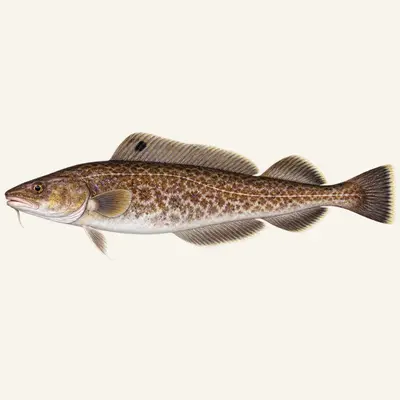
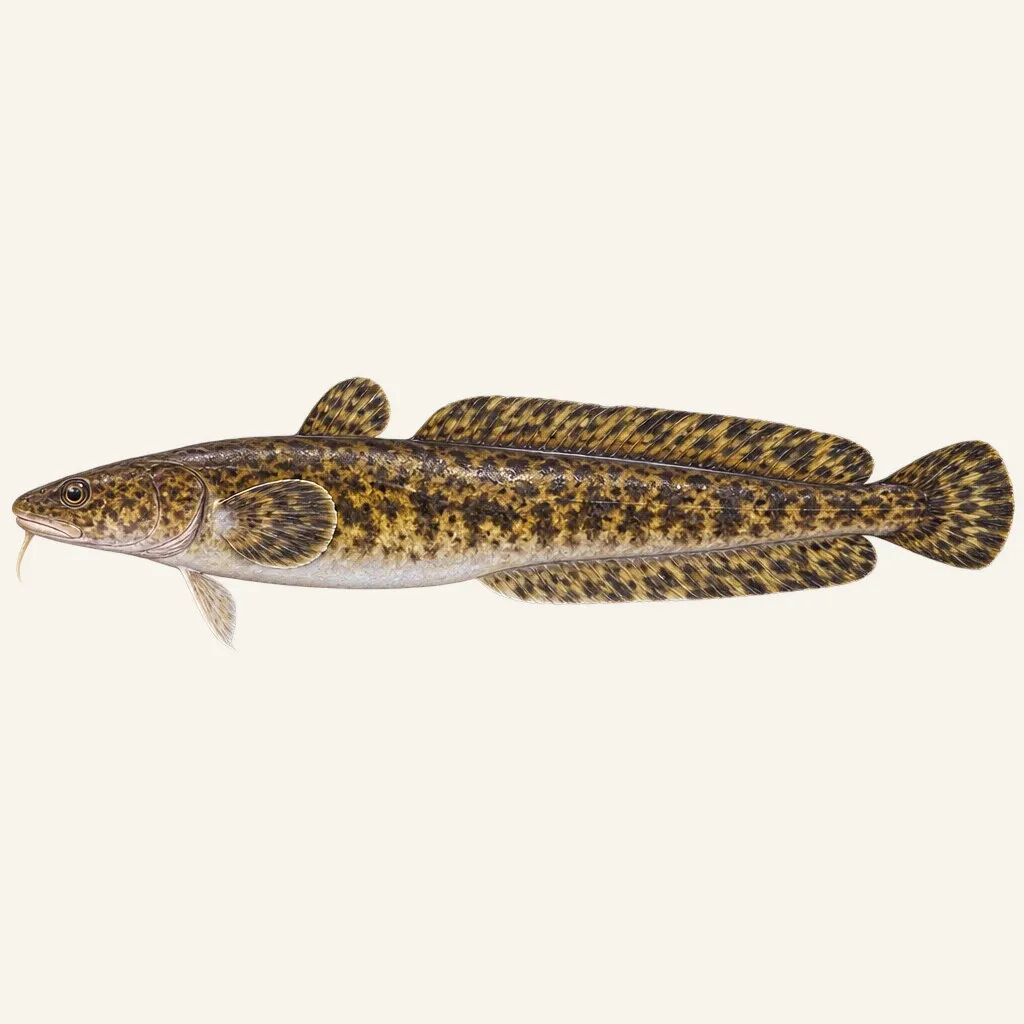
The whole build is for getting into places rather than crossing them. The body is long and circular in section, the pectorals short and rounded, the caudal rounded, and there is not a spine anywhere on the animal. Vertebrae number 50 to 67 — a backbone long enough to work like a rope.
Two characters identify it, and no other freshwater fish in Europe has either. The pelvic fins are inserted ahead of the pectorals. And there is a single barbel, on the chin. Taken together the determination is finished before the colour has been looked at.
The fins confirm the family. The second dorsal is at least six times the length of the first and runs back to join the caudal, as does the anal — the cod arrangement, stretched out. Counts give 67 to 96 rays in the second dorsal and 58 to 84 in the anal. Gill rakers are short.
The colour is a mottling: dark brown to black figuring over yellow, tan or brown, laid across body, head and fins. Only the pelvics stay pale; the others are dark and speckled.
Breeding
Every other predator in the same river waits for the water to warm. This one needs it to fall below six degrees.
Spawning runs from November to March, at night, under ice where there is ice. Up to twenty fish interlace into a ball some 60 cm across, which rolls and shifts continuously over the bottom while eggs and milt are released. Males reach the grounds first and the females join them. Short spawning migrations occur.
The eggs are semipelagic, 1.2 to 1.8 mm, faintly sticky, and they take 40 to 70 days to hatch. That duration is not a defect of a cold-water animal but the point of the entire arrangement: development is slow because the water is cold, and slow development places the hatch at the return of the light. Spawn in April and the eggs would hatch into nothing.
The larvae are drawn to light and drift just below the surface through March and April, feeding on drifting invertebrates and zooplankton. About two months later they drop to the bottom and stay there, reaching some 8 cm inside the first year. The life cycle runs backwards from the adult's: the young live in light at the surface, the adult in darkness on the floor.
In central Europe males breed at two years and females at three. After spawning, upstream runs have been observed, apparently in order to feed.
The water it needs
Eighteen degrees is the ceiling. The thermal range occupied runs from 4 to 18, and the upper figure is what makes this a northern fish and what drives it downwards every summer. Deep water in the warm season, with movements into shallower water at night to feed.
There is a second requirement, less often quoted: hard, alkaline water. Recorded pH starts at 7.5 and hardness at 18 dH, which writes off acid drainage and peat-stained upland systems whatever their temperature.
Inside those limits the range of habitats is unexpectedly wide — well-oxygenated running water, large deep lakes, big slow rivers, the estuaries of lowland rivers, and small mountain streams. Recorded depth spans 1 to 700 m.
The animal is crepuscular and nocturnal, and that governs where it spends the day: wedged under boulders, in bank crevices, among tree roots, in dense vegetation. In rivers, fish gather in the deep holes all year round, the spawning season excepted.
Areas
- Bottoms
- deep zones
- winter night fishing
Techniques
- Live baits
- Worms
- Deadbaits
Baits
- Night dead bait
- Slow lures
What it eats
Small individuals take insect larvae, crayfish, molluscs and other invertebrates. The preference shifts towards fish as size increases, and a large individual is a piscivore. Crayfish sit in the middle of that list and deserve notice, because they are being taken by a fish that occupies the same crevices they hide in.
A chin barbel and nocturnal activity describe, between them, a hunt that owes nothing to sight. Prey is located by contact and by the chemistry of the water, on the bottom, in the dark — which is why the animal stays fully operational under a lid of ice, or in loaded water where a visual predator is idle.
How to catch it
The argument for fishing this species is that it is available when nothing else is. It works at hours and in a season when the water is empty of anglers, and the fisheries literature says outright that its nocturnal habits and slow movements mean few people go looking for it.
Two windows come out of the life cycle. Winter nights, November to March, when the water drops below six degrees and fish concentrate near the spawning grounds. Summer nights, when they leave the depths and come shallower to feed. Between those, in daylight, they are under boulders or down in holes and effectively unreachable.
Technique follows a slow animal. A lure worked quickly is ignored by a fish that does not pursue; a dead or live bait laid on the bottom at the foot of a boulder field, or in a hole, matches how it searches. Dead fish selects the large individuals, since those are the piscivorous ones.
The flesh is fine but somewhat dry. What made the fish's reputation in Europe is the liver, sold smoked or canned; the species also yields oil, and is marketed mainly salted.
Conservation
A fish nobody fishes has no early warning system. The species is recorded as locally threatened by river regulation, and the decline behind that line was not detected through catches, because there are hardly any — the animal is nocturnal, slow, and left alone.
The mechanism is a calendar. Reproduction needs water below six degrees in midwinter, then 40 to 70 days of incubation at that temperature, then a larval phase at the surface in spring. A thermal regime softened by bottom releases from a dam, or levels that move at the wrong moment, breaks that sequence without a single adult being harmed. The fish stay; the year classes stop.
England is where the process ends. A species present right around the Arctic can lose a whole margin of its range permanently — not to fishing, but because the rivers stopped producing the winter its eggs required.
Handling carries its own commitment. Maturity comes at two or three years against a documented lifespan of twenty, so a female taken in the winter window is carrying the whole of one season's effort for an animal that gets relatively few of them.
Regulations
Check the local regulations in force (legal size limits, closed seasons, bag limits).
For guidance only. Legal sizes, quotas and open seasons vary by location and season: always check the local regulations in force before fishing.
Other names
Burbot in English, and the name has the merit of covering nothing else. Regional North American usage undoes that merit thoroughly: eelpout, lawyer, mariah, freshwater cod, cusk and ling all name this fish somewhere. The last two are borrowed, and badly — cusk is Brosme brosme and ling is Molva molva, both of them marine gadids of the North Atlantic.
That is the English version of a confusion every language manages with this animal. French lotte names it and also names the anglerfish on a fishmonger's slab, which is no relative of any kind.
The genus name comes from that French word, and the family, Lotidae, is built on it. This is the only member of that family living in fresh water.
Sources: fishbase.se · api.gbif.org