Pollack
Pollachius pollachius · Gadidae
- Saltwater
- Bottom fish
- Medium
- Size
75–130 cm
- Weight
4.1–18 kg
- Lifespan
8 years
- Depth
40–200 m
Where to fish
- Reef
- Rocky shore
Habitat icons: Flaticon
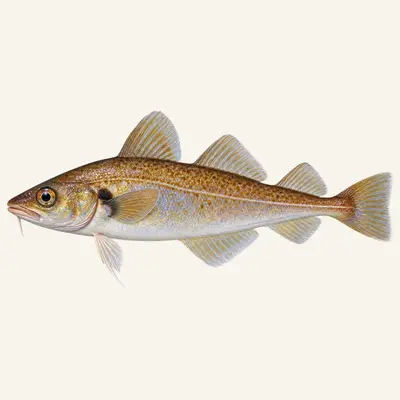
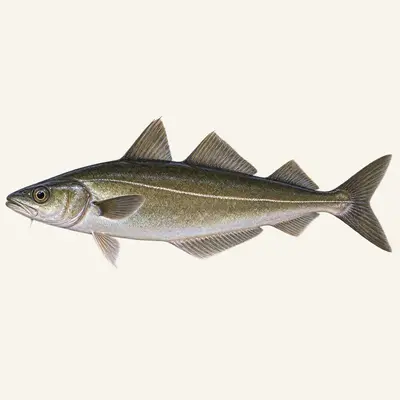
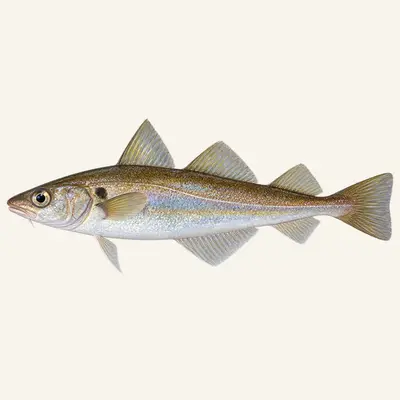
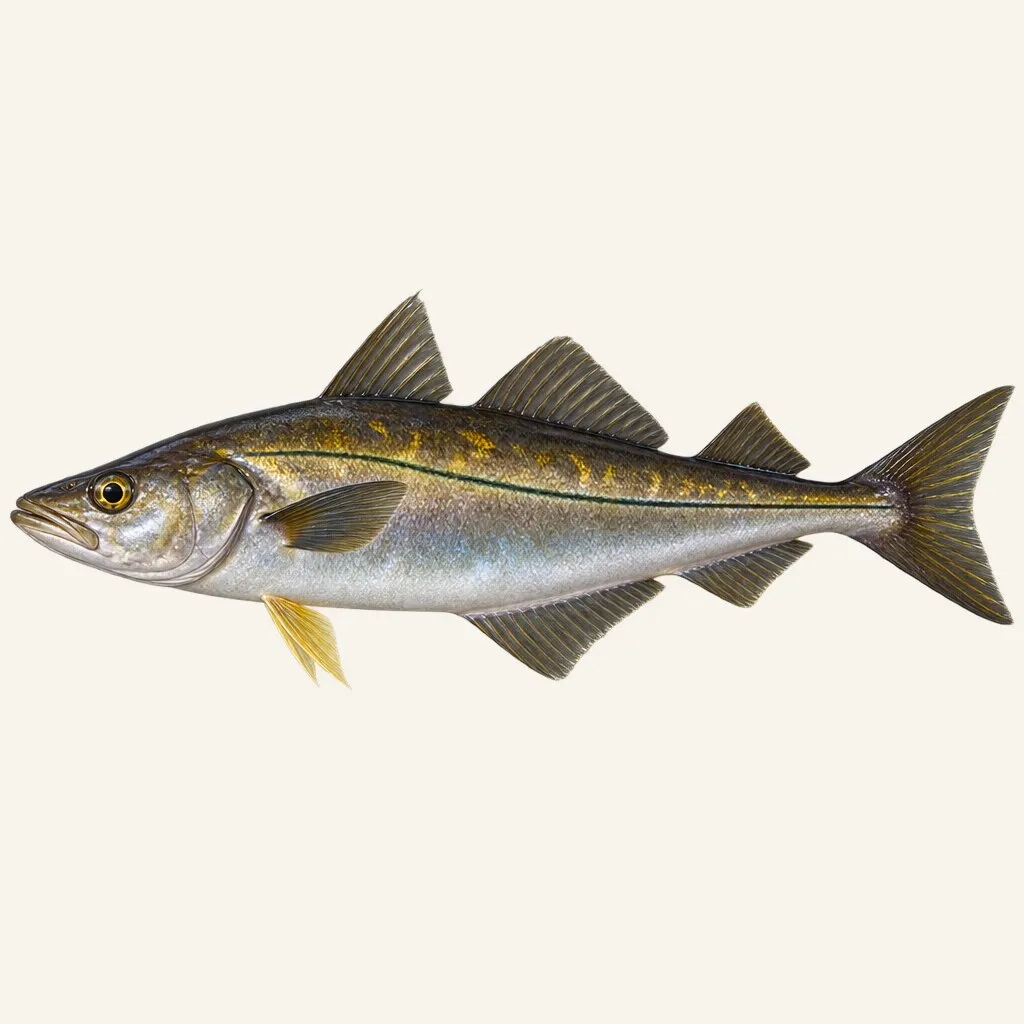
Slender gadid of north-east Atlantic rocky coasts, with a protruding lower jaw and a dark lateral line sharply curved above the pectoral fins.
Calendar
Its range
The species holds the north-east Atlantic from Iceland, the Faroes and Norway south to the Bay of Biscay, plus the southern Baltic, where it is recorded from Poland, Latvia and Estonia.
That range stops further north than many gadoids, and the Baltic presence stays marginal — a hard-bottom fish makes little of a brackish, sandy sea.
Identifying it
Three characters separate pollack from the gadoids it shares ground with, and they need taking together.
First the lower jaw, distinctly projecting beyond the upper — the profile of a fish that feeds upwards. Second the absence of a chin barbel, which rules out cod immediately. Third the lateral line, dark, curving sharply over the pectoral fin before running the length of the body.
There is no dark spot at the pectoral base, which is a further separation.
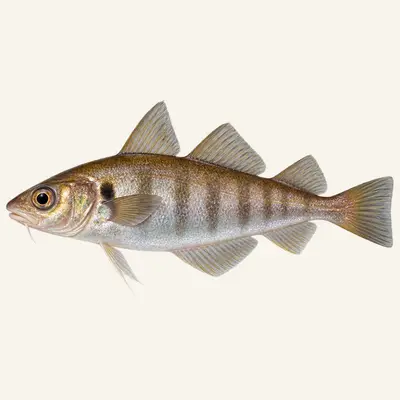
Colour varies but follows a pattern: dark back cutting sharply against silver-grey flanks and belly, with yellow to orange streaks or blotches over the upper body. The lateral line runs greenish. Fins are uniformly dark except the pelvics, which are yellowish.
Counts come down to three numbers: 29 to 33 soft dorsal rays, 27 to 30 anal rays, 52 to 55 vertebrae. No spines anywhere.
The water it needs
Pollack hold hard ground from inshore water down to 200 m, most often between 40 and 100.
The life history is clean. Juveniles are pelagic and spend two or three years close in: rocky ground, kelp beds, sandy shores and estuaries. They sometimes shoal with saithe, but have also been found solitary and defending a feeding territory — unexpected behaviour in a gadoid.
Larger fish move offshore and hold around rocky ground between 40 and 100 m. They are also found around wrecks and oil platforms, structures that do exactly the job a natural drop-off does.
Adults occur singly or in small scattered shoals, but form dense concentrations on the spawning grounds, and spawning migrations are thought to occur.
Areas
- Wrecks and rocky reefs
- Underwater cliffs
- Tidal currents
- Deep coastal trenches
Techniques
- Soft lure fishing
- Deep trolling
- Jigging
- Vertical fishing over wrecks
Baits
- Shad soft lures
- Sink-and-draw deadbait
- Metal pirks
- Natural sandeel
- Vinyl lures
What it eats
Pollack are predators, and the projecting lower jaw says which way they hunt: upwards, at prey above them.
That orientation explains where they sit — tucked against structure and watching the open water, rather than nosing the bottom the way a barbelled cod does.
How to catch it
Structure is the mark. Rock ledges, pinnacles, wrecks and artificial structures between 40 and 100 m: pollack sit against the obstruction, not over the sand beside it, and a drift that does not follow the ground finds nothing.
The way they feed sets the presentation. A fish that takes upwards responds to lures worked above it, lifted away from the bottom rather than dragged across it. That is the logic of wreck fishing on the drift, and it follows directly from the shape of the jaw.
Juveniles are caught from the shore among rocks and kelp; the big fish need a boat and depth. Two different fisheries for one species, separated by two or three years of the fish's life.
Growth is fast and life is short: the maximum recorded age is only eight years, and the fish is at full format well inside that. A very large pollack is therefore not an old fish, whatever its size suggests.
Conservation
Pollack are taken as bycatch in fisheries directed at cod and saithe. A species caught without being targeted falls outside management measures designed for the target, and its assessment is correspondingly uncertain.
The spawning concentrations are the other exposure. A fish scattered for most of the year that gathers densely to breed offers, at that moment, catches unrelated to its actual abundance.
Regulations
Check the local regulations in force (legal size limits, closed seasons, bag limits).
For guidance only. Legal sizes, quotas and open seasons vary by location and season: always check the local regulations in force before fishing.
Other names
Pollack in English, also lythe in Scotland and northern England — a name still in daily use and worth recognising in older accounts. Confusingly, "pollock" in North America usually means Alaska pollock or saithe, neither of which is this fish. Lieu jaune in French, merluzzo giallo in Italian.
Sources: fishbase.se · api.gbif.org