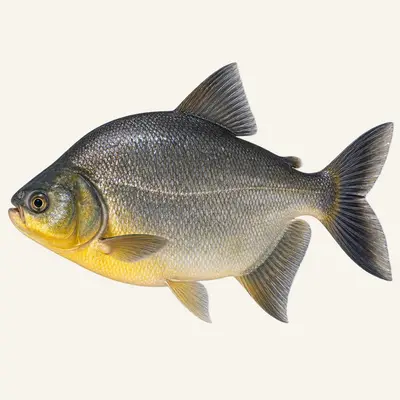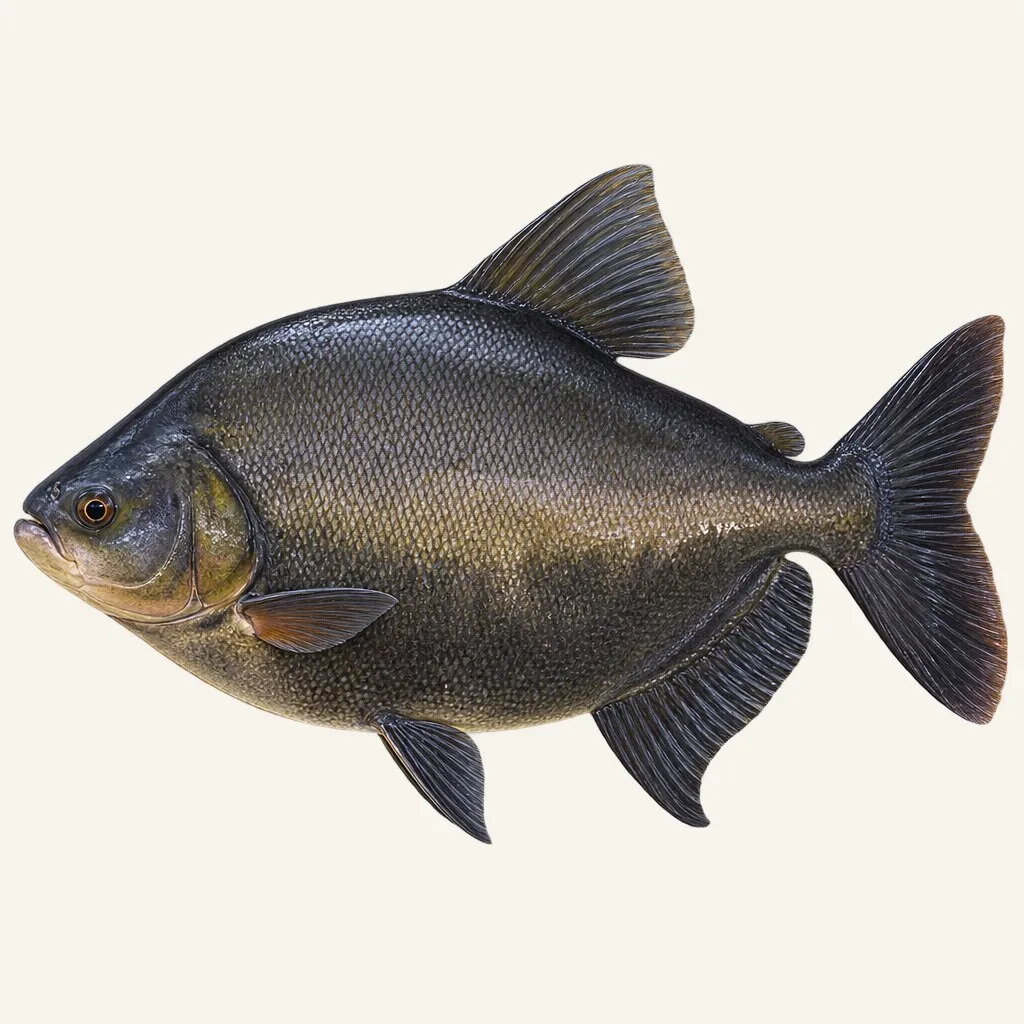
Tambaqui (black pacu)
Colossoma macropomum · Serrasalmidae
- Freshwater
- Migratory
- Medium
- Size
70–110 cm
- Weight
7.4–40 kg
- Water temp.
22–28 °C
Where to fish
- Lake
- River
Habitat icons: Flaticon
A large omnivorous Amazonian fish related to piranhas, equipped with molar-like teeth that crush nuts and seeds.
Calendar
Recorded in 4 countries
Bolivia · Brazil · Colombia · United States
GBIF occurrence records — native and introduced populations combined.
Its range
Two ranges are superimposed here, and they are not the same kind of thing. The wild form holds the Amazon and the Orinoco, two basins. The farmed form is distributed widely across South America, far outside those limits.
The reason for the second is stated plainly. The species grows in mineral-poor water and resists disease well. A fish that puts on weight in indifferent water without falling ill is an obvious candidate for pond culture, including in regions where it never swam.
One distinction is worth holding on to. The source records where the species is produced; it does not say what became of those fish in the wild water next door. A basin that farms this animal is not necessarily a basin where it has established itself.
Identifying it
The teeth are the character, and they do not come from FishBase — that page carries no morphology rubric for the species. They come from the catalogue description printed on this page: molar-like, built for crushing nuts and seeds.
That is worth pausing on. This is a serrasalmid, a relative of the piranhas, and the family is known for shearing blades set in a short deep jaw. Here the jaw has been kept and the blades replaced by pavement. Whatever else can be said about this fish, the part of it that meets the food has been rebuilt around fruit, and the two sections below follow from that.
The water it needs
Neither of this fish's two addresses is the river channel.
The young and the juveniles live in the black waters of the floodplain, and they stay there until they are sexually mature. The adults spend the first five months of the flood inside the flooded forest. Between them, those two statements account for the whole life cycle, and neither of them happens in the main river.
The chemistry explains how one animal can use both. A tolerated pH range of 5.0 to 7.8 covers strongly acid blackwater and silt-laden white water alike, which is not a span many fishes of this size can work across. Temperature is held between 22 and 28 °C, and the depths used start around five metres. Movement is potamodromous: the entire cycle runs inside the network, never near the sea.
What this species needs, in short, is a floodplain that still works — a plain that fills and empties on time.
Areas
- Flooded forests (igapós and várzeas)
- Banks beneath fruiting trees
- Floodplain lakes
- Confluences and oxbow lakes
Techniques
- Float fishing with bait
- Bottom fishing (ledgering)
- Match fishing
- Pre-baiting with fruits and seeds
Baits
- Fallen fruits
- Seeds and nuts
- Corn
- Dough balls
- Earthworms
What it eats
Two diets in one fish, and the distance between them is considerable.
Through the first five months of the flood the adults take fruit and grain, and the rubric admits nothing else onto the list. For the rest of the year the same animal lives on zooplankton, insects, snails and decaying plant matter. Frugivore for part of the year, gleaner for the remainder.
It is the first of those that matters beyond the fish. This animal swallows whole fruit beneath drowned trees, and then travels — for months, through water that is continuous from one part of the forest to another — before what it swallowed has finished passing through. Whatever it does not crush leaves the parent tree with it, and is put down somewhere the falling water will later expose.
So the relationship runs both ways. The flooded forest feeds the fish for five months of the year, and the fish carries the forest's seed away from the tree that made it. Take away either term and both are diminished, which is what makes this species something other than a stock to be counted.
How to catch it
The calendar decides before the bait does. In the months when the adults hold the flooded forest they take fruit and grain and nothing else; the same offering, presented at low water to a fish that has gone back to snails and zooplankton, means nothing to it at all. What fails in that case is the date, not the bait.
The lie follows the same logic. In high water it is beneath a tree that is producing, so the position is chosen vertically, under fruiting cover, and the presentation stays still. This animal is waiting for something to drop, not for something to flee, and movement argues against the offering rather than for it.
One handling note belongs here. The source classes the species among those capable of injuring a person, and the reason sits in the diet: jaws that break a hard shell do not distinguish between a nut and a finger.
The maturity spread is the last useful figure. Reported first maturity begins around 24 cm while the ordinary fish is nearer 70, so almost everything caught has spawned — and a small one may well have too.
Conservation · Near Threatened (IUCN) — This species is in decline. Release your catch quickly and handle it with care — wet hands, as little time out of the water as possible.
Conservation
Two pressures, and they answer one another.
The first is extraction. A capture fishery and commercial aquaculture both draw on the species, and the product is marketed fresh and frozen, which carries it far past the range a fresh fish can reach.
The second is structural, and much harder to reverse. Two life stages happen outside the channel: the immature fish in the blackwater of the plain, the adults under the trees for five months. Anything that shortens the flood, lowers it or regulates it does not remove a shelter from this fish — it removes the fattening season and the nursery at the same time. Water kept inside its bed all year can be perfectly clean water in which the species has nothing left to do.
The long juvenile residence adds inertia to all of that. An animal that stays on the floodplain until it is sexually mature has spent the whole of its youth in the most accessible part of the network, and the easiest part to drain.
Regulations
Subject to minimum sizes and closed seasons (defeso) varying by South American country; according to local regulations.
For guidance only. Legal sizes, quotas and open seasons vary by location and season: always check the local regulations in force before fishing.
Other names
Tambaqui is the Brazilian name and the one that travelled to market with the fish. Cachama is the word used in the Orinoco.
This catalogue's English entry keeps both halves — Tambaqui (black pacu) — because neither works on its own. Pacu is a group word for the deep-bodied serrasalmids and never identifies a species; tambaqui, outside Brazil, needs a gloss before it means anything.
Colossoma announces the bulk. Macropomum points at the large gill cover that closes the cheek, which is the one part of the name a person holding the fish could verify.
Sources: fishbase.se · api.gbif.org